



BY: Sam Koppelman, Jenny Ahn, Jean Wang, Till Daldrup, Blake Spendley, JD Jean-Jacques
EDITOR: Vikas Kumar
Based on Hunterbrook Media’s reporting, at the time of publication Hunterbrook Capital is short $AMD and long a basket of comparable securities. Positions may change at any time. This article is not investment advice or any recommendation. See full disclosures on our website.
After the U.S. blacklisted Chinese server maker IEIT Systems, the company kept getting newer AMD firmware, which enables AMD chips to run in servers. The Commerce Department placed IEIT on its Entity List in March 2025, which means sending IEIT anything covered by U.S. export rules requires a license. Commerce’s stated policy is to deny those licenses. Since then, IEIT has incorporated at least six newer versions of AMD’s firmware into its own products, most recently in an updated version posted October 19.
Three companies closely tied to IEIT use the same AMD firmware. Maginfra in China, Kaytus in Singapore, and Aivres in California openly sell servers built on AMD chips under their own brands. Hunterbrook found that the firmware they offer is nearly identical to IEIT’s, suggesting they may be selling servers designed by the blacklisted company. Corporate filings point the same way: IEIT’s 2022 annual report listed Aivres, then called Inspur Systems, as a subsidiary. Kaytus’s own audited accounts name IEIT as its ultimate parent company.
The New York Times and The Wall Street Journal previously identified Aivres as a node in Nvidia’s questionable China business network. What was less obvious: AMD shares that relationship. AMD’s website lists Aivres among the makers of servers built around its Instinct AI chips, designed in part to compete with Nvidia’s GPUs. Aivres announced a server built on Instinct chips in July. Aivres exported at least $5.6 billion of advanced technology to Southeast Asia between April 2024 and February, according to The New York Times. More than $3 billion was computers built with advanced Nvidia chips. Aivres shipments went to data centers and tech firms serving Chinese companies, including Alibaba and ByteDance. Last year, The Wall Street Journal traced about 2,300 Nvidia chips from Aivres to an Indonesian data center serving a Chinese AI startup.
Washington’s export rules could tighten restrictions on AMD’s foreign business. A suspension of a rule that would extend restrictions to foreign companies at least 50% owned by blacklisted entities expires on January 10, 2027; if the rule takes effect, it could broaden export restrictions to Kaytus and foreign companies IEIT at least half-owns. A separate newly released interim final rule, which takes effect today, will require licenses for advanced chips shipped to Singapore and four other countries. AMD billed $4.28 billion to customers in Singapore alone in fiscal 2025, over 10% of its sales. For AMD, this could mean additional licensing requirements that can delay or block sales.
AMD has other ties to blacklisted companies. It reported $67 million of licensing income in 2025 that Hunterbrook traced to two Chinese chip ventures blacklisted in 2019. Its February 2026 catalog lists a server from Cancon, an alias of the blacklisted company Suma. In sum: AMD appears no less at risk from China chip restrictions than Nvidia, despite the recent surge of positive coverage.
AMD, which bills over 20% of its revenue to customers in China and Hong Kong, also depends on a Chinese partner to finish most of its chips. Two ventures 85% owned by Tongfu Microelectronics provide the majority of AMD’s chip assembly, testing and packaging, according to AMD’s filing. AMD owns the other 15% and lent one of them $100 million; the loan was still outstanding at the end of September. In May, Lisa Su attended a launch of the Suzhou venture’s new factory alongside the city’s Communist Party secretary.
AMD did not answer Hunterbrook’s questions. The company asked for more time, was given until the following day, and said it would be back in touch by then. It was not. AMD did not say whether it holds licenses allowing it to sell chips or software to any of the blacklisted companies named here. IEIT, Maginfra, Kaytus, Aivres, Hygon and Tongfu did not respond to requests for comment; neither did the Commerce Department’s Bureau of Industry and Security.
In March 2025, the U.S. government put IEIT Systems, a Chinese server maker, on its export blacklist.
Over a year and a half later, on October 19, 2026, IEIT posted a software update for one of its AMD servers.
Hunterbrook Media downloaded the file and found AMD’s code inside: the startup firmware that AMD ($AMD) writes for its chips, in a version issued after the blacklisting.
The same firmware is posted on the websites of three other server sellers in AMD’s orbit, none of which are blacklisted. But corporate filings and court records, as well as the software code Hunterbrook reviewed, tie all three to IEIT.
Hunterbrook asked AMD whether it, or any distributor or firmware partner, has provided firmware, technology or support to IEIT since the blacklisting, and under what license. AMD asked for more time and was given until the following day. It said it would be back in touch by then and was not.
A few months ago, investors often looked past stories like these.
Then came Nvidia’s China crisis.
Nvidia ($NVDA) announced that Jensen Huang resigned as chief executive on November 12 amid a scandal that raised national security concerns. Nvidia also faces allegations that billions of dollars worth of its AI chips have reached China through intermediaries in Southeast Asia. Congress is asking how Nvidia’s exports were approved.
AMD has been hailed as one of the biggest winners from Washington to Wall Street. The investment bank William Blair raised its AMD rating partly due to Nvidia’s troubles.
The pitch assumes AMD does not share Nvidia’s problem.
But Hunterbrook’s reporting suggests AMD faces similar risks in China.
The three companies linked to IEIT have been scrutinized before by major outlets, including the New York Times and the Wall Street Journal. But they’ve largely focused on the companies’ ties to Nvidia. Hunterbrook’s reporting suggests AMD may be just as intertwined.
And while the three server vendors linked to IEIT are not currently blacklisted, a U.S. rulescheduled to go into effect in January could close that loophole. Unless its suspension is extended beyond January, the rule will extend export restrictions to foreign companies that are at least 50% owned by blacklisted entities. A separate interim final rule released on the heels of the Nvidia scandal will require licenses for advanced chips shipped to Singapore and four other countries deemed by Commerce as posing a heightened risk of diversion, effective today.
That rule isn’t a one-off reaction to the Nvidia scandal, according to Sam Winter-Levy, a senior fellow at the Carnegie Endowment for International Peace. He believes it may signal a “turning point” in U.S. policies on export controls to China.
“The era when you could just sell to whoever you wanted and do whatever you wanted, and the U.S. government didn’t really get in the way, I think that’s coming to an end,” he added.
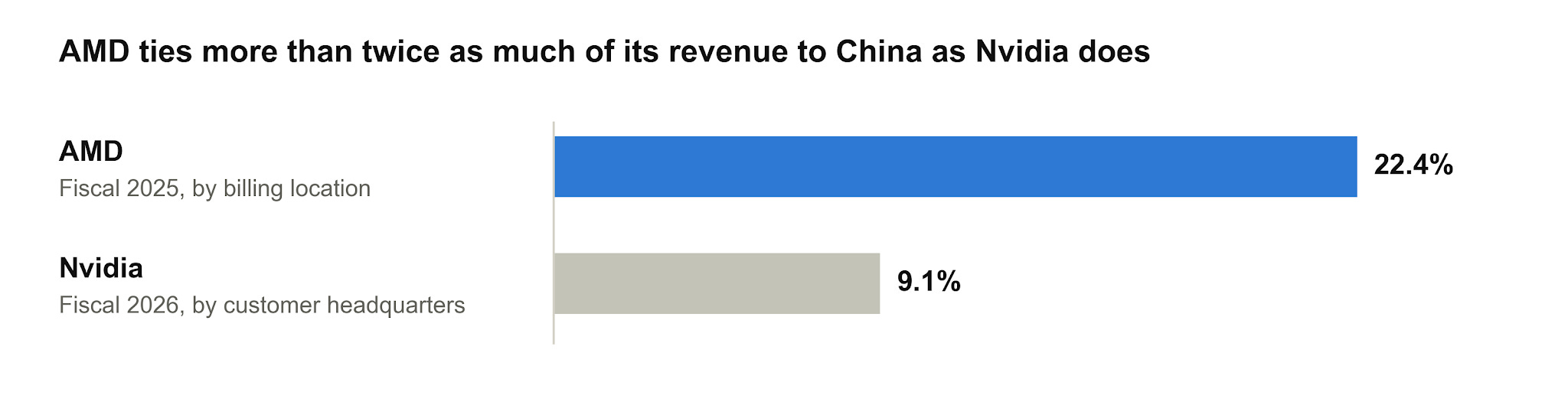
AMD’s exposure to this possible policy shift may be larger than Nvidia’s. AMD billed $7.75 billion, or 22.4% of revenue, to China (and Hong Kong) in fiscal 2025, compared to Nvidia’s 9.1% revenue share in those markets. (Though, of course, Nvidia’s revenue tied to these regions may very well be understated!)
Most AMD processors face few export restrictions today. The trouble is that AMD’s growth story rests on the chips that face tighter restrictions. The company has told investors it aims to grow data center AI revenue by more than 80% a year over the next three to five years, chasing a market Nvidia dominates. Those Instinct AI accelerators already need a license to ship to China. When Washington imposed that requirement on AMD’s China-specific MI308 in April 2025, AMD took about $800 million in inventory and related charges.

ONE NETWORK, FOUR NAMES, ALL LEADING BACK TO CHINA
IEIT is an arm of Inspur Group, a Chinese company controlled by Shandong province’s state-assets regulator. The Commerce Department added Inspur to its Entity List in March 2023, two years before adding IEIT, saying the companies had tried to acquire U.S. technology for the Chinese military.
AMD writes code that helps prepare its processors and other hardware to run. Server makers incorporate that code into their own BIOS, the firmware that enables the server to run the processors. AMD releases updates, including security fixes, for manufacturers to include in their own BIOS updates.
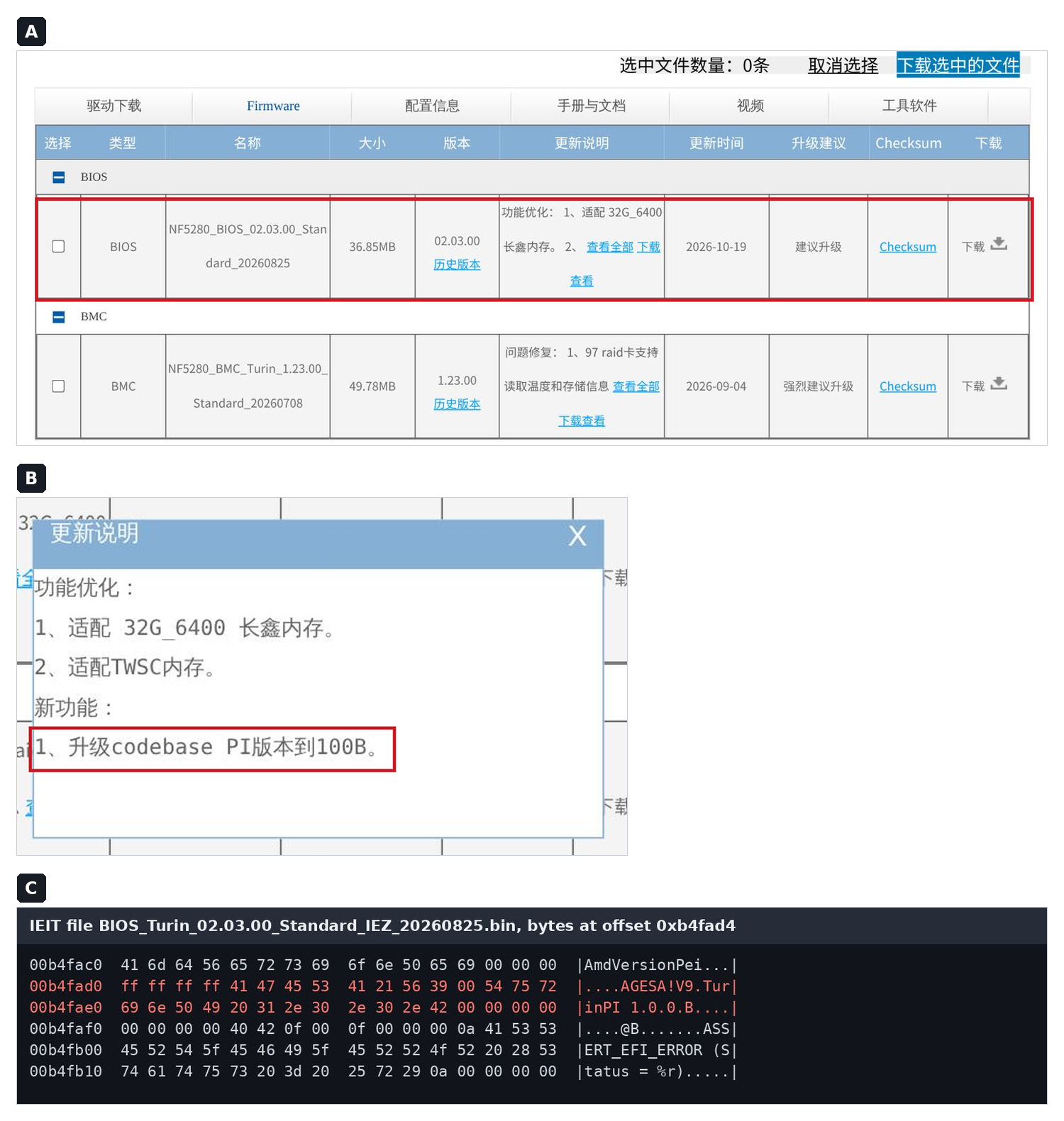
IEIT’s own release notes show the updates kept coming.
Since the blacklisting, it has incorporated at least six newer versions of AMD’s firmware into updates for three server models. Where AMD’s release dates were public, IEIT’s builds followed about one to two months later. One update posted in October 2025 included a fix for a flaw AMD did not publicly disclose until February 24, 2026.
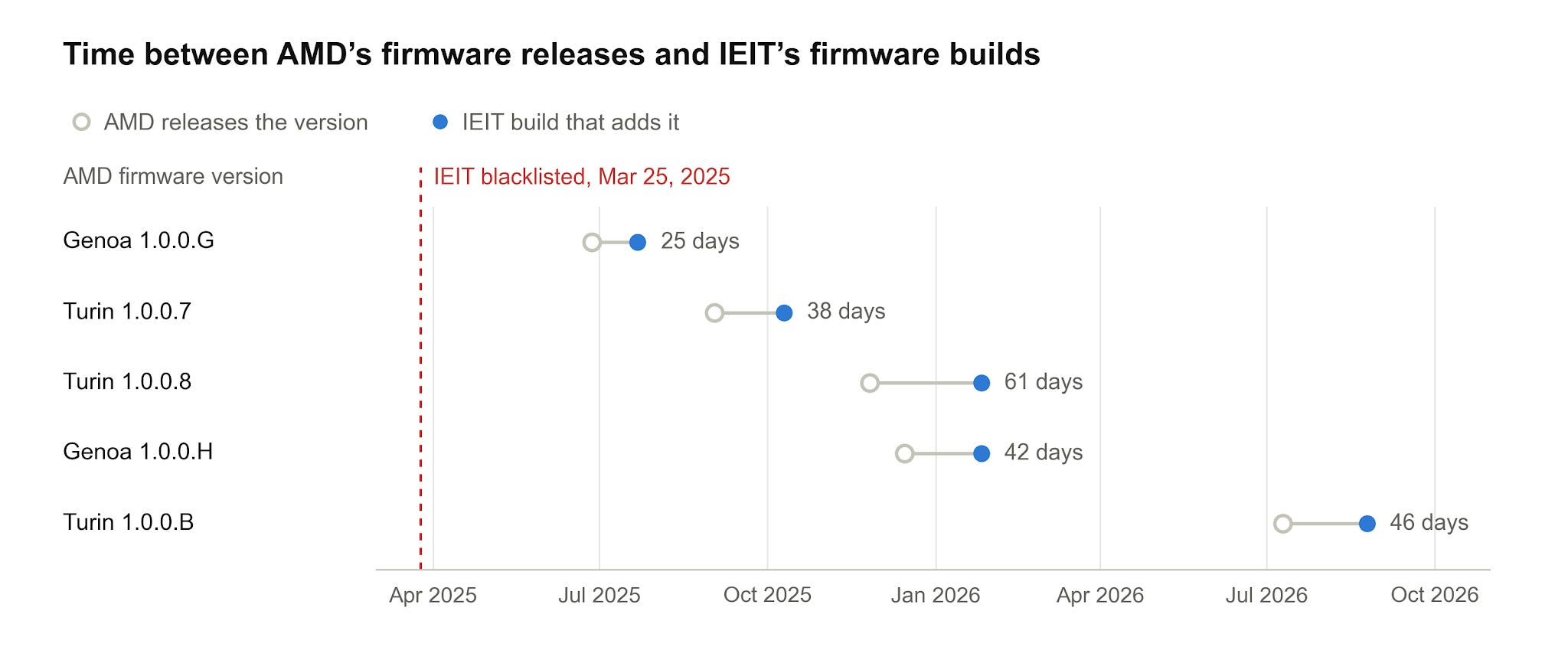
This is important because Washington treats software updates as exports. William Reinsch — former undersecretary of commerce for export administration and now a senior adviser at the think tank Center for Strategic and International Studies — told Hunterbrook that unlicensed software and hardware transfers are of equal concern, and equally enforced.
“The problem is that it’s a lot harder to enforce software transfers than it is hardware transfers.”
Reinsch also said not to rule out the possibility AMD had obtained a license to export to IEIT, though the Commerce Department keeps that information from the public. “The fact that you have to get a license does not mean automatically that the license will be denied,” he said, adding that while many companies self-select out of applying in the first place, obtaining one may not be as rare as people think. AMD did not answer repeated questions from Hunterbrook about whether it holds licenses to sell to IEIT.
Enforcement action on illegal software transfers is not without precedent. In October, the Commerce Department settled with Lambda Research, a Massachusetts software company that had sold licenses to China’s SiCarrier, through a distributor and an intermediary, before SiCarrier was added to the Entity List in December 2024. Lambda kept sending automatic updates after the listing. Commerce counted each of the seven updates as a separate violation, even though the software fell in the catch-all category that generally needs no export license. Lambda admitted the conduct.
The fine was small. It was also before the latest crackdown from Commerce on these kinds of arrangements.
Hunterbrook does not know how IEIT obtained AMD’s code, or whether AMD or anyone else held a license to supply it. AMD did not say.
But one route may be through other companies that are not blacklisted and openly sell AMD servers, including companies that records show IEIT may be linked to: China-based Maginfra, Singapore-based Kaytus, and US-based Aivres. IEIT’s code appears across the three server companies.
Hunterbrook compared Maginfra, Aivres, and Kaytus firmware files with IEIT’s firmware and found them to be 99.94% identical to IEIT’s: They are all seemingly for the same AMD server design, which both Aivres and Kaytus sell as the KR2280-E3.
Public benchmark filings point the same way. In a filing published in January 2025, the AMD server Kaytus markets as the KR2280V3 identifies itself as a “KR2280-E3-A0-R0-00,” the model number on Aivres’s datasheet. And the test Kaytus ran for that filing in December 2024 lists the same unique ID for the machine’s system drive as a test IEIT ran in April 2025, after its blacklisting, which indicates both ran from the same drive or a copy of it.
MAGINFRA
Maginfra is the trade name of a Chinese state-owned company registered in Jinan, IEIT’s home city, in February 2025, the month before the blacklisting. It sells servers powered by AMD and Intel processors.
Maginfra posted its nearly identical copy of AMD’s firmware on October 15, four days before IEIT posted its own. The file still includes the same language in IEIT’s firmware inviting users to join IEIT’s customer-experience program.
Maginfra’s software-download site also uses some of the same internal product numbers as IEIT’s. The New York Times reported this month that Maginfra was cleared to handle Nvidia’s H200 chips, that its listed office appeared deserted, and that analysts believe it is “an offshoot of Inspur.”
Maginfra did not respond to a request for comment.
KAYTUS SYSTEMS
Kaytus Systems is a Singapore server wholesaler that booked $1.57 billion of revenue across 2024 and 2025. Its audited accounts for 2025 filed with Singapore’s corporate registry state, “The ultimate holding company of the Company is IEIT SYSTEMS Co., Ltd.” The accounts show Kaytus bought nearly all of its goods from related parties and paid IEIT $164 million in “referral fees” in 2025. Its immediate parent is Kaytus Group Limited, a British Virgin Islands company that holds all of Kaytus’s shares, according to the registry.
Kaytus did not respond to a request for comment.
AIVRES SYSTEMS
Aivres Systems of Fremont, California, was called Inspur Systems Inc. until May 2023, about two months after Inspur Group was blacklisted. In a 2024 patent lawsuit, Hewlett Packard Enterprise ($HPE) alleged that Aivres was ultimately owned and controlled by Inspur. Aivres told the court it was wholly owned by “Kaytus Group Limited” and that no publicly held company owned 10% of it.
The case ended in a settlement in 2025 without a ruling on ownership.

IEIT’s own disclosures reveal more.
Its 2023 interim report confirmed Aivres owner Kaytus as a 100%-owned subsidiary. It also recorded about $44.9 million of guarantees on Aivres’ obligations. Its overseas revenue more than tripled in 2024. Inventory was up 155% this year as of September, though IEIT didn’t disclose what components it was accumulating.
AMD has been aware of the smoke surrounding Aivres since the first Inspur blacklisting. Days after Inspur Group was listed in March 2023, AMD’s chief technology officer Mark Papermaster told an investor conference that AMD was seeking clarification on the rules “because Inspur is a large holding company,” The Register reported. That week, a Commerce Department spokesperson told Reuters that “shipments to related entities constitute a ‘red flag’ due to the risk of diversion.” Two months later, Inspur Systems became Aivres.
AMD’s website still lists Aivres among the partners making servers built on its Instinct AI accelerators. AMD’s February 2026 catalog lists two configurations of an Aivres server, the KR6298-E2, each holding eight of AMD’s MI300X or MI325X accelerators. AMD alsonames Aivres as a sponsor of Advancing AI 2026, its annual AI conference, on a page that describes the company as “Based in Silicon Valley.”
Aivres itself announced a server built on AMD’s Instinct accelerators in June 2025, less than three months after IEIT was blacklisted, and another built on AMD’s newest EPYC processor, code-named Venice, in July 2026. Both Instinct and Venice are AMD’s advanced AI chips that require AMD to obtain a license before it can ship to China or to any customer whose ultimate parent is headquartered in China or another arms-embargoed country, according to its latest quarterly SEC filing.
The supply line into Fremont also stayed open. U.S. customs records show 209 ocean shipments, more than 2,000 metric tons of server parts, arriving at Aivres from China since IEIT’s blacklisting. The shipments came under three successive shipper names. A June 2025 bill of lading listed a contact with an IEIT email address.
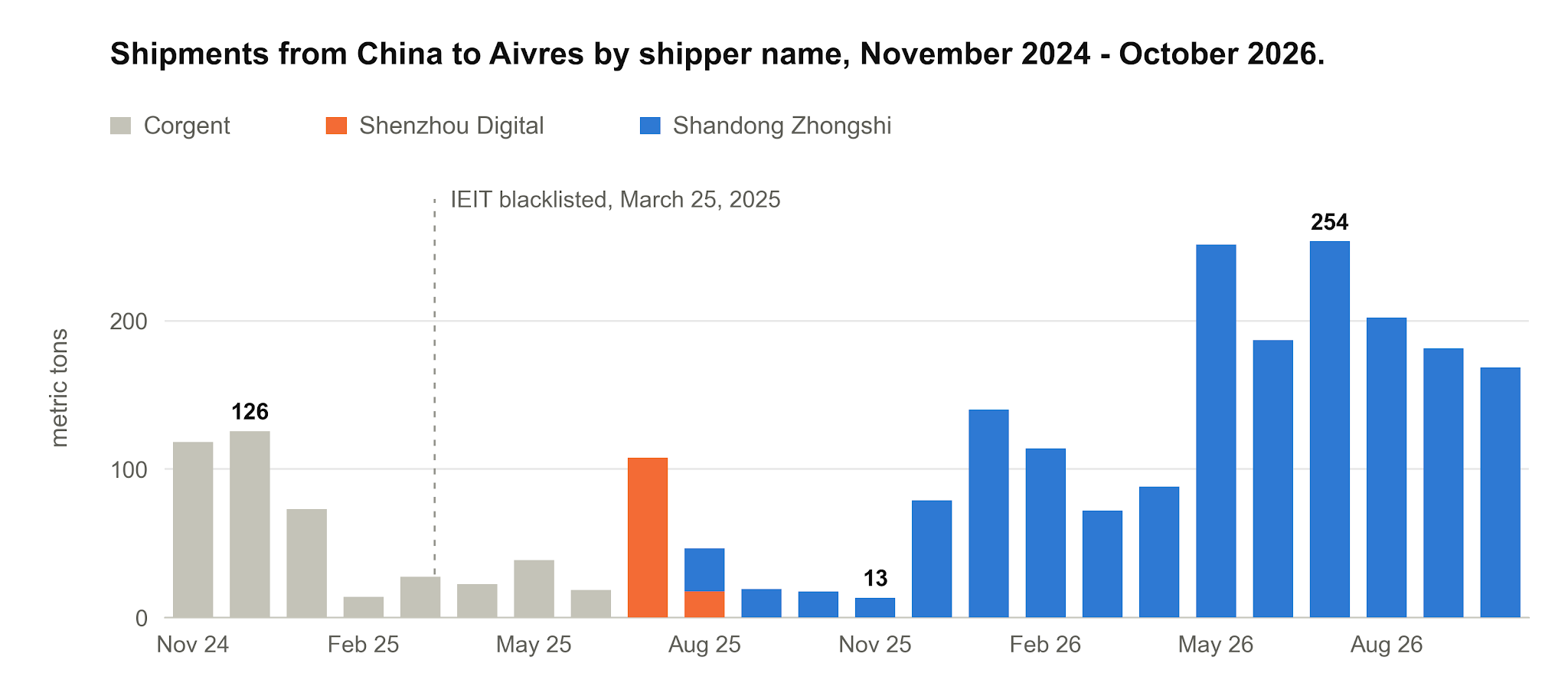
What arrives is mostly server machines without chips, such as mainboards, cases, power supplies, cooling parts, and “dummy memory,” placeholder modules for empty memory slots. Servers are commonly built this way: a factory ships a bare chassis and board, and the processors, memory, and drives are installed at final assembly. That last step is what U.S. companies such as Aivres do: insert chips from AMD or Nvidia and ship out the final products to global customers. That could include China, potentially back to the parent company, IEIT.
The records do not show whose chips went into these machines, or where Aivres shipped the completed servers, but “Aivres exported at least $5.6 billion of advanced technology from the United States to Southeast Asia” from April 2024 to February 2026, “more than $3 billion” of which was built with Nvidia’s Blackwell chips, according to New York Times reporting.
AMD’s processors may be present alongside Nvidia chips inside machines sold by Aivres. For example, the company sells an Nvidia Blackwell Ultra server, the KR9288-E3, which also includes two AMD EPYC processors.
Hunterbrook paid a visit to Aivres in Fremont on November 17. John, who described himself as an operations manager, told a Hunterbrook reporter: “I can’t disclose exact locations, but I can say we ship a lot to China and neighboring countries.”
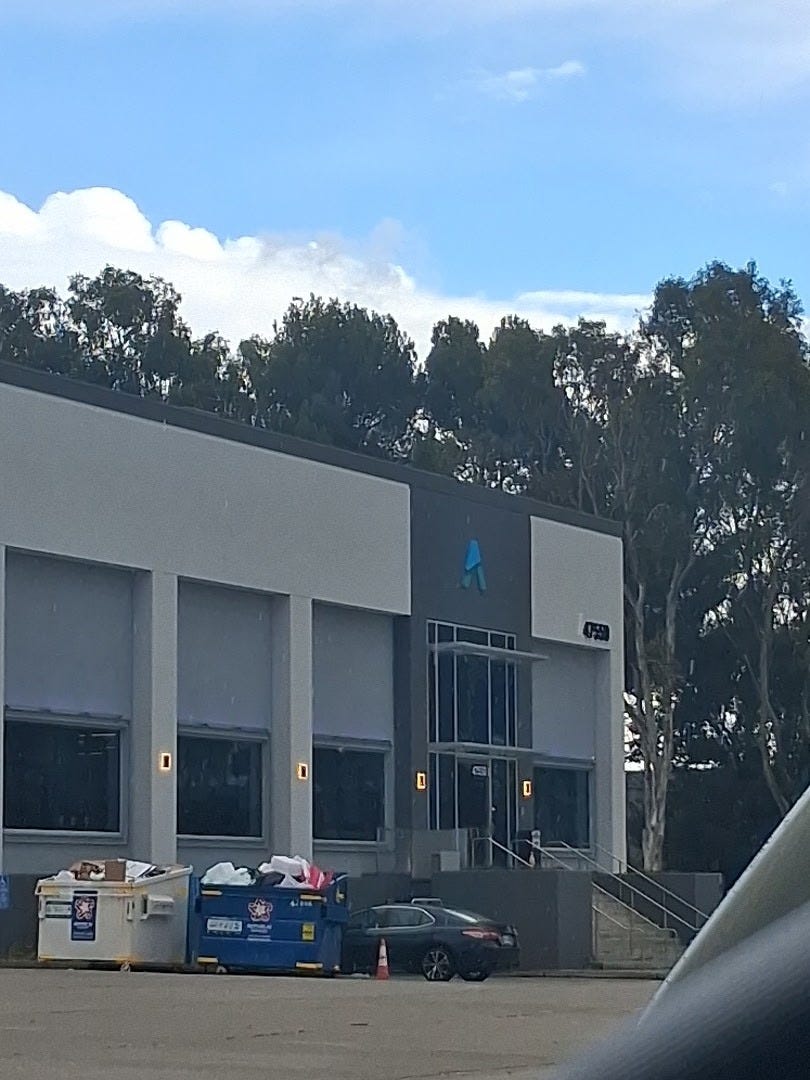
The pattern across the four suggests risks embedded in AMD’s network: one company on the blacklist, three that are not; the same AMD firmware on all of their sites; and for Kaytus and Aivres, a paper trail that appears to run to the same blacklisted parent, IEIT. It’s a network that, in theory, could have allowed AMD code to reach IEIT from an affiliate such as Aivres or Kaytus with a vendor AMD license.
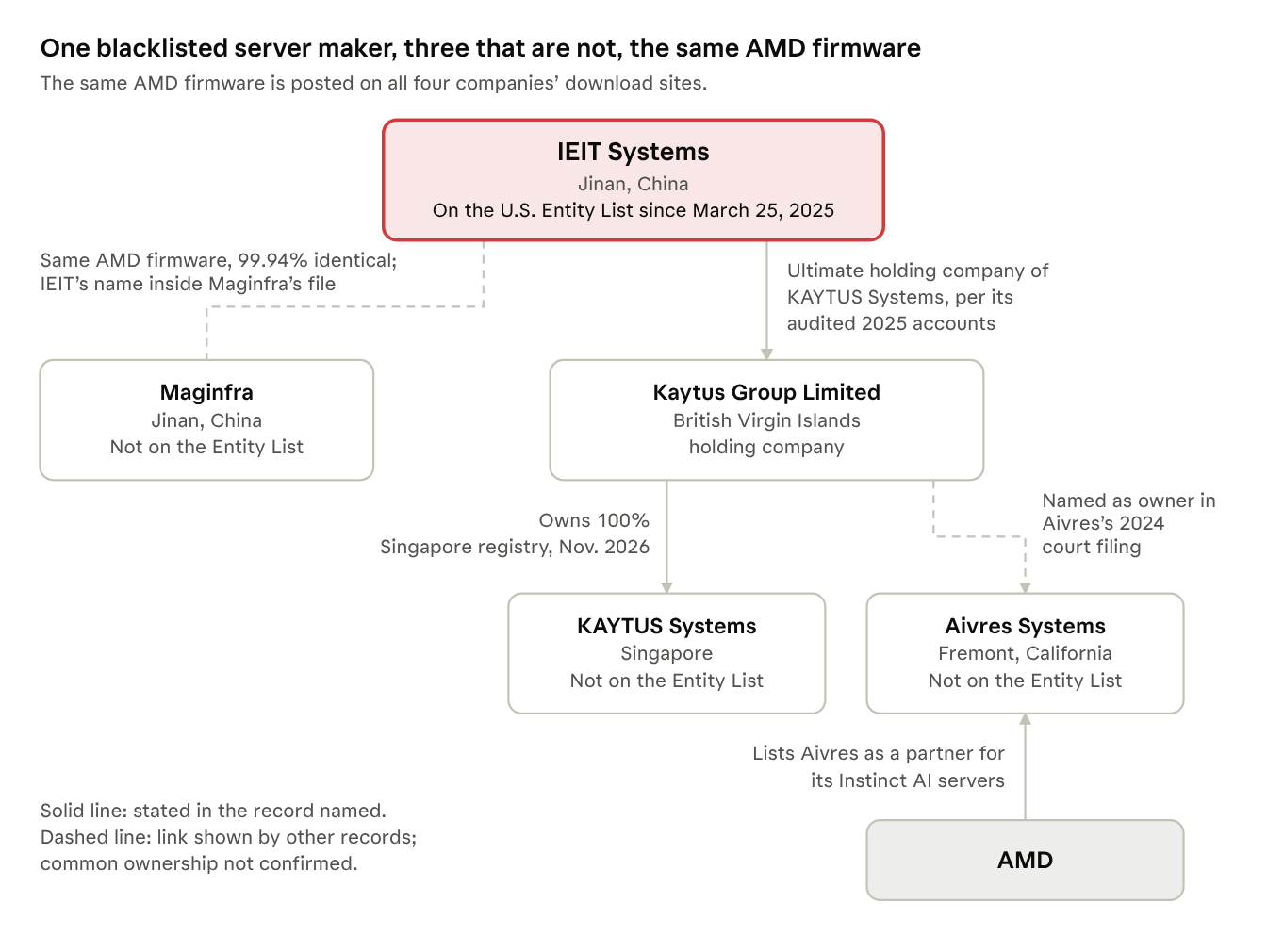
Aivres did not respond to emailed questions, including who ultimately owns it and whether any of its finished servers go to China or to Chinese-headquartered customers.
THE GAP IS CLOSING
IEIT is listed. Aivres, Kaytus, and Maginfra are not, according to the U.S. Consolidated Screening List as of November 15.
It’s a loophole that Winter-Levy attributed in part to the “political power of U.S. tech companies” wanting to continue selling computing power to the Chinese market, as well as the need to avoid massively incentivizing China to develop its own alternatives.
But that is scheduled to change.
A rule the Commerce Department issued in September 2025 would extend Entity List restrictions to any foreign company at least 50% owned, directly or indirectly, by listed entities. It was suspended last November, and this year on November 9, the Commerce Department extended the suspension through January 10, 2027. If the rule takes effect, a foreign company at least 50% owned by IEIT would carry IEIT’s restrictions: a license requirement for pretty much every item originating in the U.S., chips and firmware alike, with applications reviewed under a policy of denial.
A second, newly released rule reaches the places where these companies operate. Effective today, it requires licenses for advanced AI chips and servers shipped to Singapore, Malaysia, Indonesia, Thailand and Brazil, with an exception for U.S.-headquartered buyers and their subsidiaries. It also requires a license to supply any data center, wherever located, that provides China-headquartered companies with large volumes of computing power, and it expects suppliers to check who owns and controls a data center’s customers. AMD billed $4.28 billion, or 12.4% of its revenue, to Singapore in fiscal 2025, up from $2.23 billion two years earlier. The filing does not separately disclose revenue from other Southeast Asian countries.
Congress is pressing as well.
On November 12, the top Democrats on the Senate Finance and House Ways and Means committees said they opened an investigation into the administration’s approval of Nvidia’s exports to Chinese companies, and three House committee chairmen sought testimonyfrom Nvidia’s general counsel. The inquiries concern Nvidia. Any rule-tightening that follows would likely bind AMD too.
“My guess is that this is a real turning point,” Winter-Levy told Hunterbrook. “If Jensen can be toppled by this, the most powerful, most charismatic, most central figure in the AI industry, then it could definitely happen to other CEOs too.”
The Bureau of Industry and Security, which maintains the Entity List, did not respond to questions, including whether it has licensed any AMD technology for IEIT and whether it is reviewing who owns the three companies.
AMD’S OTHER CHINA TIES
AMD’s connections to blacklisted companies are not limited to this network.
HYGON JOINT VENTURES
It owns 51% and 30% of two chip ventures in Chengdu that the Commerce Department blacklisted in 2019, along with AMD’s partner in the ventures, Higon Information Technology, now listed in Shanghai as Hygon. Hygon says AMD stopped providing technical support after the listing.
The money kept flowing: AMD reported $67 million of “licensing gain” in 2025, up 40%, and its latest annual report dropped the explanation that tied this income to the ventures’ royalties. Hunterbrook compared the two companies’ books. Hygon recorded RMB 585.5 million of fees in 2025 to a payee it calls “Company G.” Its 2021 fee to Company G, RMB 109.7 million, matches the fee its prospectus attributes to AMD for that year. Hygon’s accounts imply about $270 million of payments over five years, against the $263 million AMD reported.
Together, the filings suggest AMD continued collecting payments from its blacklisted Chinese chip ventures: Hygon’s accounts imply roughly $270 million paid over 2021–2025, close to the $263 million AMD reported in licensing income.
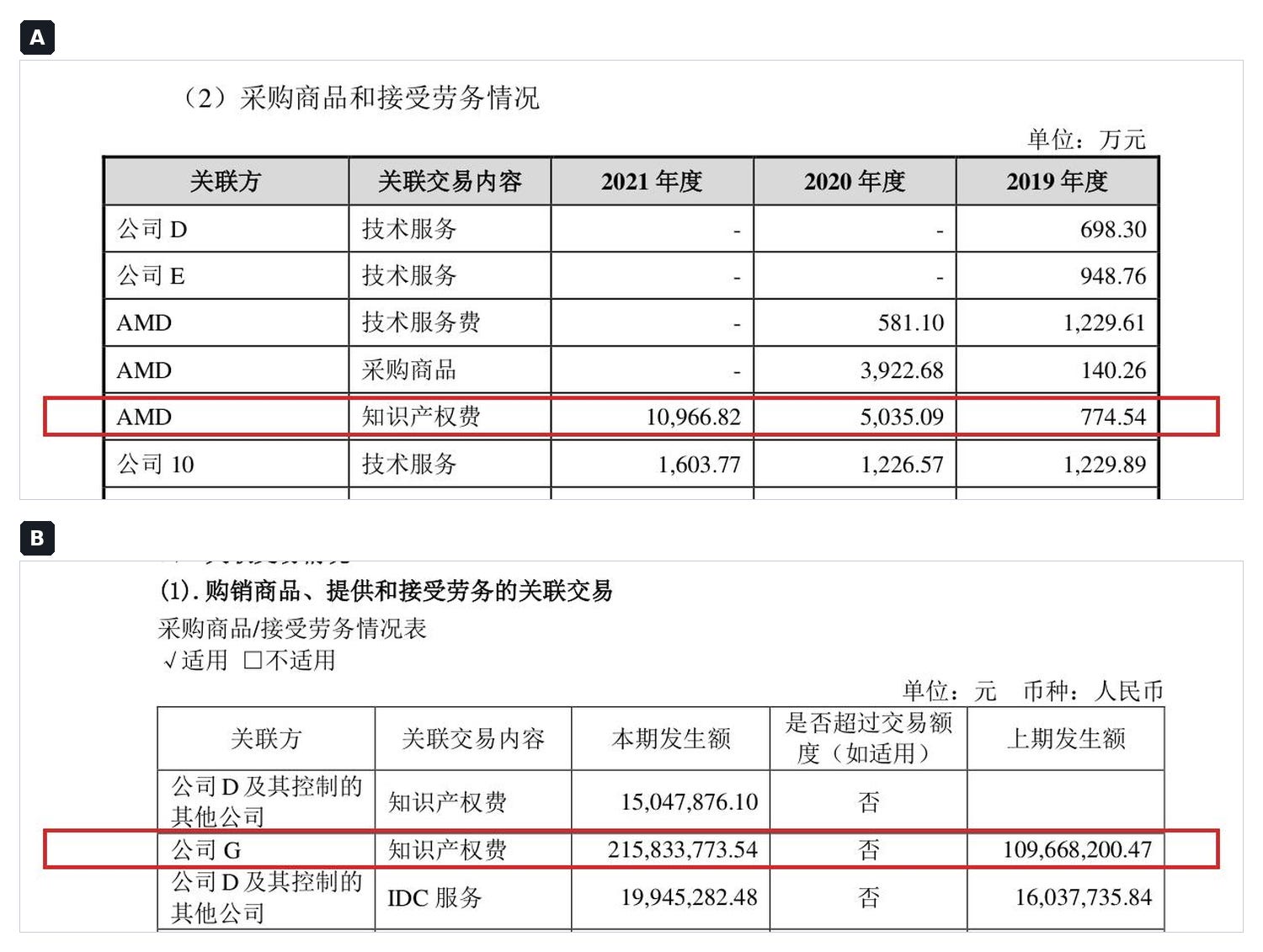
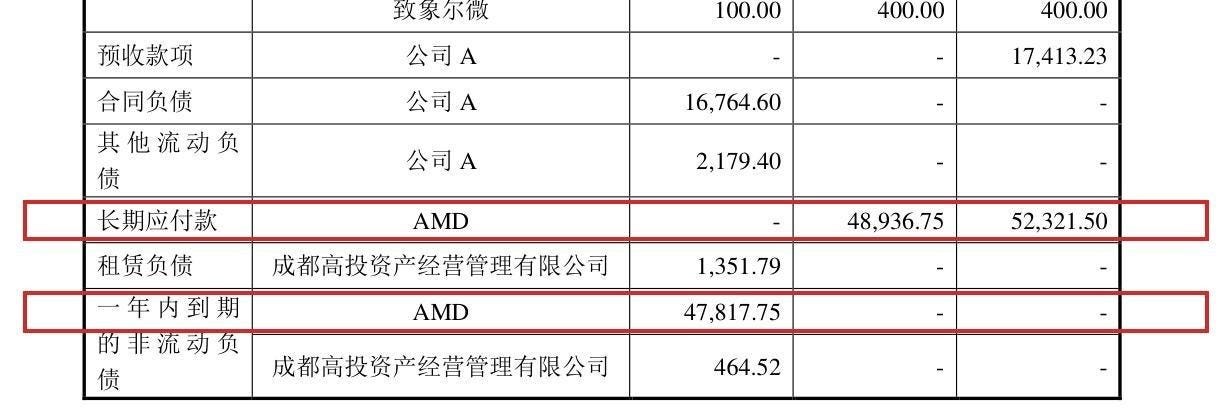
The payments do not establish that AMD violated U.S. export controls. They could reflect royalties and other payments for technology AMD licensed before the listing; the Entity List restricts exports to listed companies, not payments from them. But they do show that AMD continues to profit from Chinese chip ventures targeted by Washington, potentially leaving it financially exposed if restrictions on those relationships tighten further.
Hygon did not respond when asked whether Company G is AMD. AMD did not answer whether the $67 million is royalties from the ventures.
CANCON, AKA SUMA TECHNOLOGY
AMD’s February catalog of Instinct servers also lists a machine from Cancon, which the Entity List names as an alias of Suma Technology, a company added to the Entity List the same day as IEIT.
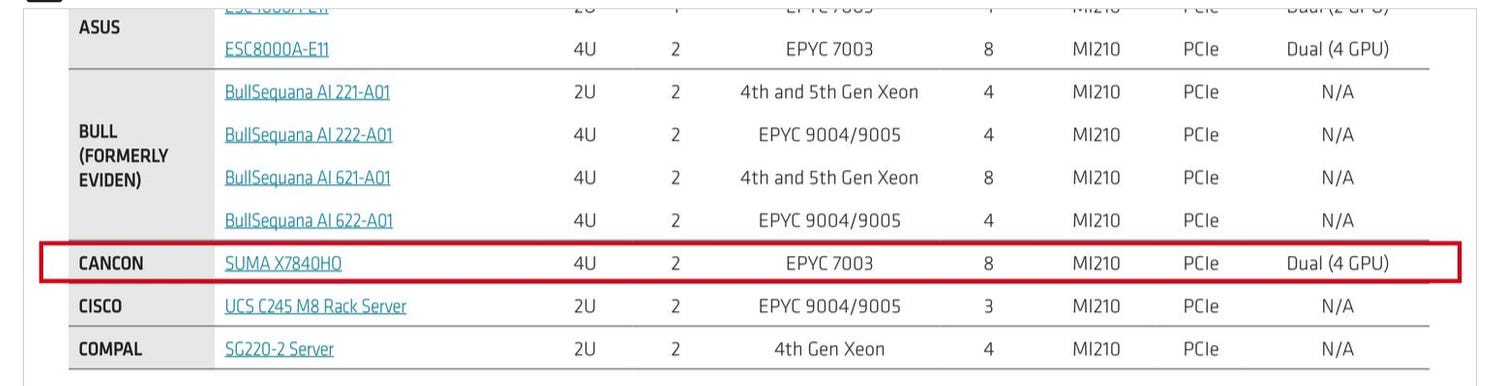
A screenshot of AMD’s February 2026 catalog listing a Cancon server. Search conducted November 15; red box added by Hunterbrook. Sources: AMD’s February 2026 catalogand U.S. Consolidated Screening List.
These relationships are relatively small given the size and scope of AMD’s business. And records Hunterbrook found don’t establish on their own a violation of export laws.
But AMD’s overall China business is meaningful. And while selling chips there is legal, and most of AMD’s processors face relatively few restrictions, that could change as AMD pursues rapid growth in AI accelerators, a business more tightly constrained by U.S. export controls.
And unlike Nvidia, whose annual report names mostly Taiwanese and South Korean suppliers, AMD depends on a Chinese partner to finish most of its chips.
TONGFU MICROELECTRONICS
Two ventures 85% owned by China’s Tongfu Microelectronics do most of AMD’s chip assembly, testing and packaging; AMD bought $2 billion worth of services from them in 2025.
But AMD is more than their customer. It owns 15% of each venture. It’s also a lender: In October 2024, AMD gave one of them a one-year, $100 million loan. Last year it extendedthe loan to October 16, 2026. AMD’s latest quarterly report, filed 19 days after that date, lists the $100 million as still outstanding at the end of September and no longer gives a maturity date. Tongfu’s half-year report does not name its lender, but its short-term liabilities include$100.8 million of 资金拆借款, or borrowed funds: roughly the size of AMD’s loan plus interest.
Tongfu’s filings call the arrangement “合资+合作,” joint venture plus cooperation, and say Tongfu handles “占其相关产品的80%以上,” or more than 80%, of AMD’s relevant products. One customer, which Tongfu does not name, supplied 48.98% of its revenue in the first half of 2026. AMD’s own filing says the ventures provide the majority of its assembly, testing and packaging.
The ties have grown this year. AMD reported $1.8 billion of purchases from its equity-method affiliates in the first nine months of 2026, mainly for assembly, testing and packaging, up from $1.5 billion a year earlier. It owed them $606 million at the end of September. On May 20, Lisa Su was in Suzhou, where she and the city’s Communist Party secretary, Fan Bo, attended the launch of the venture’s second-phase factory, according to the Suzhou Daily.
A shock to AMD’s China sales or its Chinese supplier would hit a company that has already promised to spend heavily.
As The Bear Cave reports today, AMD has $48.8 billion in purchase and service commitments and up to $8.5 billion of guarantees. It held $15.8 billion of cash and short-term investments. And right now, it’s trading at a price-to-earnings ratio three to four times higher than Nvidia’s.
Which is to say: Investors who left Nvidia over China bought a more expensive company with a China problem of its own.
AUTHORS
Sam Koppelman is a New York Times best-selling author who has written books with former United States Attorney General Eric Holder and former United States Acting Solicitor General Neal Katyal. Sam has published in the New York Times, Washington Post, Boston Globe, Time Magazine, and other outlets. He has a BA in Government from Harvard, where he was named a John Harvard Scholar and wrote op-eds like “Shut Down Harvard Football,” which he tells us were great for his social life. Sam is based in New York City.
Jenny Ahn joined Hunterbrook after serving many years as a senior analyst in the US government. She is a seasoned geopolitical expert with a particular focus on the Asia-Pacific and has diverse overseas experience. She has an M.A. in International Affairs from Yale and a B.S. in International Relations from Stanford. Jenny is based in Virginia.
Jean Wang is a machine learning engineer and data scientist at Hunterbrook Media. Previously, Jean worked on the alternative credit and fixed income desk at Magnetar Capital, studied Math at Yale University, and served as an editor for the Yale Daily News.
Till Daldrup is an investigative journalist who joined Hunterbrook from The Wall Street Journal, where he focused on open-source investigations and content verification. In 2023, he was part of a team of reporters who won a Gerald Loeb Award for an investigation that revealed how Russia is stealing grain from occupied parts of Ukraine. He has an M.A. in Journalism from New York University and a B.S. in Social Sciences from University of Cologne. He’s also an alum of the Cologne School of Journalism (Kölner Journalistenschule).
Blake Spendley joined Hunterbrook from the Center for Naval Analyses (CNA), where he led investigations as a Research Specialist for the Marine Corps and US Navy. He built and owns the leading open-source intelligence (OSINT) account on X/Twitter, called @OSINTTechnical (over 1 million followers), which also distributes Hunterbrook Media reporting. His OSINT research has been published in Bloomberg, the Wall Street Journal, and The Economist, among other top business outlets. He has a B.A. in Political Science from USC.
JD Jean-Jacques joined Hunterbrook from Goldman Sachs, where he worked as an investment banker. He was editor-in-chief of Howard University’s newspaper, The Hilltop, and wrote for The Exonian at Phillips Exeter Academy. Among other recognitions, JD was a White House Correspondents’ Association Scholar and was named Student Journalist of the Year by The National Association of Black Journalists. He graduated from Howard with a B.A. in history.
EDITOR
Vikas Kumar joined Hunterbrook from The Capitol Forum, where he led the corporate investigations team for a decade as a senior editor. He was previously an attorney at Gordon Feinblatt, a trial attorney for the Department of Justice, and a law clerk for a federal judge. He has a J.D. from University of Virginia School of Law and a bachelor’s from Emory University. Vikas is based in Maryland.
GRAPHICS
Dan DeLorenzo is a creative director with 25 years reporting news through visuals. Since first joining a newsroom graphics department in 2001, he has built teams at Bloomberg News, Bridgewater Associates, and the United Nations, and published groundbreaking visual journalism at The Wall Street Journal, Associated Press, The New York Times, and Business Insider. A passion for the craft has landed him at the helm of newsroom teams, on the ground in humanitarian emergencies, and at the epicenter of the world’s largest hedge fund. He runs DGFX Studio, a creative agency serving top organizations in media, finance, and civil society with data visualization, cartography, and strategic visual intelligence. He moonlights as a professional sailor working toward a USCG captain’s license and is a certified Pilates instructor.
DISCLOSURES
© 2026 Hunterbrook Media LLC. All rights reserved. Use of this website is strictly governed by our Terms of Use. The content herein is furnished on an “AS IS” basis without any form of express or implied warranty. For information regarding our privacy practices, please refer to our Privacy Policy.
Hunterbrook Media LLC (”Hunterbrook Media”) is an investigative news organization. Hunterbrook Media is affiliated with Hunterbrook Capital LP (”Hunterbrook Capital”), an exempt reporting adviser with the U.S. Securities and Exchange Commission that serves as investment adviser to one or more investment funds. Hunterbrook Media and Hunterbrook Capital are legally separate entities under common control. Hunterbrook Capital’s investment activities are one source of funding for Hunterbrook Media’s journalistic operations. Hunterbrook Capital may hold long positions, short positions, positions through derivative instruments including options and swaps, or no position in any security covered or mentioned on this website. Consistent with applicable policies and procedures, Hunterbrook Capital may establish, modify, or close positions in covered securities before or after the publication of any Hunterbrook Media article. Following publication of any article, Hunterbrook Capital will continue transacting in covered securities for an indefinite period and may be long, short, or flat at any time thereafter, regardless of any position described at publication. Hunterbrook Media has no obligation to update any article or disclosure to reflect subsequent changes in Hunterbrook Capital’s positions.
Nothing on this website constitutes investment advice, a recommendation to buy, hold, or sell any security, or a solicitation to purchase or sell any securities. No securities shall be offered or sold in any jurisdiction where such activities would be contrary to applicable securities laws. Hunterbrook Media is not a registered investment adviser in the United States or any other jurisdiction. Nothing herein should be construed as investment advice or a recommendation of any kind. This information should not be relied upon as a substitute for independent research or professional financial, legal, or tax advice.
This website may feature forward-looking statements reflecting Hunterbrook Media’s current views. Such statements, identifiable by terms including but not limited to “anticipate,” “believe,” “estimate,” “expect,” “intend,” “may,” “plan,” “predict,” “should,” and “will,” are inherently speculative and subject to risks and uncertainties. Actual results or outcomes may substantially deviate from those projected. Hunterbrook Media expressly disclaims any obligation to update or revise any forward-looking statements, regardless of subsequent developments or new information.
The information presented is current as of the date indicated. No representation regarding the completeness or timeliness of this information is made. Some information is sourced from third parties and, while believed to be reliable, has not been independently verified, and its accuracy or completeness is not guaranteed. Hunterbrook Media is not affiliated with any sites linked to this website. Investment in securities and other financial instruments involves significant risk, including the potential loss of principal. Users are advised to conduct their own due diligence and consult professional advisors before engaging in any investment activity. Use of Hunterbrook Media’s content is entirely at the user’s risk. Users shall not use this site for any illegal or prohibited purposes and shall comply with all applicable local, state, national, and international laws and regulations.
Should any provision of these Terms of Use be adjudged invalid or unenforceable, the remaining provisions shall remain in full force and effect. Trademarks contained in links to third-party websites belong to their respective owners. Hunterbrook Media retains copyright on all text, content, graphics, and trademarks displayed on this site.