


BY: Sam Koppelman, Jenny Ahn, Jean Wang
EDITOR: Vikas Kumar
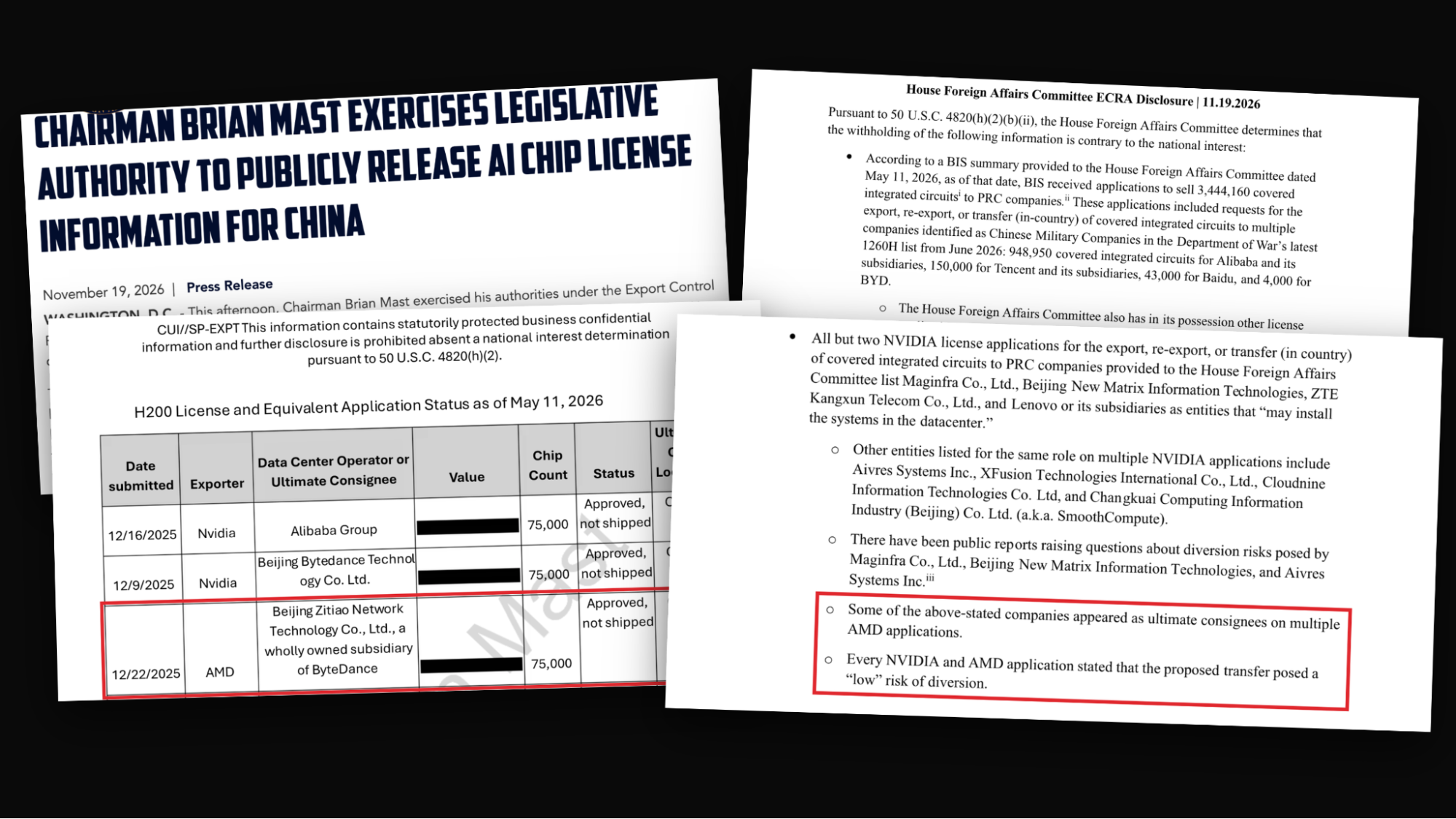
Hours after Hunterbrook Media reported that a blacklisted Chinese server maker kept getting new AMD firmware, the House Foreign Affairs Committee released previously confidential details of AMD’s and Nvidia’s applications to sell advanced GPUs to China.
AMD told the Commerce Department the risk of diversion to prohibited entities was “low,” according to the committee, which said withholding the records would be “contrary to the national interest” and called the release “the most detailed public disclosure in the history of the Export Control Reform Act.”
Based on Hunterbrook Media’s reporting, at the time of publication Hunterbrook Capital is short $AMD and long a basket of comparable securities. Positions may change at any time. This article is not investment advice or any recommendation. See full disclosures on our website.
Yesterday, the House Foreign Affairs Committee did something rare: It released previously confidential details from applications by Nvidia and AMD to export AI chips to China. The records are so sensitive that they are protected by law from public disclosure, with an exemption from the Freedom of Information Act.
Chairman Brian Mast, a Republican congressman from Florida, published the records under a provision of the Export Control Reform Act of 2018. The law lets a congressional committee disclose confidential license information only if the full committee determines that withholding it is “contrary to the national interest.” The bipartisan committee said it had made that determination, and it called the release “the most detailed public disclosure” in the law’s history.
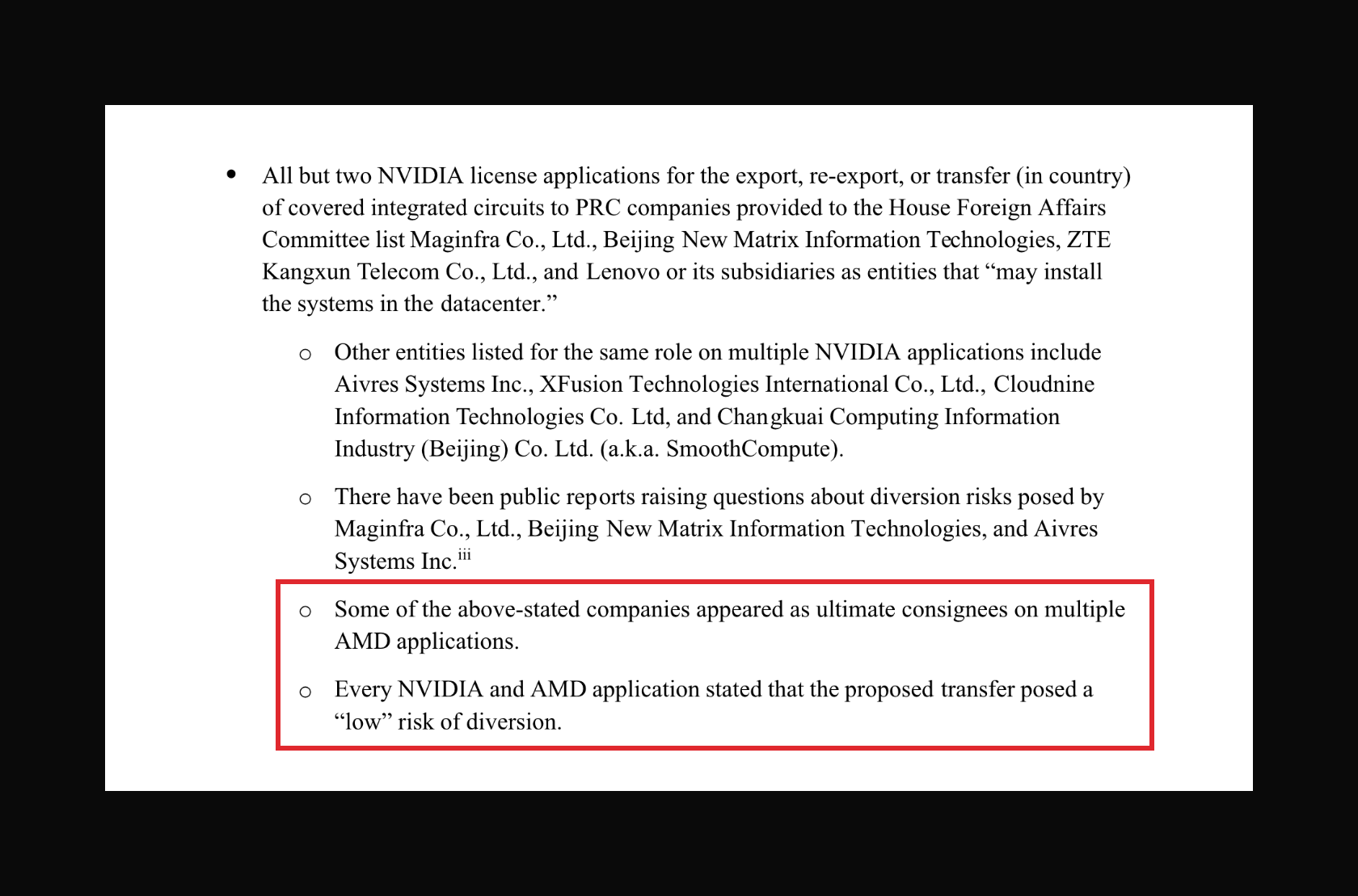
The New York Times broke the story yesterday, focusing largely on Nvidia’s applications. The records also show that AMD ($AMD) applied for licenses to export 600,000 advanced AI chips to Chinese companies. The U.S. had approved applications covering 300,000 chips as of May 11. Every AMD application stated that the proposed transfer posed a “low” risk of diversion, according to the committee’s summary.
The same summary names eight companies that appear on Nvidia’s ($NVDA) applications as possible installers of the chips, including Maginfra and Aivres Systems. It then says, “Some of the above-stated companies appeared as ultimate consignees on multiple AMD applications.” It does not specify which companies.
Hunterbrook Media reported yesterday that Maginfra and Aivres offer AMD firmware nearly identical to that of IEIT Systems, a Chinese server maker on the U.S. export blacklist. While Maginfra and Aivres are not themselves blacklisted, The New York Times has identified the two companies as potential sources of diversion for Nvidia chips. Hunterbrook’s investigation extended that point to include AMD.
In response to Hunterbrook’s initial reporting, AMD released a statement saying it “misrepresents AMD’s business practices and relationships.” It did not respond to Hunterbrook’s request for comment on the House report, but reportedly told the New York Times that “the company complied with applicable U.S. laws and regulations.”
Committee staff also did not respond to requests for comment.
The Department of Commerce sent Hunterbrook a statement.
“Today’s disclosure shows that the Department of Commerce has a long track record of transparency with Congress about licensing activity for the H200 and equivalent chips, including both approvals and rejections,” said a spokesperson for the Bureau of Industry and Security.
“The Department’s approach to H200 licensing is based on a rule published in the Federal Register in January 2026, which imposes significant additional national security-related requirements on license applicants in order to qualify for case-by-case consideration rather than a presumption of denial. Licensing decisions are the product of deliberation and consultation among multiple U.S. Government agencies.”
The House Committee did not accuse AMD or Nvidia of specific wrongdoing.
300,000 AMD CHIPS APPROVED
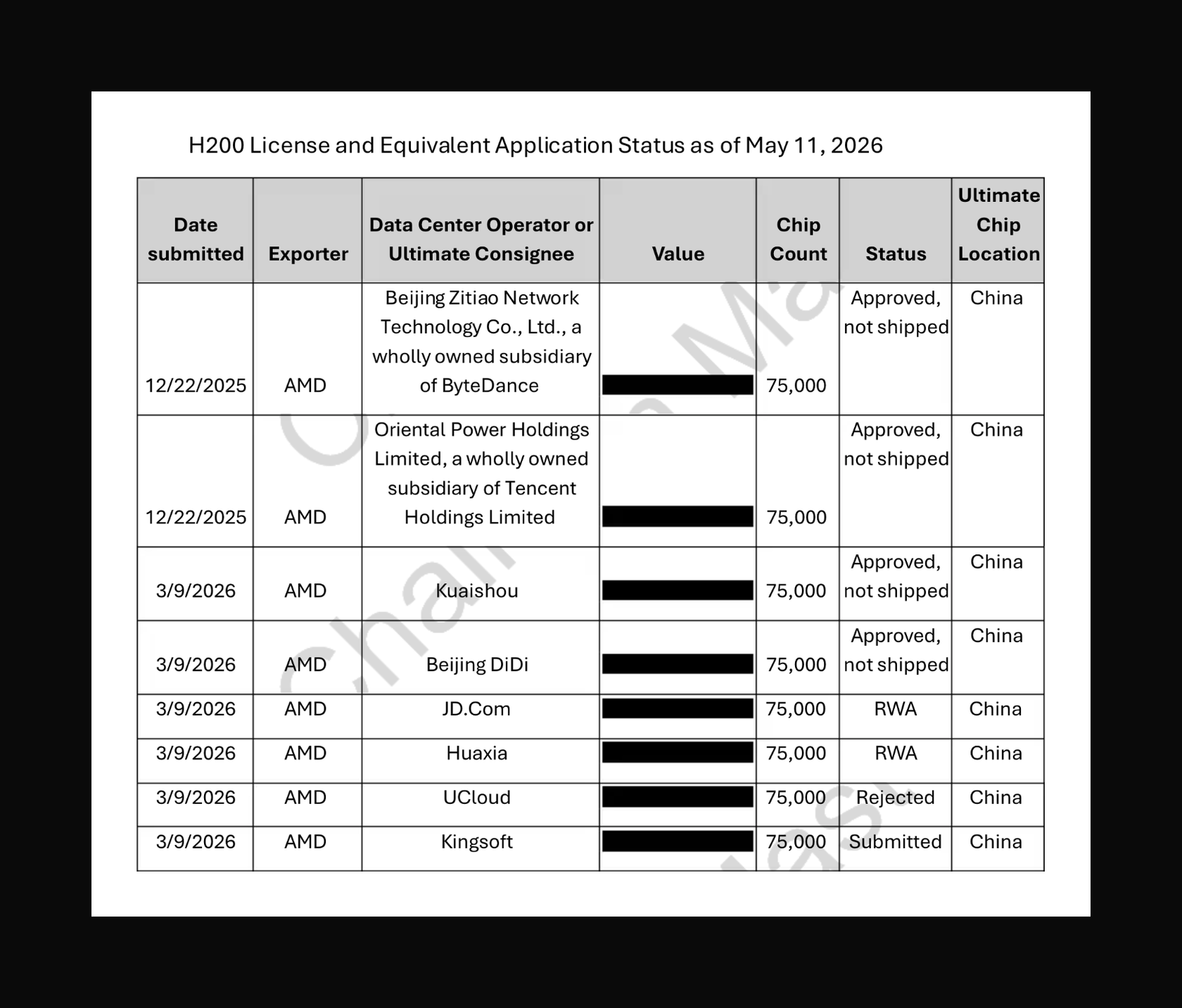
The release includes a Commerce Department table of license applications for Nvidia’s H200 chips and AMD’s MI325X chips as of May 11, 2026. The table lists over 50 applications seeking authorization to export 3,444,160 chips to Chinese companies. The Bureau of Industry and Security had approved 21 of those applications covering 879,868 chips. None of the approved chips had shipped as of May 11, the table shows. Dollar values are redacted.
Eight of the applications are AMD’s, each for 75,000 chips, according to a Hunterbrook tally. BIS approved four of AMD’s applications. They covered 300,000 chips, or 34% of all chips approved. Those four approvals list a ByteDance subsidiary, a Tencent subsidiary, Kuaishou, and Beijing DiDi as the “Data Center Operator or Ultimate Consignee.”
The committee noted that the Department of War had designated Tencent as a Chinese military company. AMD and Nvidia each applied for half of the 150,000 chips approved for Tencent and its subsidiaries in the table.
HOW THE RELEASE EXPANDS HUNTERBROOK’S REPORTING
The press release says Nvidia listed Maginfra and Aivres as potential installers of its systems in data centers. The summary notes that public reports have been “raising questions about diversion risks posed” by those companies, citing two New York Times articles.
The Times reported that Aivres exported at least $5.6 billion worth of advanced technology to Southeast Asia, with shipments going to data centers and tech firms serving Chinese companies.
The Journal traced “about 2,300” Nvidia chips from Aivres to an Indonesian data center serving a Chinese AI startup. The Times also reported that Maginfra was cleared to handle Nvidia’s H200 chips and that its listed office “appeared deserted.”
That coverage centered on Nvidia.
Hunterbrook’s report yesterday morning scrutinized the same entities and reported that they appeared to be distributing the same startup code packages containing AMD firmware posted by blacklisted IEIT. Maginfra, Aivres, and Singapore-based Kaytus offer AMD firmware that is 99.94% identical to that of IEIT Systems, a Chinese server maker blacklisted in March 2025. Neither Aivres nor Kaytus is itself blacklisted, but IEIT’s 2023 interim report listed them both as wholly owned subsidiaries.
The Committee’s press release says AMD applied for licenses to export MI325X chips, claiming “low” diversion risk from its customers. AMD’s February 2026 catalog lists an Aivres server built around Instinct AI accelerator models MI300X or MI325X. In February 2026, AMD said the U.S. had granted licenses for MI325X shipments to some China-based customers without naming them.
When a Hunterbrook reporter visited Aivres in Fremont, California, this week, a man who described himself as an operations manager said the company ships “a lot to China and neighboring countries.” Hunterbrook does not know if the shipments contained the restricted chips.
In the press release, the committee states that Nvidia had asked to rely on “possible chip-smuggling fronts” to supply Chinese customers. That phrase was not applied to AMD, which has not been accused of violating export controls. Exports made under an approved license are generally legal.
Earlier this week, Hunterbrook asked AMD whether it had received a license to export to a blacklisted Chinese entity. AMD acknowledged our deadline, requested an extension that we approved, and then wrote: “Will be back in touch by then.” It did not follow up.
This isn’t the first time the House Foreign Affairs Committee has released aggregate export licensing figures. In 2021, the committee disclosed the number and total value of licenses Commerce approved for sales to Huawei and SMIC. Then, in 2023, it published totals for sales to blacklisted Chinese companies.
The distinction this time is that the committee released application-level details, including the listed data-center operators or ultimate consignees, requested chip quantities, and whether Commerce had approved the applications.
AUTHORS
Sam Koppelman is a New York Times best-selling author who has written books with former United States Attorney General Eric Holder and former United States Acting Solicitor General Neal Katyal. Sam has published in the New York Times, Washington Post, Boston Globe, Time Magazine, and other outlets. He has a BA in Government from Harvard, where he was named a John Harvard Scholar and wrote op-eds like “Shut Down Harvard Football,” which he tells us were great for his social life. Sam is based in New York City.
Jenny Ahn joined Hunterbrook after serving many years as a senior analyst in the US government. She is a seasoned geopolitical expert with a particular focus on the Asia-Pacific and has diverse overseas experience. She has an M.A. in International Affairs from Yale and a B.S. in International Relations from Stanford. Jenny is based in Virginia.
Jean Wang is a machine learning engineer and data scientist at Hunterbrook Media. Previously, Jean worked on the alternative credit and fixed income desk at Magnetar Capital, studied Math at Yale University, and served as an editor for the Yale Daily News.
EDITOR
Vikas Kumar joined Hunterbrook from The Capitol Forum, where he led the corporate investigations team for a decade as a senior editor. He was previously an attorney at Gordon Feinblatt, a trial attorney for the Department of Justice, and a law clerk for a federal judge. He has a J.D. from University of Virginia School of Law and a bachelor’s from Emory University. Vikas is based in Maryland.
DISCLOSURES
© 2026 Hunterbrook Media LLC. All rights reserved. Use of this website is strictly governed by our Terms of Use. The content herein is furnished on an “AS IS” basis without any form of express or implied warranty. For information regarding our privacy practices, please refer to our Privacy Policy.
Hunterbrook Media LLC (”Hunterbrook Media”) is an investigative news organization. Hunterbrook Media is affiliated with Hunterbrook Capital LP (”Hunterbrook Capital”), an exempt reporting adviser with the U.S. Securities and Exchange Commission that serves as investment adviser to one or more investment funds. Hunterbrook Media and Hunterbrook Capital are legally separate entities under common control. Hunterbrook Capital’s investment activities are one source of funding for Hunterbrook Media’s journalistic operations. Hunterbrook Capital may hold long positions, short positions, positions through derivative instruments including options and swaps, or no position in any security covered or mentioned on this website. Consistent with applicable policies and procedures, Hunterbrook Capital may establish, modify, or close positions in covered securities before or after the publication of any Hunterbrook Media article. Following publication of any article, Hunterbrook Capital will continue transacting in covered securities for an indefinite period and may be long, short, or flat at any time thereafter, regardless of any position described at publication. Hunterbrook Media has no obligation to update any article or disclosure to reflect subsequent changes in Hunterbrook Capital’s positions.
Nothing on this website constitutes investment advice, a recommendation to buy, hold, or sell any security, or a solicitation to purchase or sell any securities. No securities shall be offered or sold in any jurisdiction where such activities would be contrary to applicable securities laws. Hunterbrook Media is not a registered investment adviser in the United States or any other jurisdiction. Nothing herein should be construed as investment advice or a recommendation of any kind. This information should not be relied upon as a substitute for independent research or professional financial, legal, or tax advice.
This website may feature forward-looking statements reflecting Hunterbrook Media’s current views. Such statements, identifiable by terms including but not limited to “anticipate,” “believe,” “estimate,” “expect,” “intend,” “may,” “plan,” “predict,” “should,” and “will,” are inherently speculative and subject to risks and uncertainties. Actual results or outcomes may substantially deviate from those projected. Hunterbrook Media expressly disclaims any obligation to update or revise any forward-looking statements, regardless of subsequent developments or new information.
The information presented is current as of the date indicated. No representation regarding the completeness or timeliness of this information is made. Some information is sourced from third parties and, while believed to be reliable, has not been independently verified, and its accuracy or completeness is not guaranteed. Hunterbrook Media is not affiliated with any sites linked to this website. Investment in securities and other financial instruments involves significant risk, including the potential loss of principal. Users are advised to conduct their own due diligence and consult professional advisors before engaging in any investment activity. Use of Hunterbrook Media’s content is entirely at the user’s risk. Users shall not use this site for any illegal or prohibited purposes and shall comply with all applicable local, state, national, and international laws and regulations.
Should any provision of these Terms of Use be adjudged invalid or unenforceable, the remaining provisions shall remain in full force and effect. Trademarks contained in links to third-party websites belong to their respective owners. Hunterbrook Media retains copyright on all text, content, graphics, and trademarks displayed on this site.