


By: Blake Spendley Carter Johnston
Editor: Sam Koppelman
Hunterbrook Media’s investment affiliate, Hunterbrook Capital, has no positions related to this article at the time of publication. Positions may change at any time. See full disclosures on our website.
Nine months before Iran reportedly began mining the Strait of Hormuz, a U.S. Navy director responsible for mine countermeasures delivered a candid assessment before an audience of international naval observers: The Navy’s next-generation mine-hunting systems suffered from unreliable unmanned vehicles, critical single-point failures, and sonar that couldn’t see.
Hunterbrook Media has obtained a copy of that briefing and its associated slides.
The picture they paint is harrowing. The U.S. stares down the barrel of a bleak scenario: a trio of flawed ships responsible for keeping open a global shipping artery that carries one-fifth of the world’s oil supply.
It wasn’t always this way.
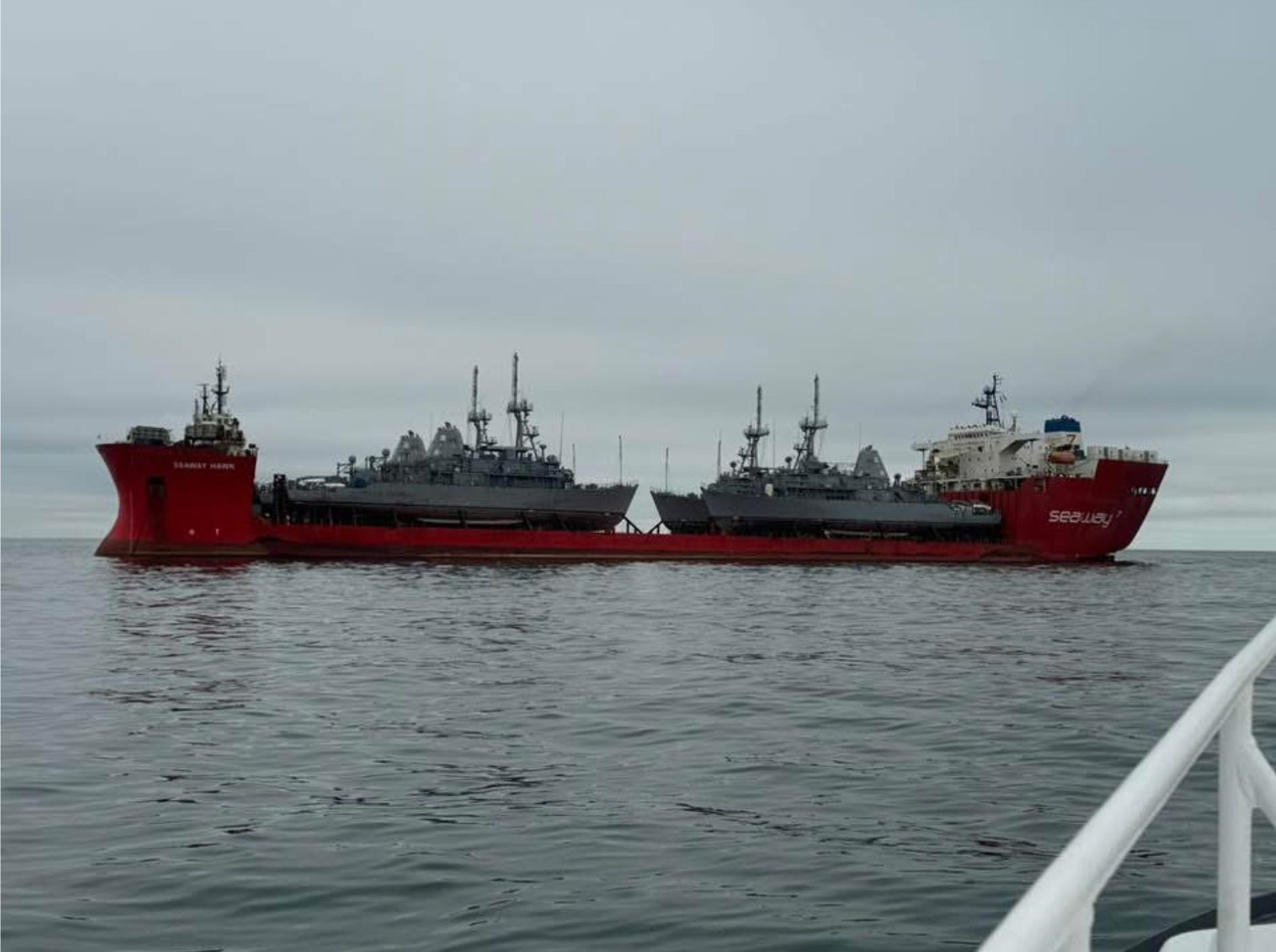
In January, the U.S. Navy loaded four decommissioned Avenger-class minesweepers onto a heavy-lift cargo ship in Bahrain and sent them home for scrap. The wooden-hulled ships had spent the entire post-Cold War era keeping the Persian Gulf’s sea lanes clear — the only vessels in the American fleet at the time purpose-built to find and destroy naval mines. Their fledgling replacements — modern Independence-class Littoral Combat Ships appended with new unmanned mine countermeasures — had just arrived in theater. The transition was complete.
Two months later, Iran is reportedly laying mines in the Strait of Hormuz. For the United States, the artery is blocked.
And the U.S. Navy has three ships that haven’t been battle-tested standing between an Iranian minefield and the passage responsible for much of the world’s oil, fertilizer, and other critical products.
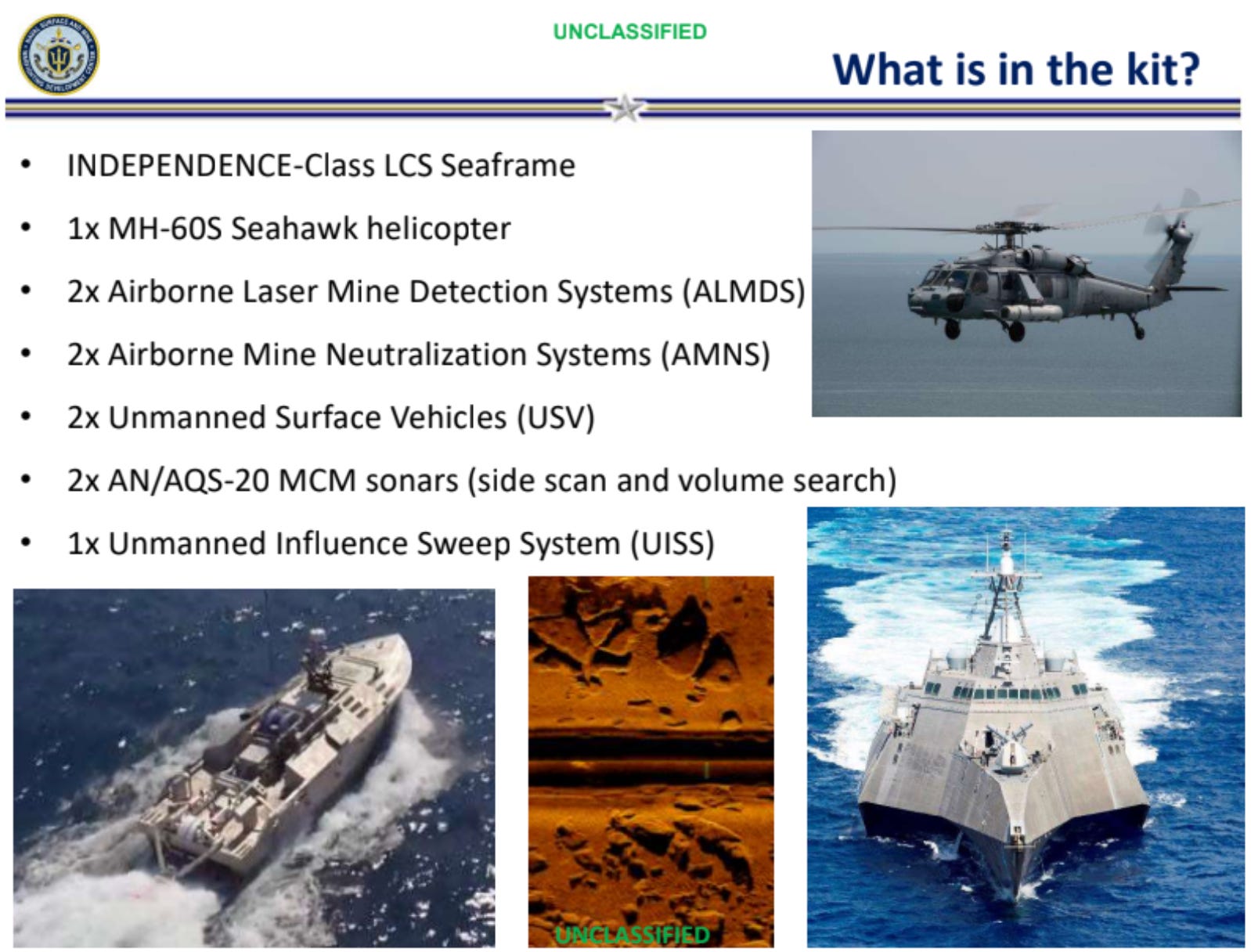
The current American mine countermeasures force positioned near the Persian Gulf is made up of Littoral Combat Ships the USS Canberra, USS Tulsa, and USS Santa Barbara. All three are Independence-class vessels — aluminum-hulled trimarans originally designed as multi-mission platforms, now carrying the Navy’s new Mine Countermeasures Mission (MCM) package in a largely fixed configuration. The modular concept that was supposed to be the LCS’s selling point — swap packages in, swap them out, reconfigure the ship for whatever the mission demands —has been quietly abandoned.
What each ship brings to a minefield: one MH-60S Seahawk helicopter carrying an airborne mine detection system using lasers and a mine neutralization system; two unmanned surface vehicles that can tow either the AN/AQS-20 side-scan and volume-search sonar or the unmanned influence sweep system; and the crew to run it all.
On paper, the package covers the full kill chain — find, classify, identify, neutralize.
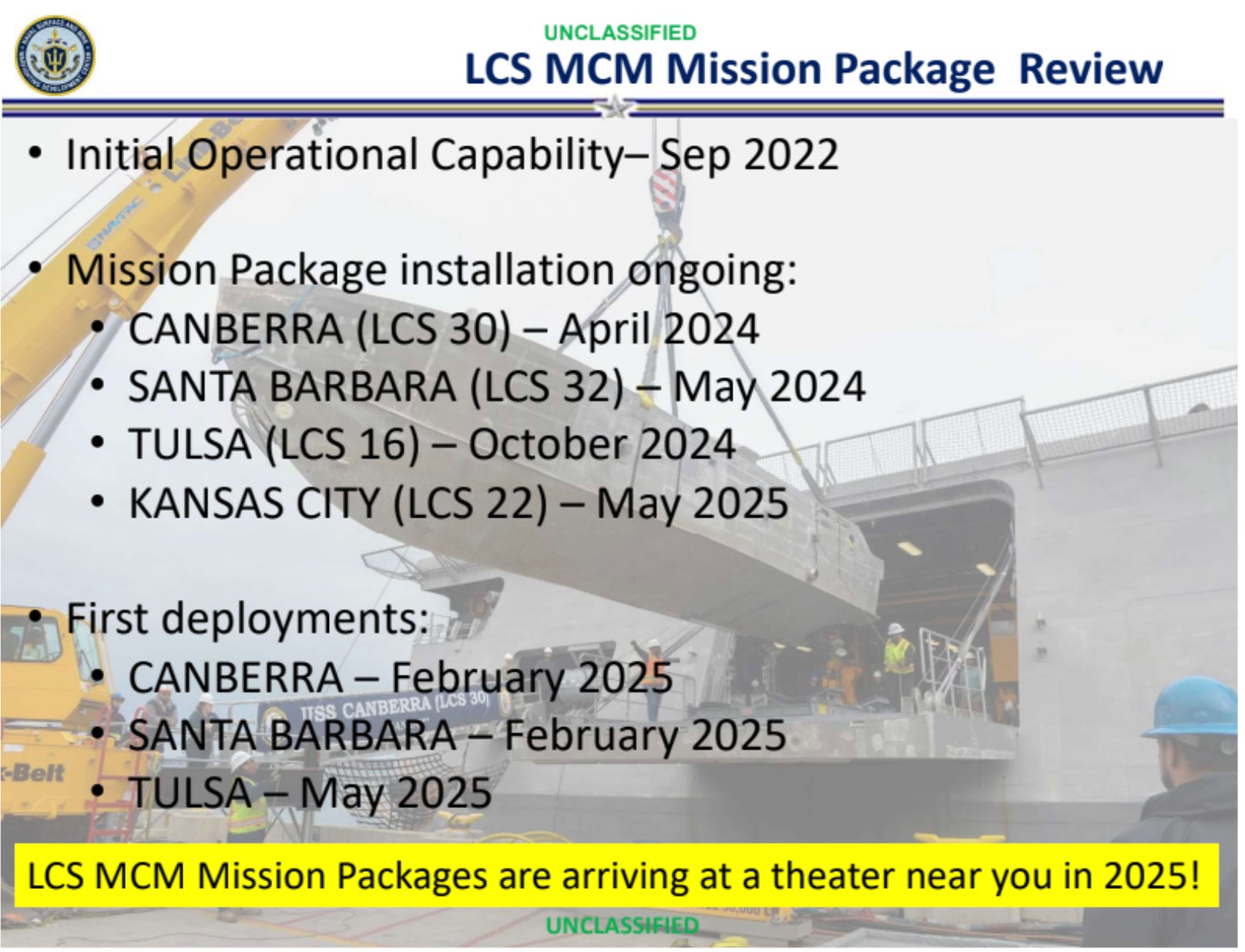
The system reached initial operational capability in September 2022, but reportedly did not deploy on an actual ship until Canberra and Santa Barbara sailed in February 2025. Tulsa followed in May. Kansas City received its package that same month. The entire operational history of the LCS MCM mission package, from first deployment to today’s crisis, is measured in months.
For comparison, the ships they replaced had been doing this work for decades.
The Avenger class entered service in the 1980s. Their fiberglass-coated wooden hulls were designed specifically to reduce magnetic signatures — a basic requirement when you’re driving over mines that detonate based on what they sense passing above them. The LCS is a metal ship, and is significantly larger than an Avenger-class vessel, limiting how close it can safely operate in known or suspected minefields. In return, it sports a slightly more capable self-defense suite against surface and air threats, equipped with a 57 mm gun and a SeaRAM launcher. But it still needs escort protection during the slow, exposed work of sweeping and hunting. At the moment, as Reuters reported, the Navy has refused to provide escorts in the Gulf.
The Washington Institute estimated years ago that clearing the Strait of Hormuz of mines could require “up to 16 MCM vessels.” The Navy has seven. Iran has an estimated 5,000 to 6,000 mines and, according to U.S. intelligence in conversations with CNN, still retains “80% to 90% of its small boats and miners.”
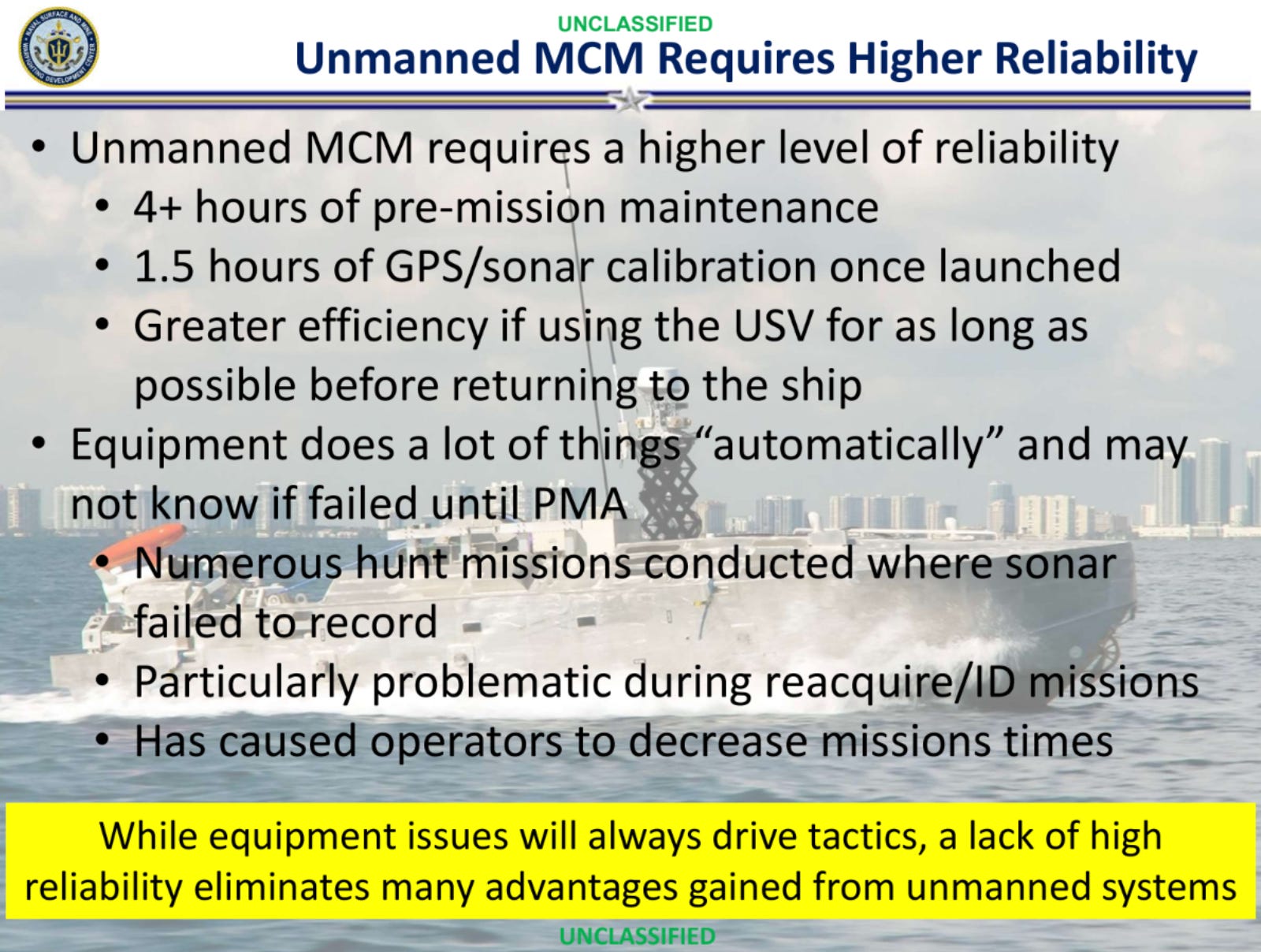
The brief covered a recent MCM Advanced Tactical Training program, the final pre-deployment mine warfare assessment for LCS crews.
Some key findings:
Unreliable unmanned systems. Each Fleet-class USV mission requires over four hours of “pre-mission maintenance” and “1.5 hours of GPS/sonar calibration once launched,” according to the presentation. Multiple hunt missions were conducted where the sonar simply failed to record data — and crews didn’t know until the post-mission analysis. This is especially damaging during reacquire-and-identify missions, exactly the kind of work needed to clear a minefield.
Operators have responded by shortening mission times, which defeats the purpose of using unmanned vehicles in the first place. One pre-deployment exercise with the USS Tulsa off the coast of San Diego resulted in a runaway MCM USV near Mexico’s territorial waters that could not be recovered by the mothership LCS. “Literally, the practice minefield I use is 1 mile north of the US-Mexico maritime border, and there’s a good chance that that UUV drifts or decides to go off on its own. I’m going to get demarched by the Mexican government,” said the leader of the U.S. Navy’s Mine Countermeasures Technical Division. The USVs themselves act as a handicap to minesweeping, with a short bandwidth range forcing the mothership LCS to operate near or inside minefields to maintain visual range to the USV’s antennas.
Visual identification doesn’t work. U.S. MCM doctrine requires a camera to visually confirm mines — the AQS-20 has to drive directly over a bottom mine. But even the relatively clear waters off Southern California have defeated this approach. In the turbid, shallow, current-swept waters of the Persian Gulf, the problem would be far worse. The officer’s conclusion: The Navy needs to adopt high-granularity sonar identification, as other navies already have.
Critical single-point failures. The platform lift between mission bay and hangar, the BIT test laptops for the USV/ALMDS/AMNS, the twin boom extensible crane, and the payload handling systems are all single-point failures with no spares or redundancy aboard. If any one of these breaks, operations stop. When describing the deployment arm, the Navy mine countermeasures lead said, “It is a troubling system. It is highly complex for what it does, and when it breaks, I’m out of a job, I’m out of a mission.”
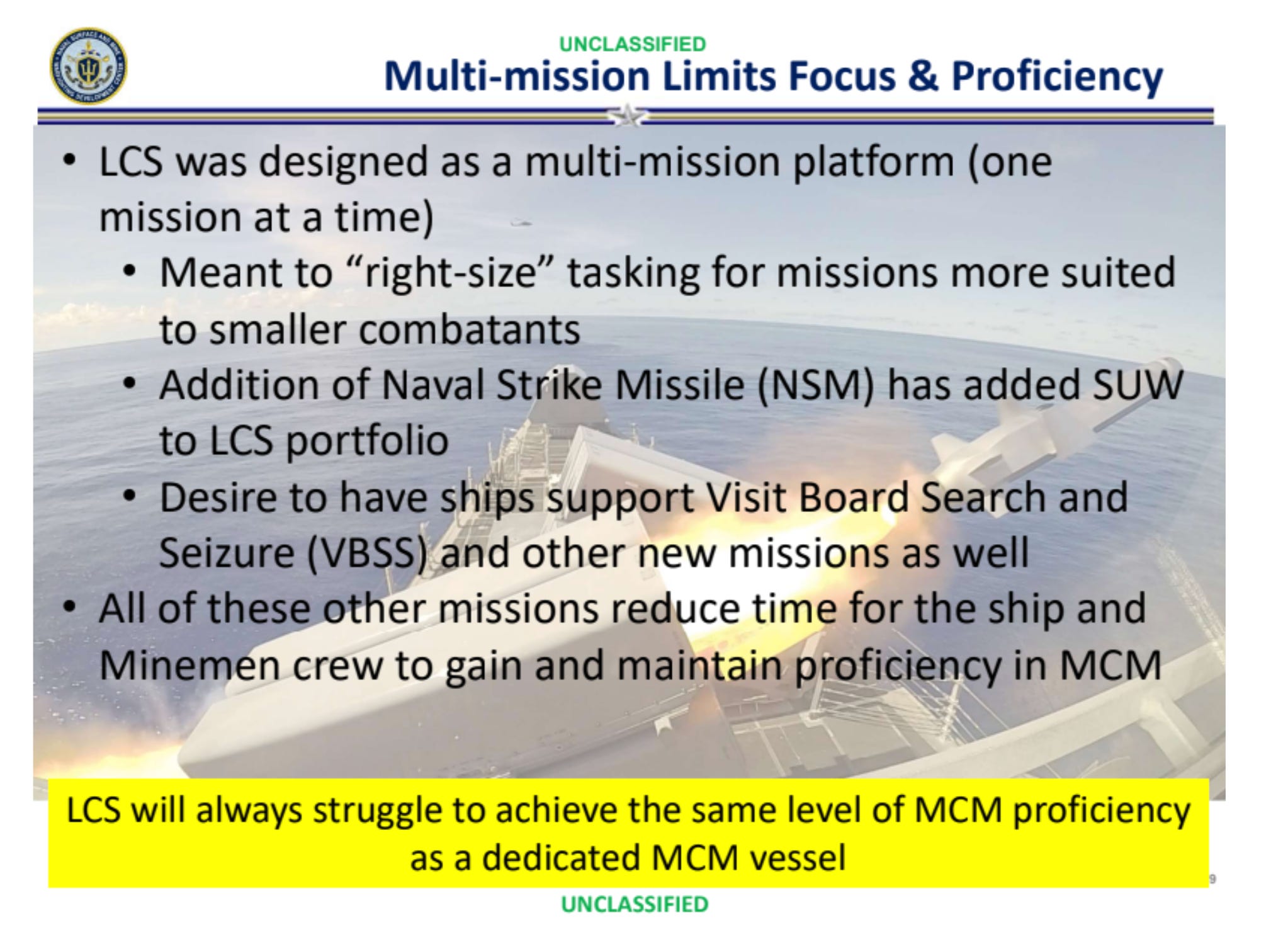
Multi-mission dilution. The LCS was designed as a multi-mission platform. The addition of Naval Strike Missiles and pressure to support visit, board, search, and seize operations means crews have less time to build and maintain MCM proficiency. “So now my ship with an LCS mission package may not necessarily be practicing MCM.” The LCS platform is also being experimented on as a long-range strike platform. The director’s own conclusion: The LCS will always struggle to match a dedicated MCM vessel.
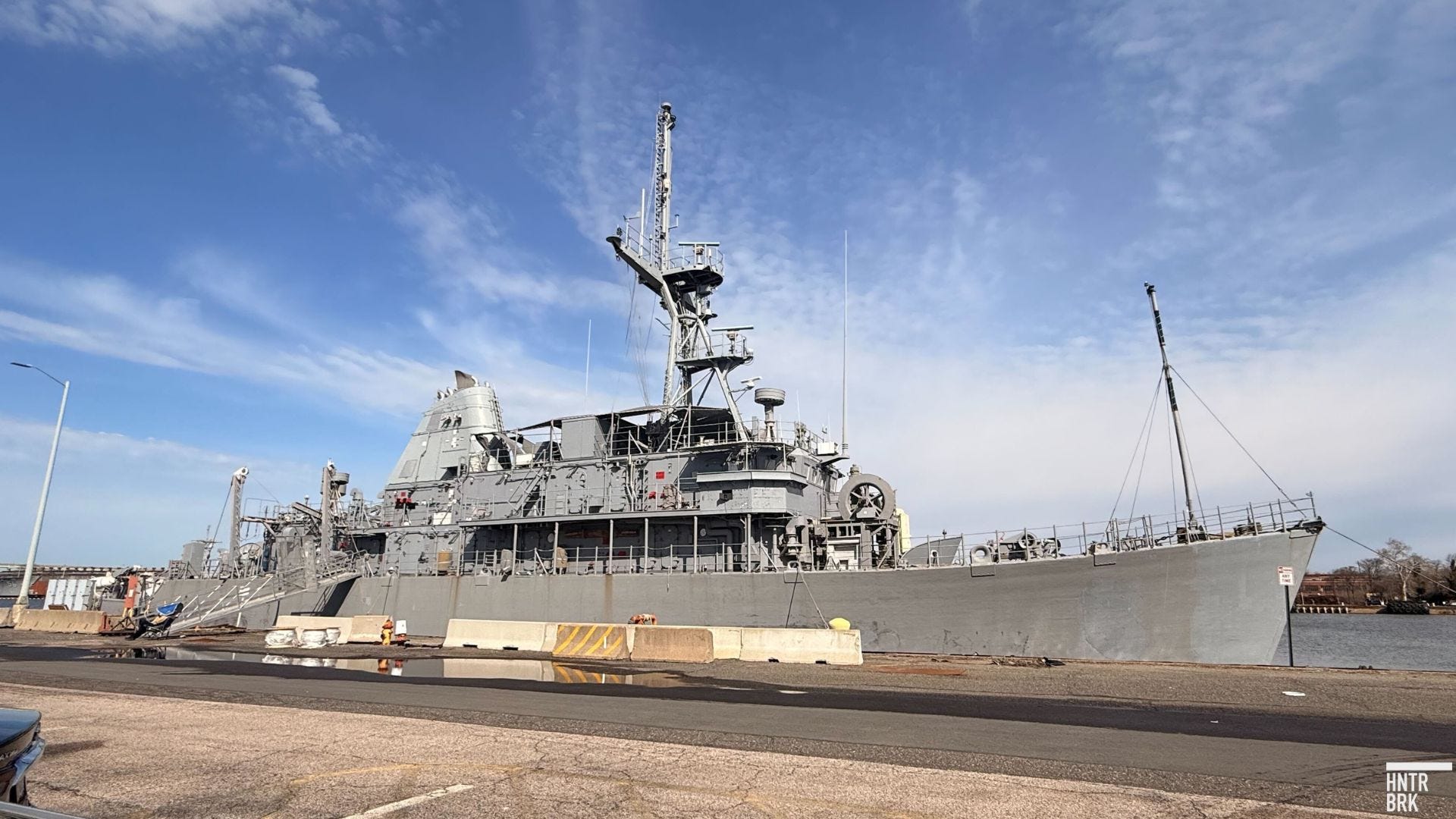
Meanwhile, Hunterbrook sent a source Philadelphia to check out the old minesweepers — where the only war they are proximal enough to intervene in now is the cheesesteak rivalry between Pat’s and Geno’s.
The Pentagon declined to comment.
Authors
Blake Spendley joined Hunterbrook from the Center for Naval Analyses (CNA), where he led investigations as a Research Specialist for the Marine Corps and US Navy. He built and owns the leading open-source intelligence (OSINT) account on X/Twitter, called @OSINTTechnical (over 1 million followers), which also distributes Hunterbrook Media reporting. His OSINT research has been published in Bloomberg, the Wall Street Journal, and The Economist, among other top business outlets. He has a B.A. in Political Science from USC.
Carter Johnston is a second-year undergraduate student at George Washington University studying International Affairs and National Security. He is a freelance defense journalist covering the Air Force and Navy for The Air Current and Naval News since 2024.
Editor
Sam Koppelman is a New York Times best-selling author who has written books with former United States Attorney General Eric Holder and former United States Acting Solicitor General Neal Katyal. Sam has published in the New York Times, Washington Post, Boston Globe, Time Magazine, and other outlets — and occasionally volunteers on a fire speech for a good cause. He has a B.A. in Government from Harvard, where he was named a John Harvard Scholar and wrote op-eds like “Shut Down Harvard Football,” which he tells us were great for his social life.
Hunterbrook Media publishes investigative and global reporting — with no ads or paywalls. When articles do not include Material Non-Public Information (MNPI), or “insider info,” they may be provided to our affiliate Hunterbrook Capital, an investment firm which may take financial positions based on our reporting. Subscribe here. Learn more here.
Please contact ideas@hntrbrk.com to share ideas, talent@hntrbrk.com for work opportunities, and press@hntrbrk.com for media inquiries.
LEGAL DISCLAIMER
© 2026 by Hunterbrook Media LLC. When using this website, you acknowledge and accept that such usage is solely at your own discretion and risk. Hunterbrook Media LLC, along with any associated entities, shall not be held responsible for any direct or indirect damages resulting from the use of information provided in any Hunterbrook publications. It is crucial for you to conduct your own research and seek advice from qualified financial, legal, and tax professionals before making any investment decisions based on information obtained from Hunterbrook Media LLC. The content provided by Hunterbrook Media LLC does not constitute an offer to sell, nor a solicitation of an offer to purchase any securities. Furthermore, no securities shall be offered or sold in any jurisdiction where such activities would be contrary to the local securities laws.
Hunterbrook Media LLC is not a registered investment advisor in the United States or any other jurisdiction. We strive to ensure the accuracy and reliability of the information provided, drawing on sources believed to be trustworthy. Nevertheless, this information is provided “as is” without any guarantee of accuracy, timeliness, completeness, or usefulness for any particular purpose. Hunterbrook Media LLC does not guarantee the results obtained from the use of this information. All information presented are opinions based on our analyses and are subject to change without notice, and there is no commitment from Hunterbrook Media LLC to revise or update any information or opinions contained in any report or publication contained on this website. The above content, including all information and opinions presented, is intended solely for educational and information purposes only. Hunterbrook Media LLC authorizes the redistribution of these materials, in whole or in part, provided that such redistribution is for non-commercial, informational purposes only. Redistribution must include this notice and must not alter the materials. Any commercial use, alteration, or other forms of misuse of these materials are strictly prohibited without the express written approval of Hunterbrook Media LLC. Unauthorized use, alteration, or misuse of these materials may result in legal action to enforce our rights, including but not limited to seeking injunctive relief, damages, and any other remedies available under the law.