


Based on Hunterbrook Media’s reporting, at the time of publication Hunterbrook Capital is short $BE and long a basket of comparable securities. Positions may change at any time. This article is not investment advice or any recommendation. See full disclosures on our website.
By: Dhruv Patel
Editor: Vikas Kumar
Hunterbrook compiled a record of Bloom's fuel cell performance from public data spanning 15 years: government datasets across the U.S. (New York, Delaware, California) and South Korea, as well as self-reported federal filings covering 126 plants in nine U.S. states.
Across the datasets, the fuel cells’ measured efficiency appears to fall below Bloom’s disclosed benchmarks before the five-year replacement interval the company claims. In New York, Hunterbrook calculated that all 37 systems fell below Bloom’s efficiency benchmark at a median of 20 months, with only one declining slowly enough to be on pace to stay above it for five years. In California, 105 of the 231 projects with usable fuel data recorded at least one month below the level at which a 2025 contract requires Bloom to repair or replace the system. And even on cumulative lifetime efficiency, the measure Bloom most typically uses, 44 of the 126 plants in the federal record fall below the guarantee line.
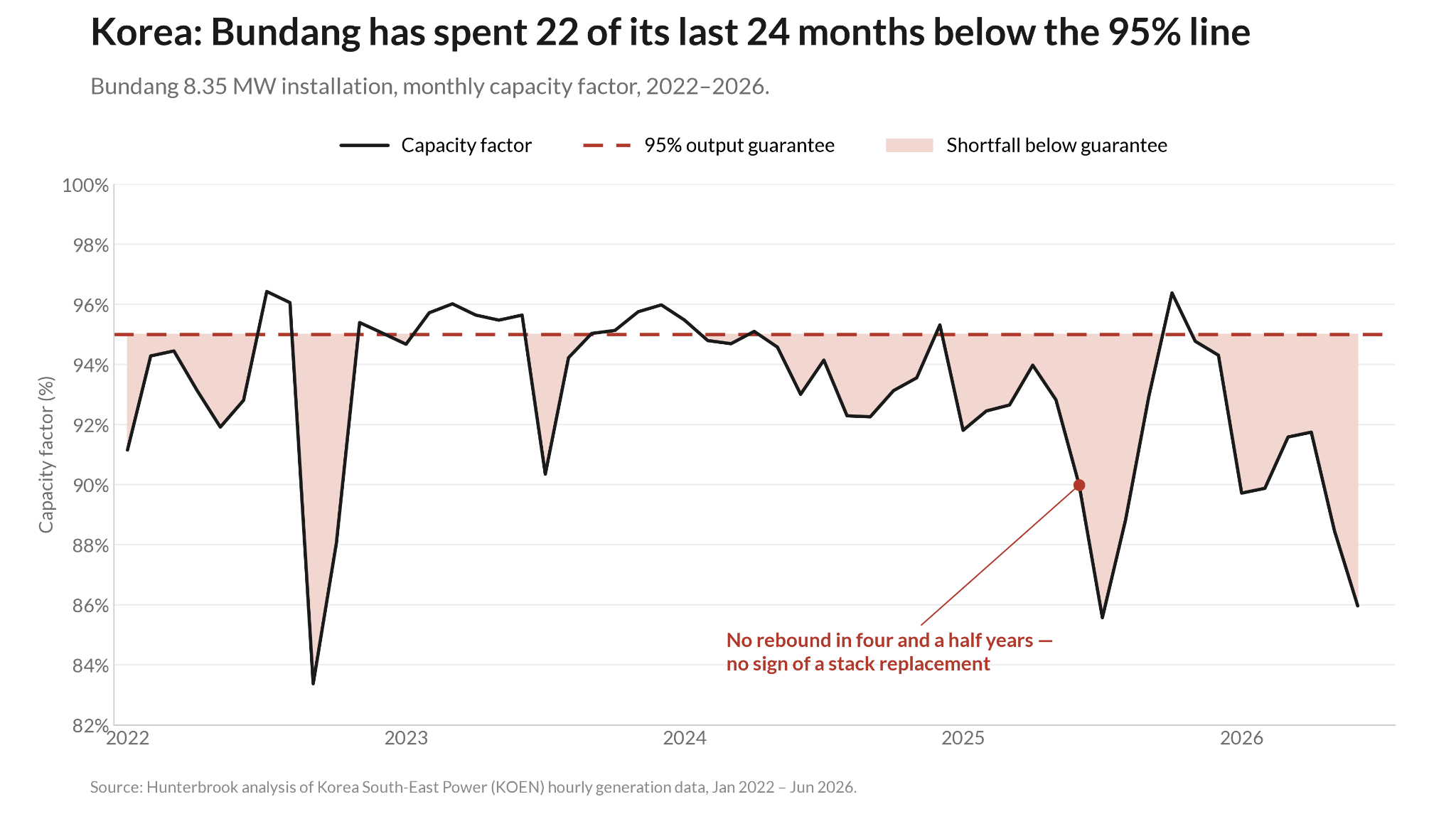
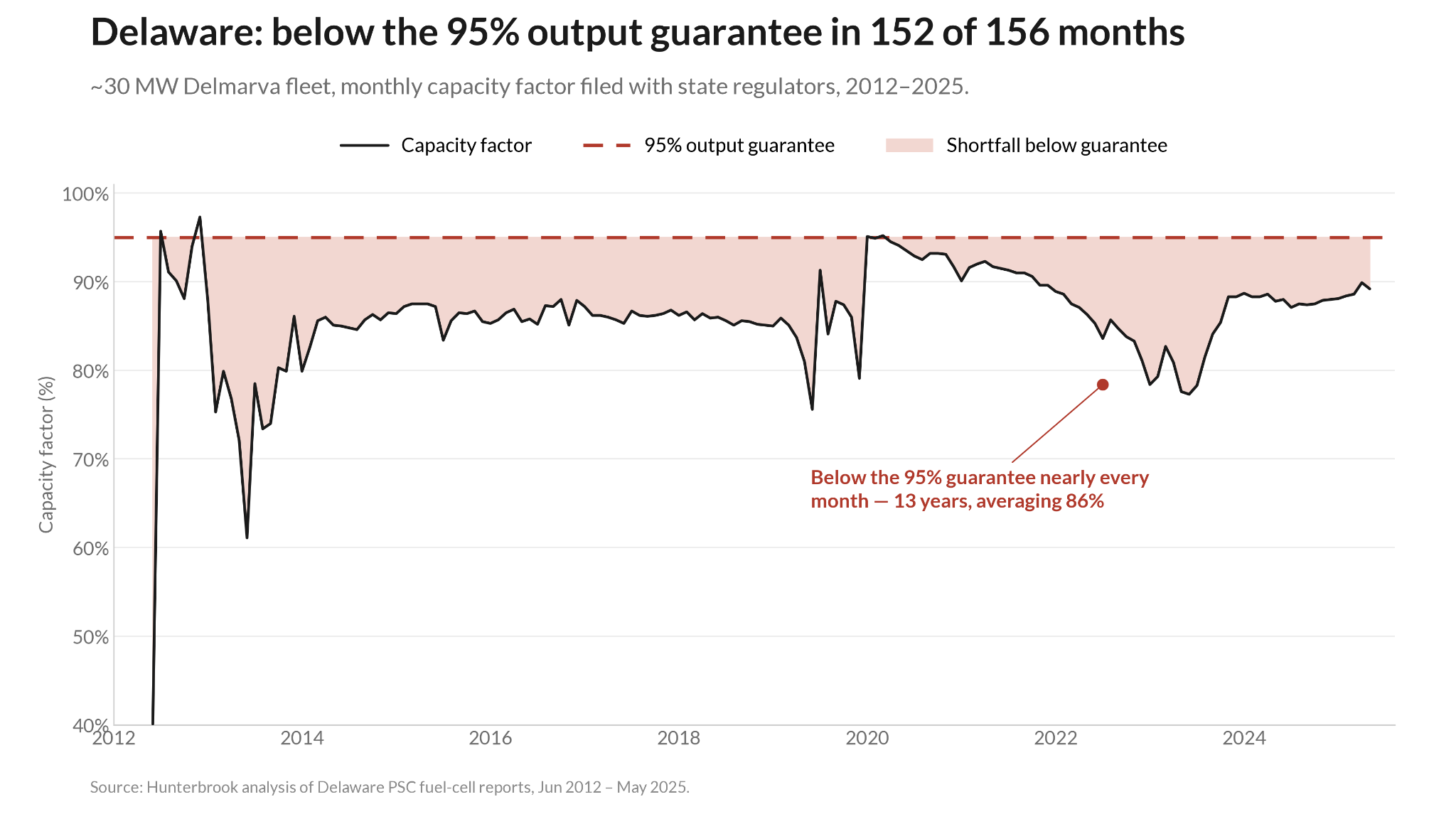
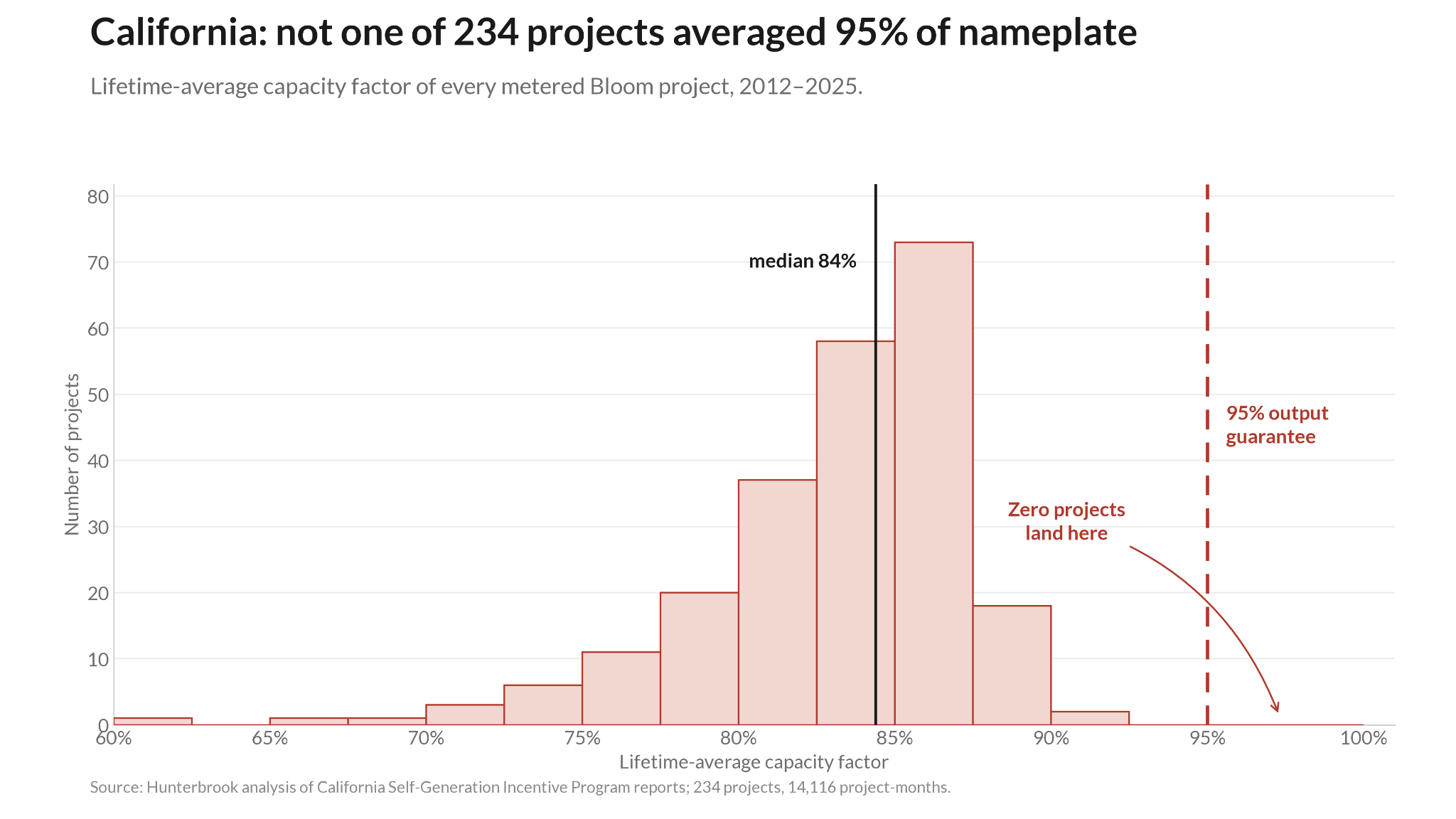
Bloom’s 95% output benchmark — a measure of how much electricity the cells actually produce against their rated capacity — was missed almost everywhere, almost always: 152 of 156 months in Delaware, 97.4% of months in California, and 22 of the last 24 months at one of Bloom’s largest continuously metered Korean plants.
The public data is reported daily or monthly, so Hunterbrook uses those intervals to track the timing and persistence of underperformance — not to determine any potential contractual breach, which may be assessed monthly, annually, or cumulatively depending on the contract.
A part-owner of a Bloom project in New York told Hunterbrook the company paid their group a multimillion-dollar contractual penalty after failing to meet one of its guarantees.
Some customers report adequate performance: One said Bloom “remains in compliance with our contract,” and a California operator called their project “fairly reliable,” but won’t buy more, citing price. Other customers said they no longer work with Bloom.
Hunterbrook’s findings directly implicate Bloom’s data center ambitions. Based on these numbers, fuel cells may be a less attractive alternative to grid power and gas turbines than they appear on paper: Given the consistently low efficiency and output numbers across Bloom’s projects, data center operators would likely have to use more gas and install more fuel cells (and replace them more frequently) than typically modeled to reach the desired capacity. It’s, perhaps, one explanation for why Bloom has only named several partners.
Bloom did not reply to Hunterbrook’s repeated requests for comment for this article. After Hunterbrook published its prior investigation, Bloom filed an 8-K form with the SEC as a rebuttal, claiming it “categorically rejects the Report’s claims regarding the Company’s financial results and accounting.”
It’s always been a good story: a box that turns gas into electricity through a chemical reaction, with no combustion required.
Since the early 2000s, that has been Bloom Energy’s ($BE) promise — and it’s one fit for the AI era as data center developers scramble to improve what they call “time to power.”
Earlier this year, Bloom briefly reached a market cap of about $100 billion, with the stock up roughly 1,000% over the preceding 12 months. This came as Bloom announced splashy deals with partners like Oracle, which agreed to purchase up to 2.45 gigawatts of fuel cells for its flagship site in New Mexico.
This month, Hunterbrook reported cracks in Bloom’s story, including the company’s sourcing of a key rare earth ingredient, scandium, from China, a practice the company has repeatedly and publicly denied. Hunterbrook also detailed delays across Bloom’s biggest planned projects, at least one of which has wobbled further in recent weeks.
But beyond those headwinds lies a more elemental question, which Hunterbrook has investigated through state regulatory filings, foreign generation data, and interviews with Bloom customers and former employees.
Do the fuel cells actually work as advertised?
The answer appears to be no — at least according to the data.
That could present a big problem for Bloom’s data center ambitions.
None of the Bloom deployments in the public record approaches gigawatt data center scale; the largest sites Bloom has disclosed anywhere are a pair of 40-megawatt plants in South Korea.
The AI commitments are of a different order: Oracle’s Project Jupiter arrangement alone is 10 times the size of Bloom’s entire metered U.S. fleet.
On Tuesday’s earnings call, CEO KR Sridhar listed “reliability without overbuild” among the capabilities that other commercial vendors cannot provide. The public record Hunterbrook analyzed points the other way: Across the metered fleet, Bloom’s fuel cells have typically delivered 80 to 90% of rated output, below the 95% number Bloom has cited in the past as its typical benchmark. This means a data center operator would need to install more units and replace their stacks more often than Bloom’s previous disclosures might suggest.
If the company’s existing deployments have had problems, what does that mean for data centers requiring an order of magnitude more power, at facilities where a missed output guarantee doesn’t mean a contractual penalty but, absent costly backup, downtime for the most expensive computers on earth?
It’s a question that comes at an interesting time for Bloom. One of its largest known shareholders earlier this year was the hedge fund Situational Awareness, led by Leopold Aschenbrenner. Today, the Financial Times reported that the fund has been sold to Citadel amid a rout in its AI positions.
The Promise
On the earnings call, Sridhar said the company “kept the promise that we make to our customers. Bloom will not be your bottleneck. We will deliver power at AI speed and enable our customers to grow.” The metered record suggests that the risk isn’t whether Bloom can ship its boxes to customers quickly, but rather how those boxes perform once they are running.
While each Bloom contract is individually negotiated, the company has periodically provided windows into the typical levels of efficiency, output, and durability it promises its customers. The benchmarks we use for our analysis are derived from those disclosures, found in a 2018 filing, a 2019 technical note, a 2021 SEC filing, and a 2025 purchase order from Fresno County, CA. The key metrics:
Efficiency guarantee: 46.9%. Efficiency measures the percentage of the energy in the gas fed to the box that comes out as electricity, and directly feeds into a customer’s fuel bill per kilowatt-hour. The most recent publicly available Bloom purchase order Hunterbrook identified, signed with Fresno County, CA, in 2025, guarantees that number will be at least the equivalent of 48.8%.1 According to that contract, if, at the end of each calendar year, the system’s cumulative efficiency is below that number, Bloom must pay liquidated damages. Earlier filings disclosed that its contracts typically set the efficiency benchmark at the equivalent of 46.9%, and to be conservative our analysis tests the fleet against that older, lower number. We call this benchmark the “guarantee line” throughout this article.
Replacement floor: 45.2%. The Fresno agreement separately requires that if cumulative efficiency, measured at the end of each calendar year, drops below this benchmark, Bloom must repair or replace the system within 90 days. We call this the “replacement floor.”
Output guarantee: 95%. Each installed Bloom system has a rated maximum output, known as its “nameplate capacity.” The company has disclosed that it typically guarantees the system will deliver 95% of that rating, measured annually.
Time between fuel cell component replacement: ~5 years. Bloom’s 2018 IPO prospectus told investors that in the early years, the period between stack replacements “was typically 12 to 18 months,” but that “from 2017 onwards we expect to average over five years between replacements.” When Hindenburg Research challenged that math in September 2019, Bloom responded that its latest-generation fuel cells shipped from 2016 to 2018 “have an average life of 4.8 to 5.2 years,” and published a technical note claiming median time to replacement had improved from 1.9 years for its 2011 vintage to 4.7 years for its 2015 vintage.
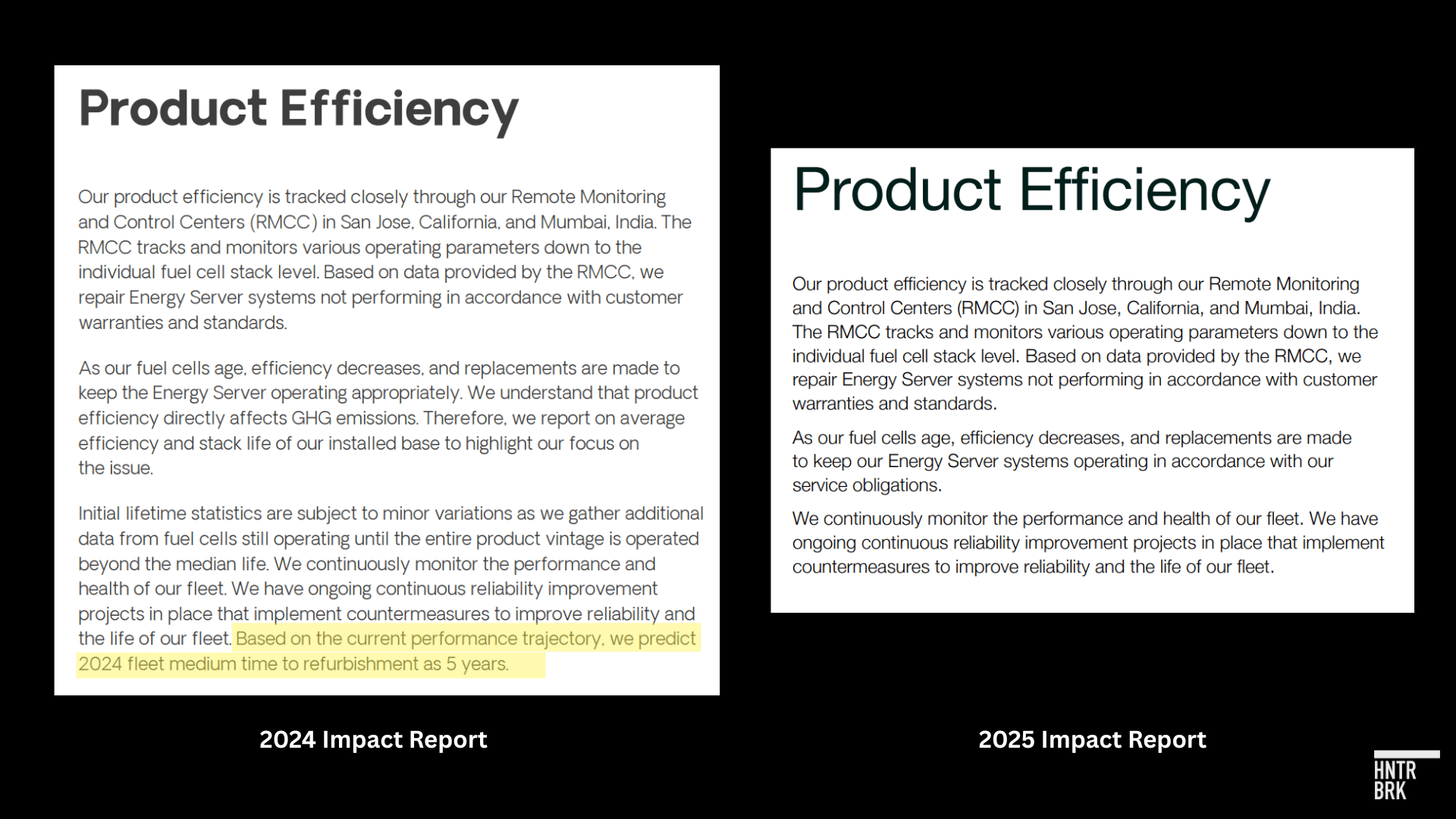
Since 2021, Bloom’s regular SEC filings have stopped reporting the specific output and efficiency levels its contracts guarantee, so these sources represent the best publicly available record of what Bloom is promising its customers.2 Notably, between its 2024 and 2025 Impact Reports, Bloom made its language regarding the life of its fuel cells more conservative. In 2024, the company said: “We predict 2024 fleet medium time to refurbishment as 5 years.” In 2025, the company deleted that language, saying only: “As our fuel cells age, efficiency decreases, and replacements are made.”
And Bloom’s real-world performance can be tracked and compared to these benchmarks via the fleet the company has already deployed: at Home Depots and hospitals, malls and utility substations, in New York, Delaware, California, and South Korea, and as supplemental power for a handful of Equinix’s legacy data centers.
Much of that fleet happens to be metered by governments and state-owned utilities, so the numbers are public.
Hunterbrook compiled five of those public datasets:
South Korea: Hourly output from Korea South-East Power’s 8.35-megawatt Bundang Phase 6 plant, commissioned in April 2019, covering January 2022 through June 2026; plus monthly output and efficiency data from Korea Southern Power’s Yeongwol plant and Korea East-West Power’s Honam and Bukpyeong plants. Hunterbrook calculated Yeongwol’s efficiency from reported generation and gas consumption; Honam and Bukpyeong’s efficiency figures were calculated and published by the utilities. A separate daily Korea East-West Power file extends the Bukpyeong record through mid-2025.
New York: Daily NYSERDA meter readings from September 2014 through December 2025, covering efficiency and output for 37 Bloom systems.3
Delaware: Monthly filings with the Delaware Public Service Commission from June 2012 through May 2025 — 156 consecutive months — including efficiency and output data for the roughly 30-megawatt Bloom fleet serving Delmarva Power. This fleet was updated with newer models in 2019.
California: Monthly Self-Generation Incentive Program reports from December 2012 through October 2023 (a handful of later biogas projects extend into 2025), containing efficiency and output data for 234 Bloom projects and roughly 14,100 project-months.
United States, National: Monthly net-generation and gas consumption data reported to the U.S. Energy Information Administration from 2011 through December 2025, covering 126 installations Hunterbrook verified as Bloom installations.
To be clear: as we said above, a meter reading below one of Bloom’s guarantee lines on a given day or month does not necessarily imply a contractual breach. We do not know the specifics of the guarantees in each Bloom contract. And the company has disclosed warranties measured monthly or quarterly, as well as performance guaranties measured annually or cumulatively. Hunterbrook uses the daily and monthly readings to track when performance declines and how long it remains below Bloom’s disclosed levels — not to determine whether every individual reading breached a particular contract.4
Measured on the cumulative efficiency metric Bloom typically uses, most systems remain above the guarantee line, though 44 of the 126 Bloom systems in the federal record fall below the guarantee level even on that measure.
But cumulative efficiency can hide the repairs and replacements required to keep that average afloat. A fresh stack would lift current performance while the system’s stronger early years stay baked into the lifetime calculation. So a passing average can conceal hardware wearing out far faster than Bloom says it should.
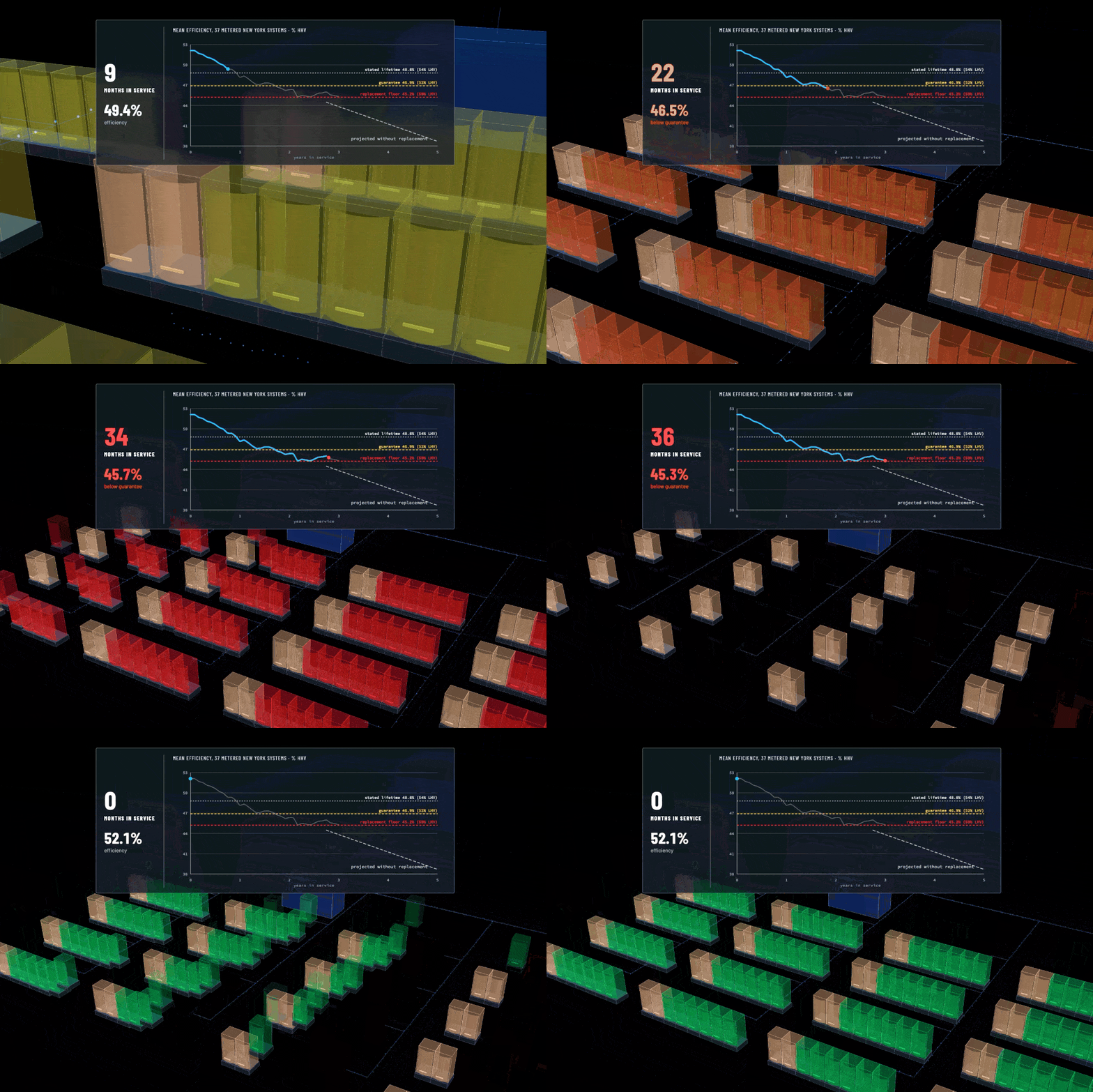
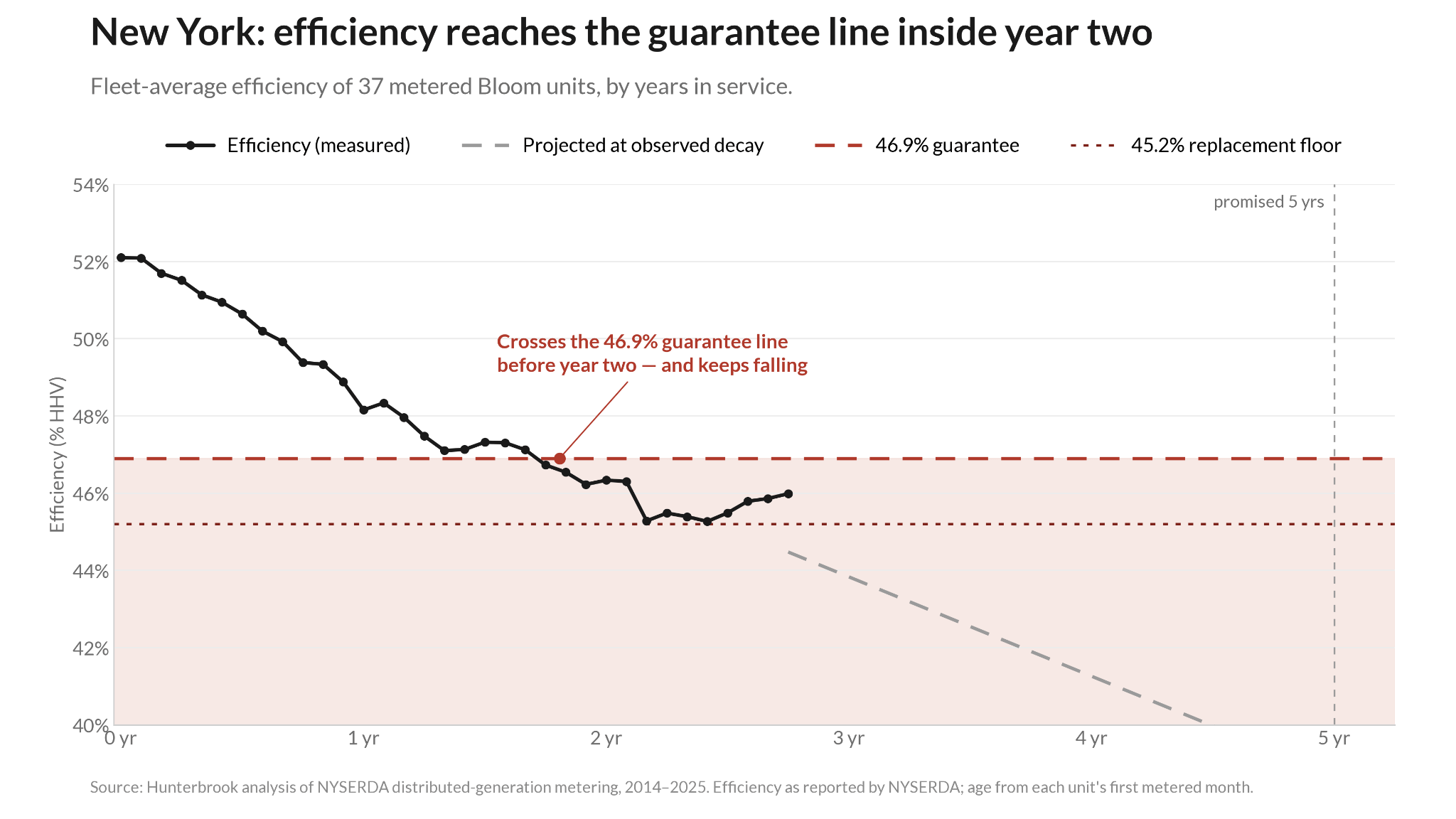
Taken together, the monthly meters show what the cumulative numbers obscure: Efficiency falls to Bloom’s guarantee line within roughly two years, then flattens or rebounds in patterns consistent with repair or replacement. The lifetime average may still pass, but the hardware appears to be wearing out years before Bloom’s claimed five-year replacement interval, which could pose a serious risk to the unit economics of the company’s servicing business.
South Korea
South Korea is Bloom’s largest market outside the United States, using about 682 megawatts installed, or roughly 45% of the company’s ~1.5-gigawatt global fleet. Nearly all of it is installed at sites through Bloom’s partnership with SK ecoplant. Four of those installations are metered by Korean state power companies, and the readings are public.
One is the 8.35-megawatt Phase 6 expansion at the Bundang plant, operated by Korea South-East Power and commissioned in April 2019. The public hourly data Hunterbrook analyzed, the earliest available, begins in January 2022 and runs through June 2026.5
Bundang averaged about 95% of rated output in 2023 and has slipped every year since — to about 92% in 2025, the most recent full year, and roughly 90% in the first half of 2026. Its output shows no sustained recovery, running below Bloom’s typical 95% output benchmark in 22 of its last 24 months.
Three more plants, run by Korea Southern Power and Korea East-West Power, publish enough data to track efficiency. Yeongwol reports gas consumption, allowing Hunterbrook to calculate its efficiency directly; for Honam and Bukpyeong, Hunterbrook relied on efficiency figures calculated and published by the utilities.
Yeongwol (15 MW, online 2021): efficiency fell from about 51% to 46% in three years; output from about 95% of nameplate capacity to 77%.
Honam (15 MW, online 2021): efficiency fell from about 51% to 46% by late 2024; output from near 100% to 78%.
Bukpyeong (4.2 MW, online 2022): efficiency fell from about 58% to 52%, while output slipped from above nameplate to ~93% in 2024, down to ~80% by mid-2025.
Another question mark hangs over Korea. SK ecoplant, a longtime strategic partner of Bloom, with a 500 MW purchase commitment Bloom valued at $4.5 billion in product and service revenue, was determined by Korean regulators to have overstated the 2022-2023 revenues of its U.S. fuel cell subsidiary, the unit that handles its Bloom business, allegedly to inflate its valuation ahead of a planned IPO.
Regulators initially deemed the violation intentional and recommended criminal prosecution before downgrading it to “gross negligence.” The IPO never happened: This spring, SK Group bought out its pre-IPO investors for roughly 1.05 trillion won (about $770 million) rather than take the company public by its July 2026 deadline.
As Hunterbrook reported in its first investigation into Bloom, months after Bloom’s relationship with SK ecoplant ended, Bloom began a new related-party partnership with Brookfield Asset Management ($BAM).
New York
New York’s data covers 37 Bloom installations. Among them: Home Depot stores, Queens Center Mall, Morgan Stanley’s Purchase campus, Fordham University, an IKEA in Red Hook, an Equinix data center, and a roughly 7.9-megawatt community fuel cell portfolio on Staten Island. The state meters the installations daily and posts the readings.
Straight out of the box, the 37 installations averaged 52.0%6 efficiency, about five points clear of the guarantee line. They did not stay there long. Losing an average of 2.4 percentage points a year7, every one of the 37 fell below the guarantee line at a median of 20 months, inside its second year of service. And 32 were still below it when their state-reported data ended.
Twenty-eight of the 37 decayed all the way to the replacement floor (the level at which Bloom’s contract with Fresno obliges it to repair or replace the hardware), and 13 finished below even that. Based on each installation’s measured rate of decline, the median projected time to reach that floor was under three years. Only one of the 37 was on pace to last the “over five years” that Bloom tells investors its stacks now run between replacements.
Output is no better. Only seven of the 37 units cleared 95% of rated output even in their first year; every one fell short on a cumulative average. Across the fleet, output slid from roughly 90% of nameplate in year one to about 80% by the final year of data.
One caveat: the metered New York fleet skews toward Bloom’s older ES-5-generation hardware. Twenty-six of the 37 units were installed in 2017-2018, and NYSERDA meters each unit for only about three years — so most of these records both begin and end in the ES-5 era, roughly 2017 to 2021. A newer batch installed in 2020 (Fordham, Equinix, the Red Hook IKEA, and the Annadale portfolio) runs through 2023, and one 2023 installation (Cablevision) runs through December 2025.
Bloom has a common response to numbers like these. After Hindenburg’s report drew on the same NYSERDA portal, the company filed a technical note arguing the state’s data was misleading: metering can begin 15 to 538 days after a unit switches on, missing the high-efficiency first weeks; a handful of sites carry gas boosters or backup batteries that shave a point or two; and the right yardstick, Bloom said, is cumulative efficiency, not a unit’s efficiency on any given day.
Grant the company all of it. Add back a half-percentage point for metering losses, three percentage points for ancillary equipment at the five community and resiliency sites that might have it, and even the full 538-day head start to every unit’s clock, and 30 of the 37 still fall below the guarantee line within about four years. That’s inside the five-year life Bloom promises between replacements.8
Delaware
Delaware is one of Bloom’s manufacturing homes and the site of its highest-profile early deployment: a roughly 30-megawatt fleet serving Delmarva Power under a state tariff. The project’s performance has been reported monthly to regulators since 2012. Importantly, Bloom replaced older-generation fuel cells with newer ones at this site in 2019, so any improvements in the technology available at that time would presumably be present in this data.
Hunterbrook compiled all 156 monthly observations. The initial 3-megawatt phase opened at roughly 52% efficiency in the summer of 2012. After the project reached its full 30-megawatt capacity in November 2013, efficiency fell below the guarantee line by August 2014 and through the replacement floor by November 2014, within a year of full buildout. From June 2015 through May 2019, annual weighted efficiency remained around 44%.
In 2019, Bloom repowered the project, doing away with the original 30 megawatts of Energy Servers and installing 27.5 megawatts of newer-generation equipment. Efficiency jumped straight back to about 52%. But the replacement stacks did exactly what the originals had done: declined, on a similar path, sliding back to about 47%, approximately the guarantee line, by 2023, before a partial rebound to roughly 49% by May 2025. That rebound could, of course, reflect maintenance or component replacements. Across the full record, the fleet’s monthly efficiency was below the guarantee line in 67 of its 156 months, and below the replacement floor in 52.
Output tells the same story. Measured against the fleet’s nameplate capacity in force each month (30 MW through early 2019, then 27.5 MW after the 2019 replacement), the fleet fell below Bloom’s typical 95% output guarantee in 152 of 156 months, averaging about 86%, and never once clearing 95% on a full-year average either. The 2019 replacement made no lasting difference: once the full fleet was online, it cleared the 95% guarantee just twice, both immediately after the 2019 repower, and never once in the time it was running at the full 30 MW nameplate capacity. (The only other two months above 95% came in 2012, when just 3-6 MW of the eventual fleet was installed.)
California
California is where Bloom was born, where Hindenburg found much of its 2019 evidence, and where the largest public sample of Bloom fuel cells lives. The state’s Self-Generation Incentive Program, which provided hundreds of millions of dollars in incentives to Bloom projects, requires five years of metered monthly reporting from every project it pays.
Hunterbrook analyzed 234 Bloom fuel-cell projects totaling about 92 megawatts: 14,116 project-months of data from December 2012 through October 2023 (a handful of later biogas projects extend into 2025), with the median project metered for five years — exactly the period needed to test Bloom’s five-year lifespan claim.
Almost none of that record meets the typical benchmarks. Bloom’s California project-months came in below the 95% output guarantee 97.4% of the time and below 90% in three months out of four. After excluding 20 physically impossible monthly readings above 110% capacity factor9, not one of the 234 projects averaged 95% of nameplate over its monitored life; only two cleared even 90%. The median project delivered about 84%.
The efficiency record in California largely tracks what we saw in New York.
Bloom’s projects began at a median 55.6% efficiency across their first three reported months. Median efficiency fell to 50.3% in year two, then to 49.2%, 48.5%, and 47.9% in years three through five. Of the 231 projects with usable fuel-consumption data, 105 recorded at least one month below Bloom’s 45.2% repair-or-replace threshold.
After the first year drop, the decline slows. That flattening is consistent with Bloom periodically repairing or replacing lower-performing power modules as they approach contractual thresholds, preventing the fleet average from falling much further, though the SGIP data do not identify individual replacement events.
This is the same dataset Hindenburg used in 2019, when it calculated that Bloom’s post-2016 California units were on pace to need stack replacement in under three years. That was a projection: those units had a median of 32 months on the meter at the time. The record has since added 3,450 project-months, and the answer has not changed.
America: The National Data
The U.S. Energy Information Administration collects generator characteristics annually through Form EIA-860 and publishes monthly or annual plant-level generation and fuel-consumption data through Form EIA-923, federal filings used to track power plants across the country.
The EIA does not identify the manufacturer of fuel cells in its published generator inventory. Hunterbrook identified 167 fuel-cell plants with at least one megawatt of combined fuel cell nameplate capacity and positive generation in the EIA record, cross-referencing the Department of Energy’s stationary fuel-cell inventory, EIA operator records, and court, regulatory, and SEC filings.
Using this methodology, we were able to identify 126 as Bloom Energy (as well as 37 as FuelCell Energy, and four as part of the UTC Power and Doosan PureCell lineage). Those 126 Bloom plants total about 245 megawatts across nine states, operating from 2011 through 2025, and include installations in New Jersey, Connecticut, Massachusetts, Maryland, North Carolina, and Utah that the other datasets do not capture.10
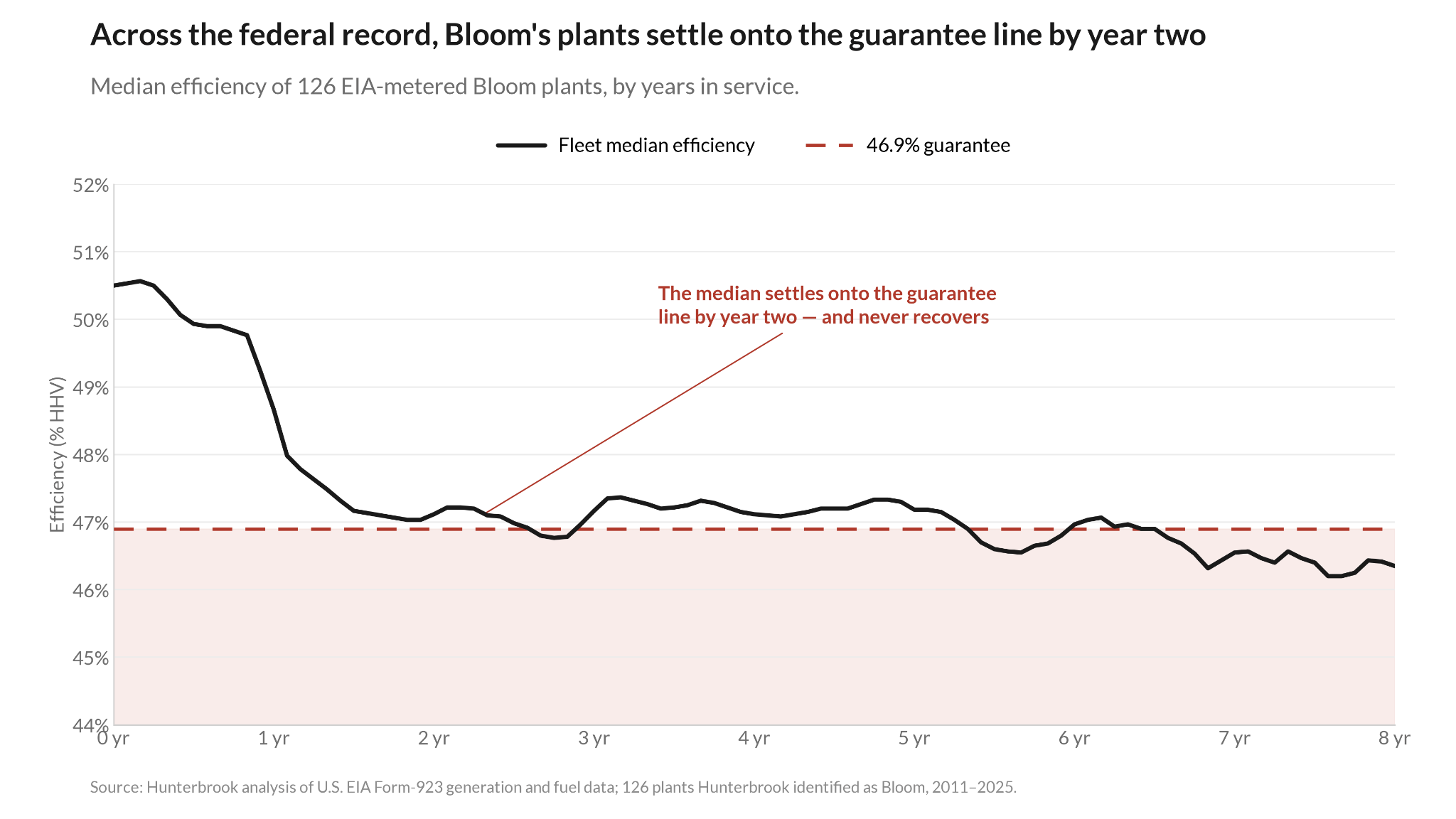
The national record tells the regional story again. When new, the fleet ran at about 51% efficiency. Within two years it fell to roughly 47%, barely over the guarantee line. As in California and Delaware, the way that steep first-year drop collapses into a slow crawl appears to be consistent with stacks being swapped as they hit the floor (though it’s hard to know for certain). Measured the way Bloom measures it (using a system’s cumulative, whole-life average), 44 of the 126 plants run below the guarantee line, and roughly 60% of the 126 never rise more than a point above it. And 110 of 111 reliably metered11 plants average below the 95% output Bloom typically guarantees.
Bloom’s showcase customers fare no better. Apple, whose Maiden, North Carolina, data center Bloom spent years promoting as a clean-energy landmark, performed worst on output: its three reliably metered sites ended at a median 42.9% efficiency and delivered a median 69% of rated output — before its flagship Maiden, North Carolina plant dropped off the federal record in 2021.
Equinix, Bloom’s marquee data-center customer before the AI era with 15 sites across the fleet, delivered a median 85% of nameplate across its nine reliably metered sites, while their median efficiency ended around Bloom’s guarantee line. AT&T, Kaiser, and Intel also fell below 95% on a customer-level median.
“Multimillion-Dollar Payment”
Hunterbrook also spoke to some of the customers who lived through the decay curve.
A part-owner of one of the larger Bloom installations in New York told Hunterbrook that their group signed a service contract after being shown an independent engineering report during the sales process. The source shared this report with Hunterbrook.
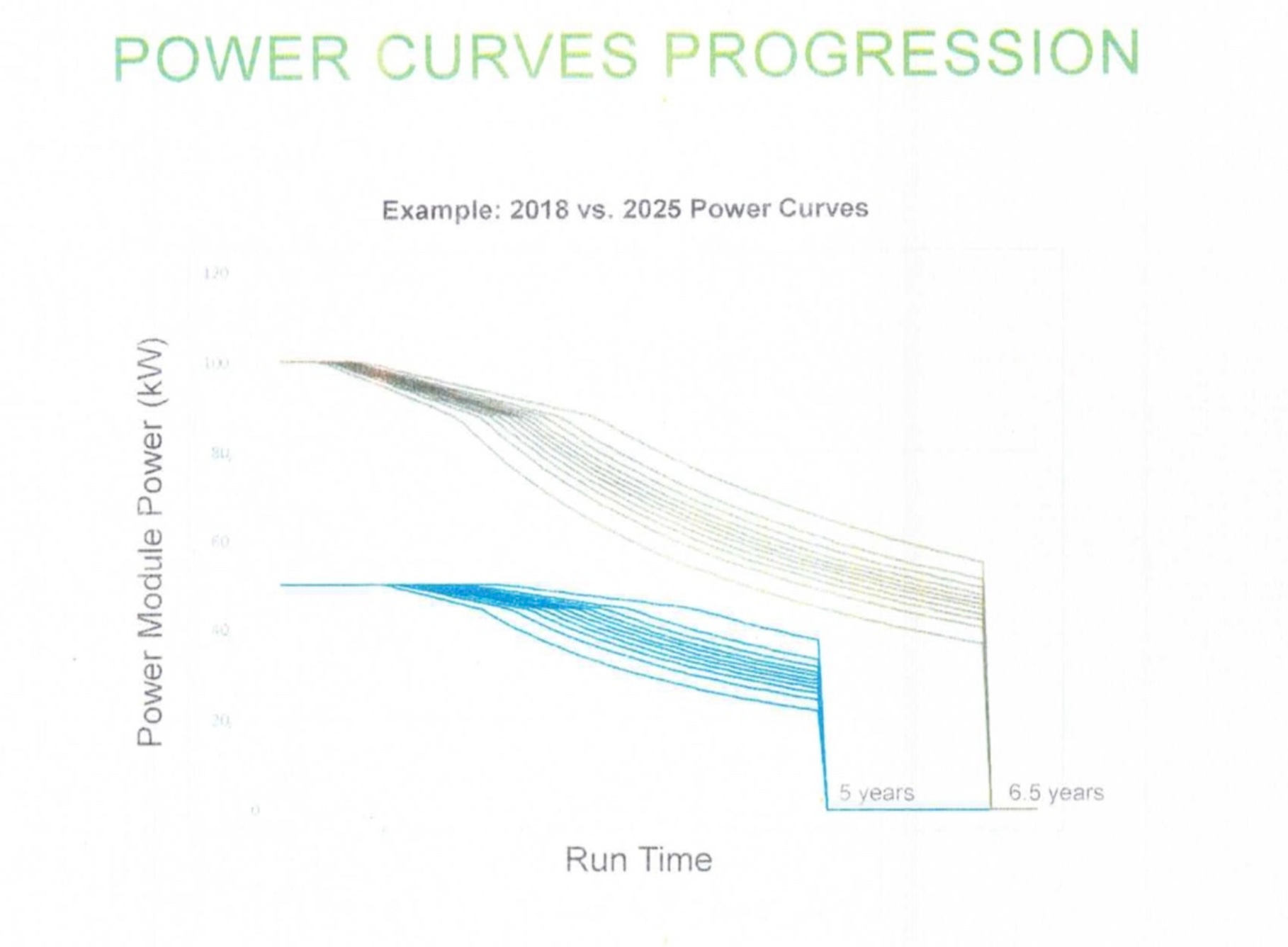
The source said Bloom’s sales team also promised that the fuel cells would perform at 95% output, with a life expectancy beyond five years.
That turned out to be wildly optimistic, according to the source. “They have never been able to get beyond that time frame ... they have failures a lot quicker than that.”
“Based on the contract, Bloom paid a multimillion-dollar payment to us,” the source said, because the fuel cells allegedly operated “below 95%.” The source did not provide evidence of this payment.
“The 95% is gone,” the source said. “Long gone.”
LSB Industries and NineDot Energy separately told Hunterbrook that they no longer work with Bloom.
What Bloom Gets Right — And What It Doesn’t
Bloom has repeatedly pointed to returning customers as evidence that its fuel cells work. In February, CEO KR Sridhar said more than two-thirds of the company’s business came from repeat customers. In April, he put the figure at 70% to 80% of its business. During the company’s earnings call on Tuesday, he described the measure more specifically, saying roughly 80% of orders came from repeat customers.
“That speaks more loudly than anything else about how happy our customers are,” he said, days after Hunterbrook had reached out to the company for comment.
“We do not obsess on the competition,” he said. “We obsess on the customer.”
But Bloom has not identified many of the customers behind those figures. And on Tuesday’s call, CFO Simon Edwards acknowledged the ambiguity, stating, “When you see the word customer in our filings, it can mean either party, the financier that buys from us and appears in our revenue and concentration disclosures or the end customer whose demand created the deal.” Its SEC filings disclose the concentration of revenue among its largest customers without naming most of them.
To the company’s credit, the public record is not all bleak — and the data shows the potential for real generational improvement. In the New York data, 2014-2018 systems averaged roughly 83% of rated output over their lives and the newest monitored project — a 2023 Cablevision installation — has run about 94% over its life, still hitting 97% to 99% at the end of its data.
One Bloom customer told Hunterbrook that Bloom “remains in compliance with our contract” and that it continues to save money. A California dairy-digester operator said their three Bloom projects have been “fairly reliable,” running “right around the contracted minimum” — though their company will not buy more, citing price, and now prefers competitor Mainspring’s linear generators.
But improvement is not the same as delivering the expected number. Even the improved units often miss the typical 95% guarantee on lifetime average; the two largest 2020-vintage projects in the New York data ran near 80%. And Delaware — the one dataset long enough to watch Bloom’s replacement hardware age — shows the newer stacks decaying on the same slope as the old.
That distinction has potential financial consequences. Every fuel cell Bloom ships is also a service liability. On Tuesday’s earnings call, Edwards attributed the company’s 22% service margin to “fleet performance, longer stack life and scale.” He added, “We believe we will sustain them there over the long term.” How Bloom accounts for these things makes the claim testable. Edwards explained on the call that service revenue “is recognized ratably net of guarantees while the service costs are booked as incurred….” Edwards also stated that “stack replacement in particular moves the margin quarter to quarter.”
In other words, every stack that wears out early lands directly on the margin line Edwards discussed.
Meanwhile, Bloom’s current accrued warranty liability rose from $20.0 million at Dec. 31, 2025, to $77.8 million at June 30, 2026, according to the company’s most recent quarterly filing, which attributed higher performance-guarantee costs to “the effects of fleet degradation.”
If stacks last more than five years, Bloom’s 10-, 15-, and 20-year service contracts can be profitable. If stacks last roughly two years in the field — as, for example, the New York median implies — then every gigawatt of AI bookings is also a gigawatt of stack replacements arriving twice as often as its stated five-year stack life implies.
That also magnifies Bloom’s scandium problem. Scandium is embedded in the fuel-cell stacks, so the faster those stacks wear out, the more scandium Bloom must source over the life of each installation.
Asked on Tuesday’s earnings call how much scandium Bloom uses and how much supply it has available, Sridhar insisted that the company could support 25 gigawatts of deployments and was not dependent on China, without addressing Hunterbrook’s reporting that Bloom has sourced the material from China despite repeatedly denying it.
Then he shut down the exchange: “Everything else is proprietary to the company. Next question.”
Our next question: Whether the product at the center of Bloom’s $50 billion valuation can actually deliver as promised.
This piece represents Hunterbrook Media’s best estimate. As always, we have laid out both what we know and how we know it. That doesn’t mean we didn’t miss something. We welcome other analyses and estimates, including from Bloom. Write to us with any math of your own at ideas@hntrbrk.com.
Author
Dhruv Patel is an investigative journalist based in Cambridge, Massachusetts, specializing in data-driven reporting. He helps spearhead investigative coverage at The Harvard Crimson, and his reporting has been cited and discussed by The New York Times, CNN, The Boston Globe, ABC News, and BBC, where he also frequently contributes commentary. A John Harvard Scholar at Harvard College, he studies computer science and economics to leverage machine learning for accountability journalism.
Editor
Vikas Kumar joined Hunterbrook from The Capitol Forum, where he led the corporate investigations team for a decade as a senior editor. He was previously an attorney at Gordon Feinblatt, a trial attorney for the Department of Justice, and a law clerk for a federal judge. He has a J.D. from University of Virginia School of Law and a bachelor’s from Emory University. Vikas is based in Maryland.
Sam Koppelman and Till Daldrup contributed reporting.
DISCLOSURES
© 2026 Hunterbrook Media LLC. All rights reserved. Use of this website is strictly governed by our Terms of Use. The content herein is furnished on an “AS IS” basis without any form of express or implied warranty. For information regarding our privacy practices, please refer to our Privacy Policy.
Hunterbrook Media LLC (”Hunterbrook Media”) is an investigative news organization. Hunterbrook Media is affiliated with Hunterbrook Capital LP (”Hunterbrook Capital”), an exempt reporting adviser with the U.S. Securities and Exchange Commission that serves as investment adviser to one or more investment funds. Hunterbrook Media and Hunterbrook Capital are legally separate entities under common control. Hunterbrook Capital’s investment activities are one source of funding for Hunterbrook Media’s journalistic operations. Hunterbrook Capital may hold long positions, short positions, positions through derivative instruments including options and swaps, or no position in any security covered or mentioned on this website. Consistent with applicable policies and procedures, Hunterbrook Capital may establish, modify, or close positions in covered securities before or after the publication of any Hunterbrook Media article. Following publication of any article, Hunterbrook Capital will continue transacting in covered securities for an indefinite period and may be long, short, or flat at any time thereafter, regardless of any position described at publication. Hunterbrook Media has no obligation to update any article or disclosure to reflect subsequent changes in Hunterbrook Capital’s positions.
Nothing on this website constitutes investment advice, a recommendation to buy, hold, or sell any security, or a solicitation to purchase or sell any securities. No securities shall be offered or sold in any jurisdiction where such activities would be contrary to applicable securities laws. Hunterbrook Media is not a registered investment adviser in the United States or any other jurisdiction. Nothing herein should be construed as investment advice or a recommendation of any kind. This information should not be relied upon as a substitute for independent research or professional financial, legal, or tax advice.
This website may feature forward-looking statements reflecting Hunterbrook Media’s current views. Such statements, identifiable by terms including but not limited to “anticipate,” “believe,” “estimate,” “expect,” “intend,” “may,” “plan,” “predict,” “should,” and “will,” are inherently speculative and subject to risks and uncertainties. Actual results or outcomes may substantially deviate from those projected. Hunterbrook Media expressly disclaims any obligation to update or revise any forward-looking statements, regardless of subsequent developments or new information.
The information presented is current as of the date indicated. No representation regarding the completeness or timeliness of this information is made. Some information is sourced from third parties and, while believed to be reliable, has not been independently verified, and its accuracy or completeness is not guaranteed. Hunterbrook Media is not affiliated with any sites linked to this website. Investment in securities and other financial instruments involves significant risk, including the potential loss of principal. Users are advised to conduct their own due diligence and consult professional advisors before engaging in any investment activity. Use of Hunterbrook Media’s content is entirely at the user’s risk. Users shall not use this site for any illegal or prohibited purposes and shall comply with all applicable local, state, national, and international laws and regulations.
Should any provision of these Terms of Use be adjudged invalid or unenforceable, the remaining provisions shall remain in full force and effect. Trademarks contained in links to third-party websites belong to their respective owners. Hunterbrook Media retains copyright on all text, content, graphics, and trademarks displayed on this site.
Bloom states its efficiency guarantees against the “lower heating value” of the gas — a measure that leaves out the energy lost as water vapor, which makes any efficiency percentage look a few points higher. The government performance data in this article all use the “higher heating value,” which counts the gas’s full energy content. To compare Bloom’s promise against the metered data, we restate its guarantees (54%, 52%, and 50%) on the meter’s higher-heating-value basis, and about 10% lower for gas, giving us 48.8%, 46.9%, and 45.2%. Each efficiency figure in this article is on that meter basis.
Bloom continues to disclose what it pays when systems underperform, including $18 million in 2025 and $8.4 million in the first quarter of 2026.
NYSERDA’s roster lists two more, both 5 MW at Apple’s Staten Island site, but their fuel data is unreliable: Nearly every gas reading is logged as a round multiple of 1,000, and the efficiency it implies swings erratically between about 45% and 65% month to month — at times above what even Bloom’s newest cells can reach. We therefore use the independent federal records for these two instead.
Bloom has disclosed several measurement periods, sometimes within the same program or contract. In a 2018 quarterly filing, the company said its traditional lease program typically measured both its Output Warranty and Efficiency Warranty monthly, while separately measuring its 95% Output Guarantee annually and its 52% Efficiency Guarantee cumulatively. A purchase, use, and maintenance agreement dated in 2016 and amended in 2017 likewise required Bloom to assess each facility against a 45% minimum efficiency level after every full calendar month.
KOEN’s public hourly feed only reaches back to January 2022, so the record begins in the plant’s third year, meaning the ~95% seen in 2022–23 is already a partly degraded figure, not new-stack performance
Efficiency here is NYSERDA’s published Electric Efficiency (% HHV), which divides electricity generated (× 3,412 Btu/kWh) by fuel input valued at NYSERDA’s stated higher heating value of 1,032 Btu/cf for gas (per the DER portal glossary). Recomputing with a generic 1,000 Btu/cf assumption inflates efficiency by ~3% (≈1.5 points) — e.g., ~53.5% rather than 52.0% when new. All efficiency figures use NYSERDA’s 1,032 Btu/cf HHV basis, consistent with the portal’s own reporting.
We exclude four physically impossible monthly readings — one unit’s first month, metered before its gas meter was live (implying ~239% efficiency), and three months at another where an apparent faulty fuel meter implied 64% to 90%.
Bloom writes that gas-pressure booster blowers reduce efficiency “by approximately 2%” and resiliency batteries “by about 1%,” and that such equipment is “present in less than 5% of Bloom Energy Servers.” We cannot identify from the NYSERDA data which units carry it, so we apply the full 3-point deduction to the five installations most likely to — the four Annadale community fuel cells and Cablevision — and leave it off the rest.
Even with all 20 left in, the median project’s lifetime output barely moves (84.4% to 84.5%), and the only change to the headline is that one project would appear to average 95% or better — solely because a single one of its months reads an absurd 6,432% of capacity. We do not exclude unusually low readings, which likely reflect real downtime rather than bad data: 30 months record no output at all and 44 fall below 10% of nameplate, three-tenths of a percent of the record. Excluding those would nudge the median project up to 84.6% (from 84.4%) and change nothing else.
Because these are federal filings — a separate source from the state programs above — they independently corroborate the state-level findings on the plants they share and extend the picture to dozens more the state programs never metered.
“Reliably metered” means a plant’s EIA nameplate and generation are internally consistent: its capacity factor comes out physically possible, at or below nameplate. We set aside roughly 15 of the 126 Bloom plants whose recorded nameplate is understated: they show impossible capacity factors of 129% to 259%, above what any generator can produce. Legitimate plants top out at 98% of nameplate.