


By: Matthew Termine, Sam Koppelman
Editor: Vikas Kumar
Based on Hunterbrook Media’s reporting, at the time of publication Hunterbrook Capital is long $CVNA. Positions may change at any time. This article is not investment advice or any recommendation. See full disclosures on our website.
Mark Walter may need billions of dollars. But one of the sources of cash investors assumed he might tap — his enormous Carvana stake — may not be sellable right now.
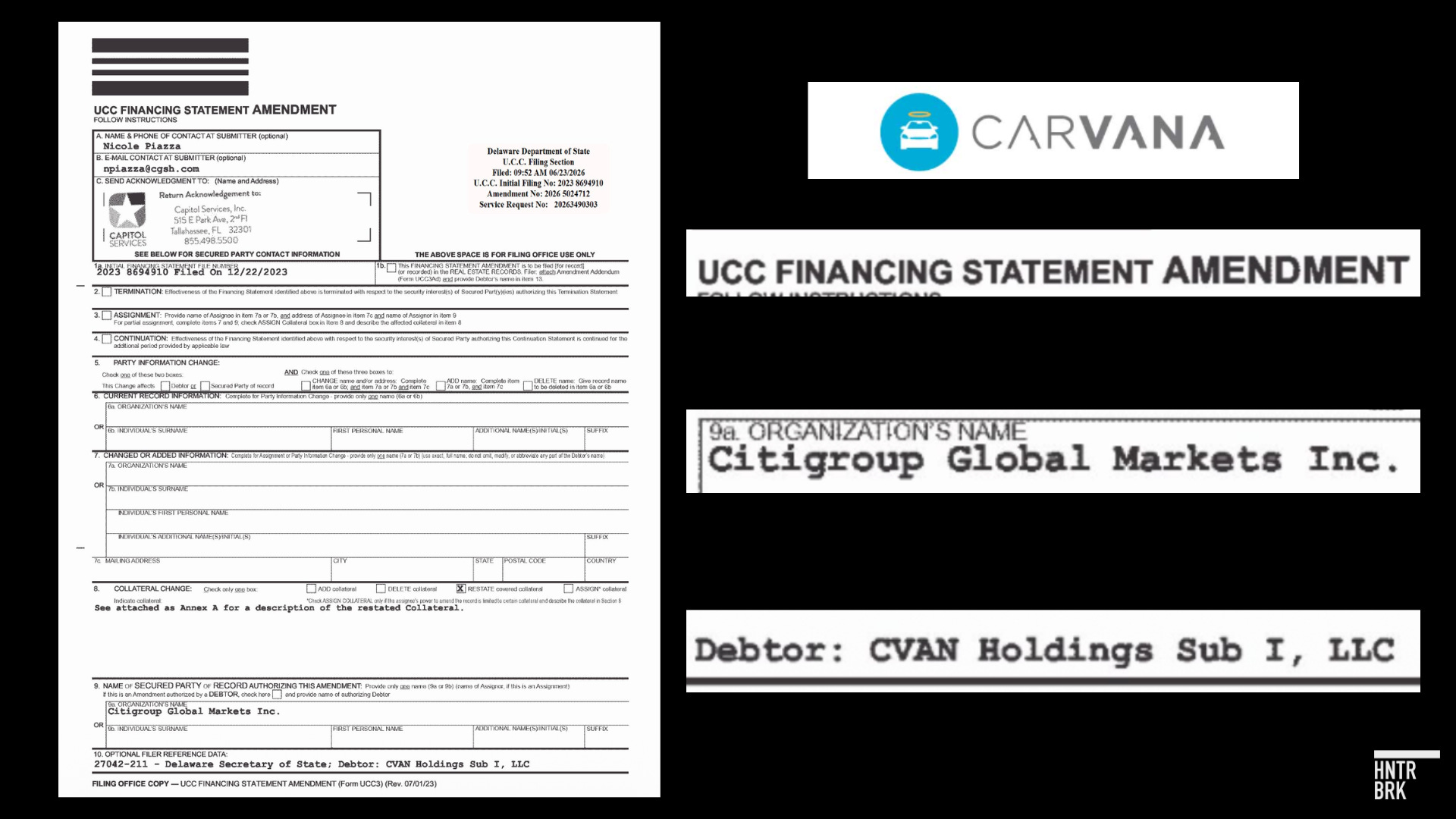
Delaware UCC filings obtained by Hunterbrook on Tuesday show that Citigroup Global Markets filed UCC financing statements and amendments through which Citi has a presently effective security interest in assets held by CVAN Holdings Sub I, LLC, where TWG holds essentially its entire Carvana position. A UCC financing statement is a public notice filed with a state, here Delaware, through which a lender perfects its security interest in pledged collateral.
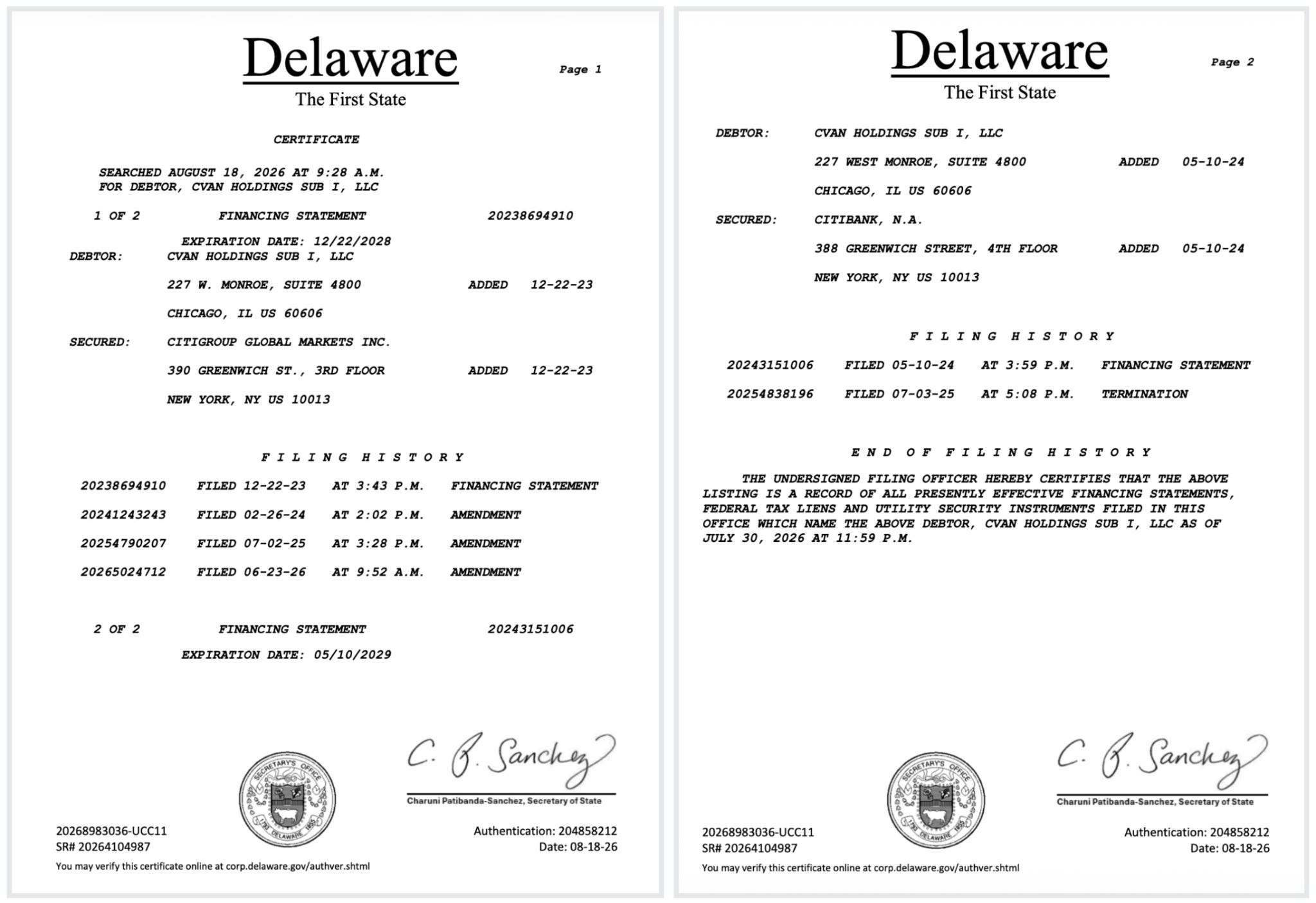
The results of a Delaware UCC search on CVAN Holdings Sub I, LLC, the entity that holds Mark Walter’s $2 billion stake in Carvana. The filings show two separate security interests in the Carvana shares held within the entity, one of which is still active and the other terminated as of July 3, 2025.
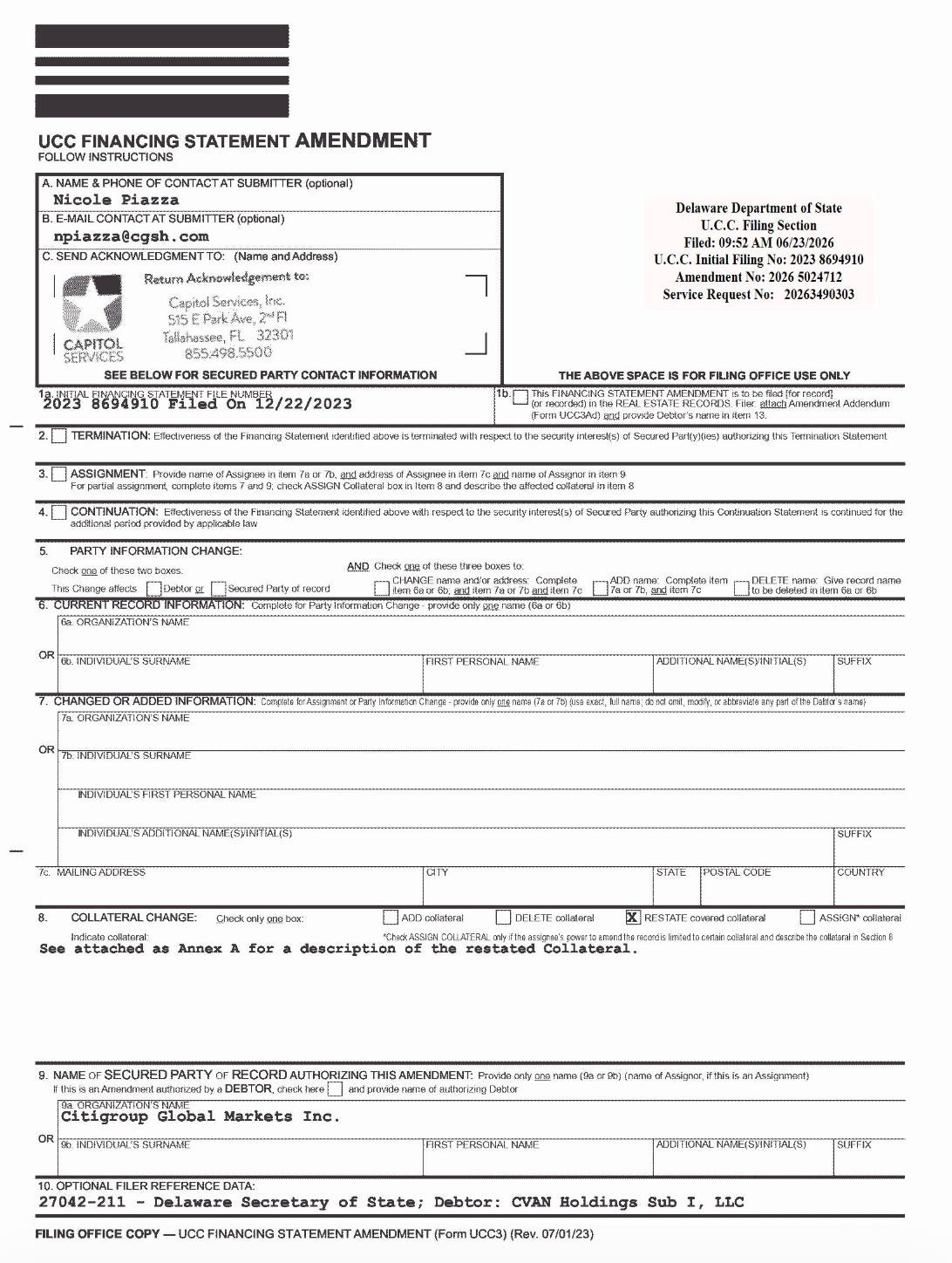
Citigroup amended the financing statement on June 23, less than two months ago, specifically to account for shares created by Carvana’s recent five-for-one stock split.
The finding complicates a growing bear case against Carvana: that Walter, suddenly desperate for liquidity amid federal scrutiny of his sprawling business empire, could dump his massive Carvana position into the market.
He can’t simply do that — at least not without Citigroup Global Markets Inc. releasing the collateral.
The collateral is pledged to Citigroup Global Markets Inc. Selling it would generally require satisfying the secured obligations, obtaining Citi’s consent, or otherwise negotiating a release of the collateral. And the lien expressly extends beyond the shares themselves to proceeds and other assets.
Citi could of course sell the shares if, for example, an event of default were triggered under the facility’s terms, which remain largely undisclosed. But there is reason to believe that at least some of the borrowing or pre-payment pursuant to forward contracts occurred in connection with Walter’s purchase of a majority interest in the Lakers. And he just agreed to sell his Lakers stake to a group including Bob Iger and Joshua Kushner. Is Citi likely to sell these shares when a significant Walter liquidity event is pending?
Carvana shares were down more than 7% again Tuesday after a sharp decline Monday. Walter and TWG’s post-split core position represents approximately 30 million Carvana shares, worth roughly $2 billion at Tuesday morning prices.
But $2 billion is the gross market value, not necessarily available liquidity for Walter.
That distinction suddenly matters.
The Wall Street Journal reported Monday that Walter “drew on loans from insurers to invest in startups,” including Carvana and Beyond Meat. The revelation comes as federal prosecutors and the SEC investigate whether Walter or his companies committed fraud by concealing financial connections while borrowing billions from insurers he controlled. Walter and his businesses have not been charged with crimes. TWG — Walter’s holding company — has said it acted in good faith and denied attempting to circumvent its obligations.
Walter is now racing to raise money and unwind insurer-related investments. That has naturally raised the question of whether his publicly traded holdings could be sold for cash.
The Delaware records show the answer, at least for Carvana, is considerably more complicated.
CITI’S CLAIM COVERS THE WHOLE CORE STAKE
Walter’s filings with the SEC had already provided a clue.
They said CVAN Holdings Sub I had pledged all of its Carvana LLC units and corresponding 5,995,376 Class B shares to secure “one or more prepaid variable forward sale contracts and certain margin loans with an unaffiliated third party.” Walter ultimately controls the TWG entities above CVAN Sub.
What the SEC filing did not reveal was the identity of that third party — or whether the pledge remains live today.
The Delaware records answer both questions much more clearly.
The secured party is Citigroup Global Markets Inc., acting as agent for Citibank, N.A. The original financing statement dates to December 22, 2023. It was amended in February 2024, July 2025 and, critically, June 23, 2026.
That most recent amendment came after Carvana’s five-for-one stock split. Citi updated its collateral description to expressly capture the additional shares issued in the split, bringing the pledged Class B position to approximately 30 million post-split shares.
That is powerful evidence that the pledge was not merely a stale artifact from an old Walter financing.
Someone was actively maintaining Citi’s security interest this summer.
THERE WAS ALSO A MARGIN LOAN
A second UCC filing reveals more.
On May 10, 2024, Citibank filed a separate financing statement against CVAN Holdings Sub I. Its collateral schedule refers explicitly to a “Margin Loan Agreement” dated May 10, 2024, among CVAN Sub as borrower, multiple lenders, and Citibank as administrative agent. Citigroup Global Markets served as custodian for the collateral account.
That filing was terminated on July 3, 2025.
But the timing is notable: One day earlier, on July 2, Citi amended and expanded its other, still-active financing statement to cover 5,995,376 Carvana shares (pre-split).
And six weeks later, Walter’s SEC filing still said the entire position secured both “prepaid variable forward sale contracts” and “certain margin loans.”
That sequence suggests the financing may have been restructured or consolidated rather than simply paid off — though the UCC records alone cannot prove that.
Notably, Citi then returned in June to update the still-active lien for Carvana’s stock split.
WHAT THIS MEANS FOR CARVANA
For traders, there are two very different risks tied to Walter.
The first is the one currently worrying the market: Walter voluntarily dumps tens of millions of CVNA shares because he needs cash.
These filings make that scenario look substantially less straightforward.
Walter and TWG do not appear to control an unencumbered $2 billion block that he can simply sell and redeploy elsewhere. Citi already has a claim against essentially the entire core stake. A sale could still happen, but it would have to be coordinated with the secured financing structure, with some portion of the proceeds potentially going first to satisfy Citi or the forward counterparties.
That should reduce the simplistic near-term “Walter needs cash, therefore 30 million shares are for sale” overhang.
But there is a second risk.
If Walter’s obligations to Citi become stressed, Citi itself could have rights over the collateral.
The filings do not disclose the requisite loan-to-value ratio, margin-call threshold, maturity dates, or current exposure under Walter’s prepaid forward contracts. The filings provide no evidence that Citi is currently forcing — or even considering — a sale of Carvana shares.
A UCC filing also does not prove how much debt is presently outstanding.
Still, the newly obtained records change the picture materially.
Walter’s Carvana position looks less like a $2 billion piggy bank he can raid to solve his liquidity crunch and more like a $2 billion pool of collateral over which Citi already holds influence.
TWG and Carvana did not immediately respond to Hunterbrook’s request for comment. Citi declined to comment.
AUTHOR
Matthew Termine is a former corporate lawyer with significant experience advising companies operating within regulated industries. Matt led Hunterbrook’s investigation and reporting on United Wholesale Mortgage. In 2017, Matt was credited by the Wall Street Journal, among others, for identifying suspicious mortgage loan transactions that led to several successful criminal prosecutions, including that of a prominent political operative and the chief executive officer of a federally chartered bank. He is a graduate of Trinity College and Fordham University School of Law.
Sam Koppelman is a New York Times best-selling author who has written books with former United States Attorney General Eric Holder and former United States Acting Solicitor General Neal Katyal. Sam has published in the New York Times, Washington Post, Boston Globe, Time Magazine, and other outlets. He has a BA in Government from Harvard, where he was named a John Harvard Scholar and wrote op-eds like “Shut Down Harvard Football,” which he tells us were great for his social life. Sam is based in New York City.
EDITOR
Vikas Kumar joined Hunterbrook from The Capitol Forum, where he led the corporate investigations team for a decade as a senior editor. He was previously an attorney at Gordon Feinblatt, a trial attorney for the Department of Justice, and a law clerk for a federal judge. He has a J.D. from University of Virginia School of Law and a bachelor’s from Emory University. Vikas is based in Maryland.
DISCLOSURES
© 2026 Hunterbrook Media LLC. All rights reserved. Use of this website is strictly governed by our Terms of Use. The content herein is furnished on an “AS IS” basis without any form of express or implied warranty. For information regarding our privacy practices, please refer to our Privacy Policy.
Hunterbrook Media LLC (”Hunterbrook Media”) is an investigative news organization. Hunterbrook Media is affiliated with Hunterbrook Capital LP (”Hunterbrook Capital”), an exempt reporting adviser with the U.S. Securities and Exchange Commission that serves as investment adviser to one or more investment funds. Hunterbrook Media and Hunterbrook Capital are legally separate entities under common control. Hunterbrook Capital’s investment activities are one source of funding for Hunterbrook Media’s journalistic operations. Hunterbrook Capital may hold long positions, short positions, positions through derivative instruments including options and swaps, or no position in any security covered or mentioned on this website. Consistent with applicable policies and procedures, Hunterbrook Capital may establish, modify, or close positions in covered securities before or after the publication of any Hunterbrook Media article. Following publication of any article, Hunterbrook Capital will continue transacting in covered securities for an indefinite period and may be long, short, or flat at any time thereafter, regardless of any position described at publication. Hunterbrook Media has no obligation to update any article or disclosure to reflect subsequent changes in Hunterbrook Capital’s positions.
Nothing on this website constitutes investment advice, a recommendation to buy, hold, or sell any security, or a solicitation to purchase or sell any securities. No securities shall be offered or sold in any jurisdiction where such activities would be contrary to applicable securities laws. Hunterbrook Media is not a registered investment adviser in the United States or any other jurisdiction. Nothing herein should be construed as investment advice or a recommendation of any kind. This information should not be relied upon as a substitute for independent research or professional financial, legal, or tax advice.
This website may feature forward-looking statements reflecting Hunterbrook Media’s current views. Such statements, identifiable by terms including but not limited to “anticipate,” “believe,” “estimate,” “expect,” “intend,” “may,” “plan,” “predict,” “should,” and “will,” are inherently speculative and subject to risks and uncertainties. Actual results or outcomes may substantially deviate from those projected. Hunterbrook Media expressly disclaims any obligation to update or revise any forward-looking statements, regardless of subsequent developments or new information.
The information presented is current as of the date indicated. No representation regarding the completeness or timeliness of this information is made. Some information is sourced from third parties and, while believed to be reliable, has not been independently verified, and its accuracy or completeness is not guaranteed. Hunterbrook Media is not affiliated with any sites linked to this website. Investment in securities and other financial instruments involves significant risk, including the potential loss of principal. Users are advised to conduct their own due diligence and consult professional advisors before engaging in any investment activity. Use of Hunterbrook Media’s content is entirely at the user’s risk. Users shall not use this site for any illegal or prohibited purposes and shall comply with all applicable local, state, national, and international laws and regulations.
Should any provision of these Terms of Use be adjudged invalid or unenforceable, the remaining provisions shall remain in full force and effect. Trademarks contained in links to third-party websites belong to their respective owners. Hunterbrook Media retains copyright on all text, content, graphics, and trademarks displayed on this site.