


BY: Sam Koppelman, Matthew Termine, JD Jean-Jacques
EDITOR: Vikas Kumar
Guggenheim CEO Mark Walter just agreed to sell the Lakers for liquidity after the Feds seized his phone and computer amid a probe into life insurers he owns.
Meanwhile, Guggenheim’s largest shareholder — the conglomerate Sammons, which owns $130 billion of life insurance assets largely managed by Guggenheim — has stayed out of the spotlight, even as its own CEO announced retirement this month.
How? In 2024, Sammons restructured its Guggenheim stake and stopped classifying the firm as a related party, even as it retained a huge stake and continued investing billions through Guggenheim vehicles. That is strikingly similar to the disclosure issue now drawing federal scrutiny to Walter.
Caught in the middle: Sammons policyholders across the country, whose insurance money has flowed into Walter-linked businesses — including the insurers under federal investigation and, apparently, a professional bull-riding team.
Sammons and Guggenheim did not respond to repeated requests for comment.
Nick Nemeth of Mispriced Assets and Hunterbrook Media reporter-at-large Bethany McLean contributed reporting.
Based on Hunterbrook Media’s reporting, at the time of publication Hunterbrook Capital is short bonds issued by Sammons Financial Group. Positions may change at any time. This article is not investment advice or any recommendation. See full disclosures on our website.
Shaq and Kobe. Magic and Kareem. Feds and warrants.
In the golden age of grift and graft, it’s not every day FBI agents stake out a private jet to seize a phone and laptop from a billionaire. But last year, on a Chicago tarmac, that’s exactly what they did, targeting devices belonging to Mark Walter.
Walter is the CEO of financial giant Guggenheim, as well as the owner of the Los Angeles Dodgers, the Los Angeles Lakers, and now, quite a few legal bills.
Last week, Walter agreed to sell the Lakers to Josh Kushner and Bob Iger for a record $12.5 billion, less than a year after closing on the team for $10 billion. It’s among the richest, quickest flips in NBA history. $2.5 billion! In a year!
ESPN credulously framed it as an offer Walter couldn’t refuse, claiming he was not “looking to sell.”
But that didn’t make sense. You buy the Lakers because you want to own the Lakers. If you sell the Lakers just a year later, it’s probably because you have to.
Sure enough, Bloomberg quickly reported what really drove the deal: Walter’s holding company was raising cash “to help pay down loans on the books of its insurers that had drawn scrutiny from the Justice Department.” The FT then broke news that the president of Guggenheim Investments “had her phone seized by the FBI” on the same day as Walter’s.
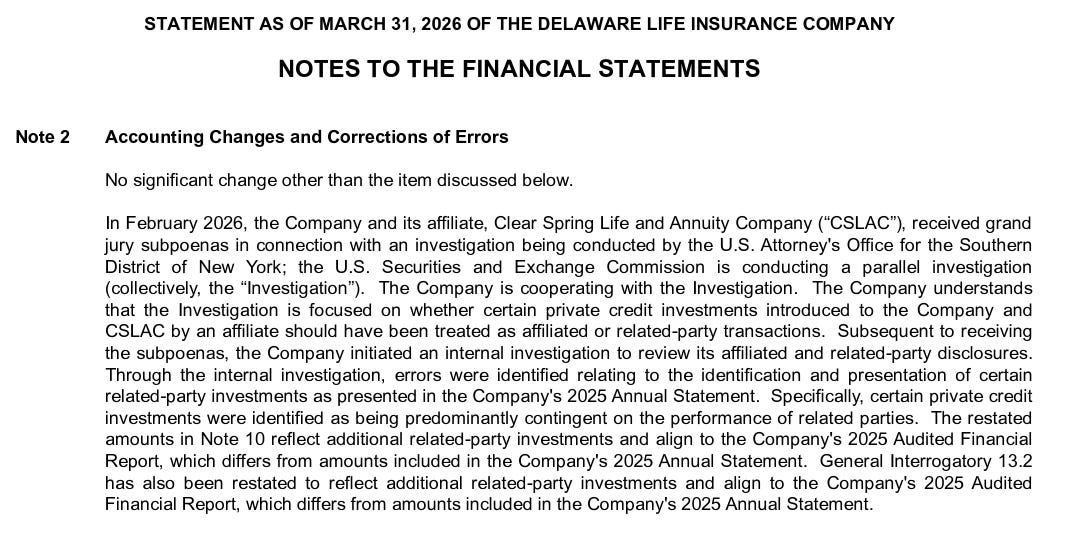
The insurers tied to the probe — Delaware Life and Clear Spring Life and Annuity, the life insurance arm of The Walter Group (TWG) — received grand jury subpoenas after a whistleblower report. The companies then restated their financials to disclose that their respective investment portfolios were significantly more intertwined with Walter and TWG than they had initially disclosed.
But as Delaware Life and Clear Spring Life and Annuity have been taking heat, one player very close to all this has managed to avoid scrutiny: Sammons.
As of 2021, the conglomerate owned roughly a third of Guggenheim. Sammons paid the firm tens of millions each year for managing tens of billions of dollars of Sammons life insurance money, according to its 2023 filing. Sammons even buys Guggenheim loans in circular transactions that smell like a Proustian madeleine from 2008.
But Sammons hasn’t been included in the coverage of the Walter scandal yet.
One potential explanation: In 2024, before subpoenas hit Walter’s insurers, Sammons restructured. It renounced its voting shares in Guggenheim, enabling Sammons to claim Guggenheim was no longer an “affiliate or related party.” But the money, fees, loans, and a right to appoint representatives to the executive committee at Guggenheim remain. Only the affiliation vanished, just in time. Abracadabra!
The timing of the disappearing act looked like magic.
Then again, life insurers are supposed to be pretty good at predicting when someone’s time is up. And was it ever the right time for Sammons to downplay its ties to Guggenheim.
If Sammons was trying to pretend that the relationship with Guggenheim doesn’t exist, Guggenheim doesn’t seem to have gotten that memo.
Its investment manager’s July 30th filing still lists the Sammons insurers as related persons.
Which makes sense! Guggenheim still invests Sammons’ money, contributed by ordinary Americans to life insurance policies. And Sammons still owns a huge stake in Guggenheim.
That raises the question: Why, exactly, isn’t Guggenheim labeled as an affiliate in the Sammons filings? Especially because a Guggenheim filing from May 2026 still describes Sammons as holding “voting interests” in Guggenheim Capital and being its “largest individual stakeholder.”
The answer is unclear. Neither Sammons nor Guggenheim responded to repeated requests for comment.
But the Americans who have paid into the more than 1.7 million policies held by Sammons-owned insurers — and their beneficiaries — deserve to know the risks. Just how linked are their AM Best-rated, A+ insurers to the Guggenheim/Walter/TWG complex, parts of which are now under federal investigation?
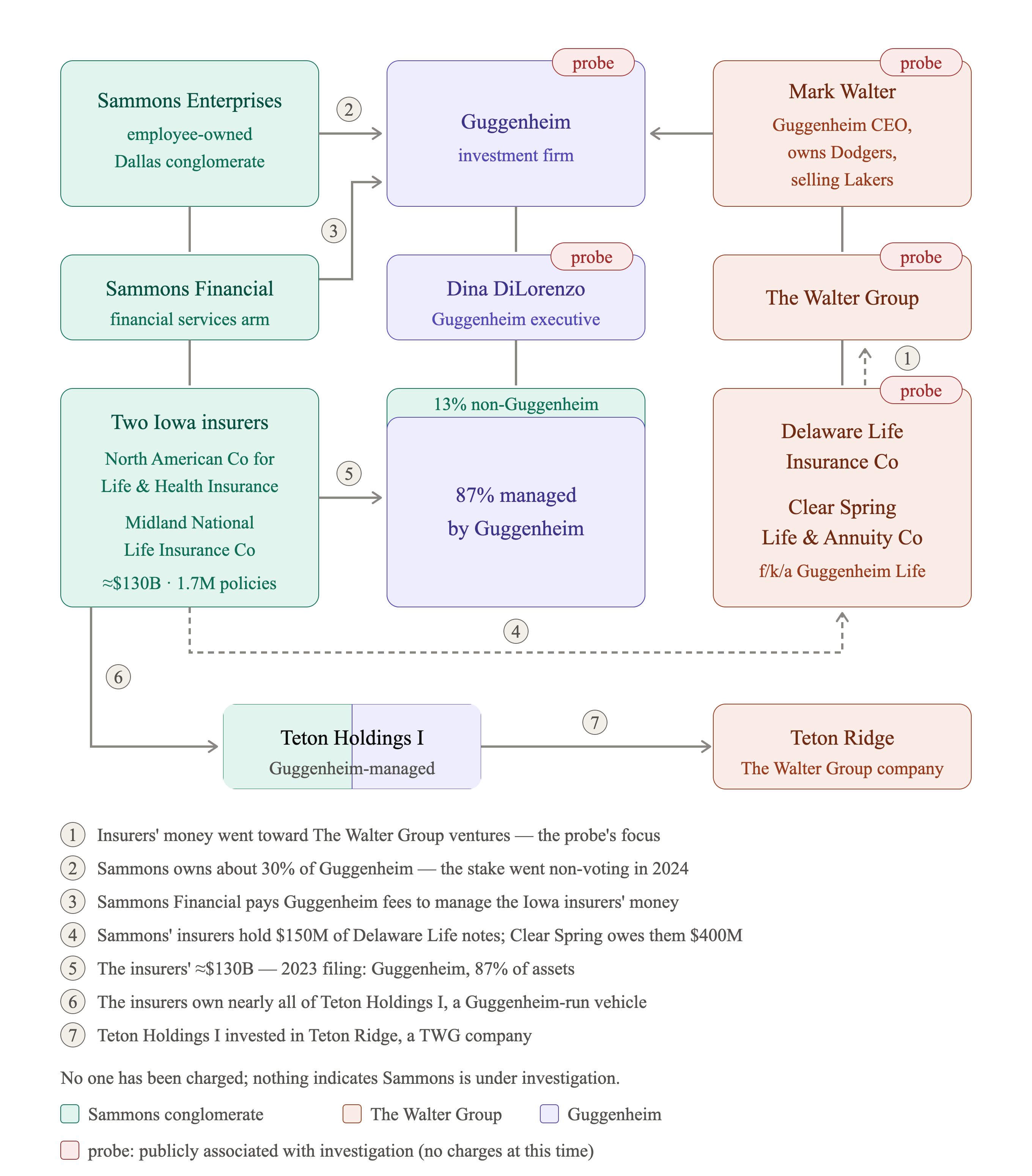
HOW IT ALL FITS TOGETHER: SAMMONS, GUGGENHEIM, MARK WALTER’S TWG, AND TENS OF BILLIONS OF DOLLARS IN AMERICAN LIFE INSURANCE POLICIES
THE MISSING INSURERS
Sammons is a conglomerate whose insurers — Midland National Life and North American Company for Life and Health — hold roughly $130 billion in assets, rank among America’s largest sellers of annuities, and serve millions of people.
If you’ve never heard of Sammons, that’s unsurprising, despite its size. It’s a private company that hasn’t gotten much national coverage.
Charles Sammons took control of Reserve Life Insurance Company in Dallas in 1938 and spent the next four decades adding businesses in communications, industrial equipment, travel, and hospitality. The company became Sammons.
In 1978, Sammons launched an Employee Stock Ownership Plan (ESOP), making it one of the largest employee-owned companies in America. Which means the people with the most riding on what follows — other than perhaps the life insurance and annuity policyholders — are Sammons workers, whose retirement accounts hold the company’s stock.
The Sammons relationship with Guggenheim is older than Guggenheim itself.
Before Guggenheim Partners existed, Mark Walter co-founded Liberty Hampshire, an investment management firm in Chicago. Sammons bought into the firm. When Walter combined it with the newly created Guggenheim Partners (alongside partners including a descendant of the eponymous Guggenheim), Sammons came along.
That’s how a Dallas ESOP ended up as the largest shareholder of a firm named for a Gilded Age smelting, mining, and philanthropic dynasty — and how Walter’s firm ended up managing the Sammons insurance empire’s money. The concentration that followed wasn’t the result of a bake-off among asset managers; it was baked in from the start, a quarter century ago.
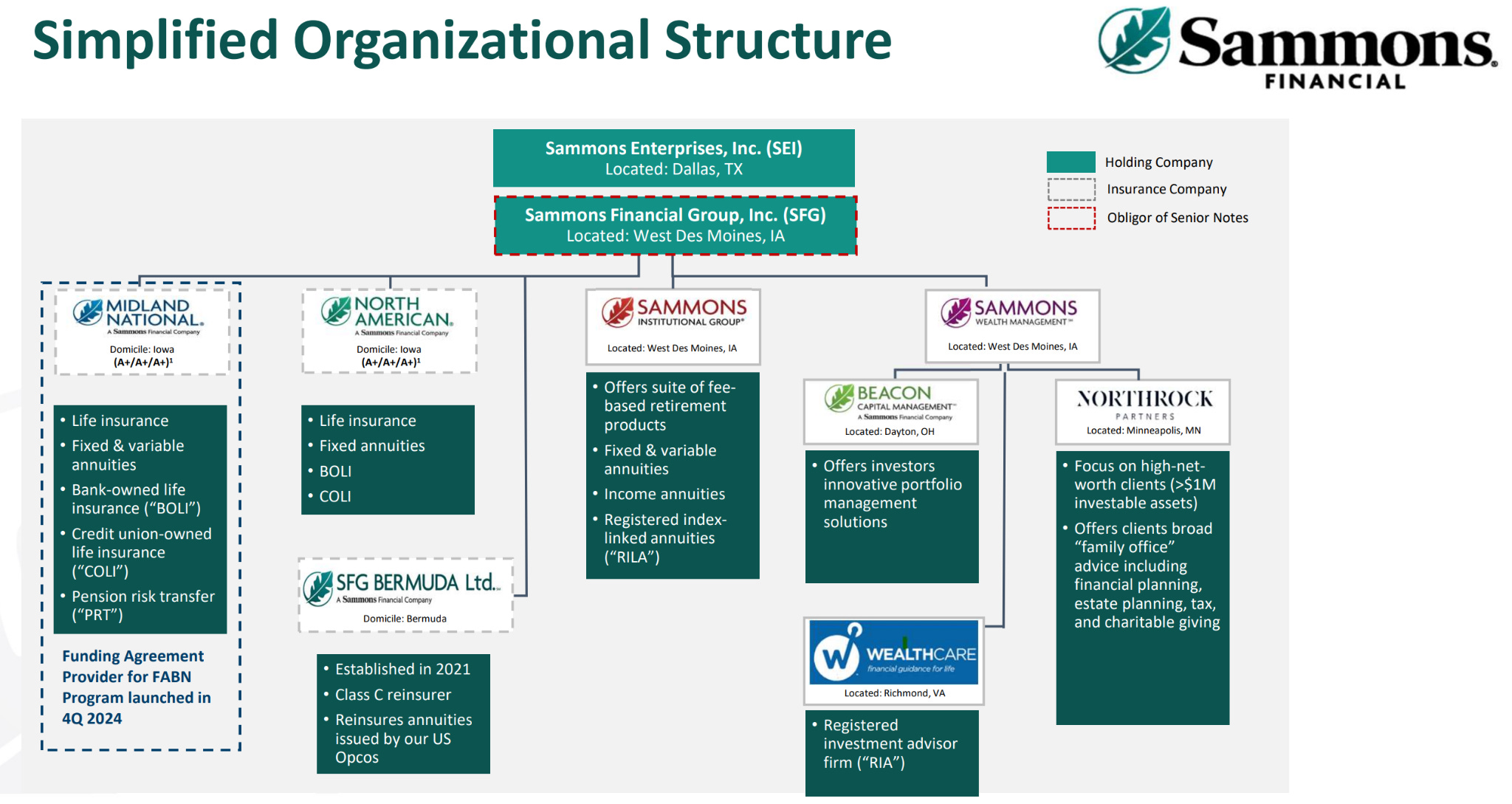
At the top of the Sammons org chart sits Sammons Enterprises, the Dallas holding company.
Below it are an industrial arm, a real estate arm, and the crown jewel: Sammons Financial Group (SFG), headquartered in West Des Moines, Iowa.
SFG owns various life and health insurers, including Midland National and North American.
As of 2023, Guggenheim ran 87% of SFG’s assets and collected roughly $75 million a year in disclosed fees. To put that in perspective: in the National Association of Insurance Commissioner’s data, handing a meaningful share of your portfolio to a single outside manager is overwhelmingly a small-company practice. 96% of insurers that do it have under $5 billion in assets, generally because they’re too small to run their own investment departments.
Among giants, the model exists in one well-known form: the private-equity-partnered insurers, like Apollo with Athene. The manager relationship is disclosed on page one of every filing, scrutinized by rating agencies, and debated by regulators precisely because of the conflicts it creates. Sammons runs the same concentrated model with the relationship labeled “unaffiliated.”
Strange as it was, the relationship between Sammons and Guggenheim had not been a secret.
Guggenheim Private Investments (GPI), a registered investment adviser within Guggenheim, dedicates an entire paragraph of its annual filing to the numerous conflicts created by Guggenheim’s multifaceted relationship with Sammons.
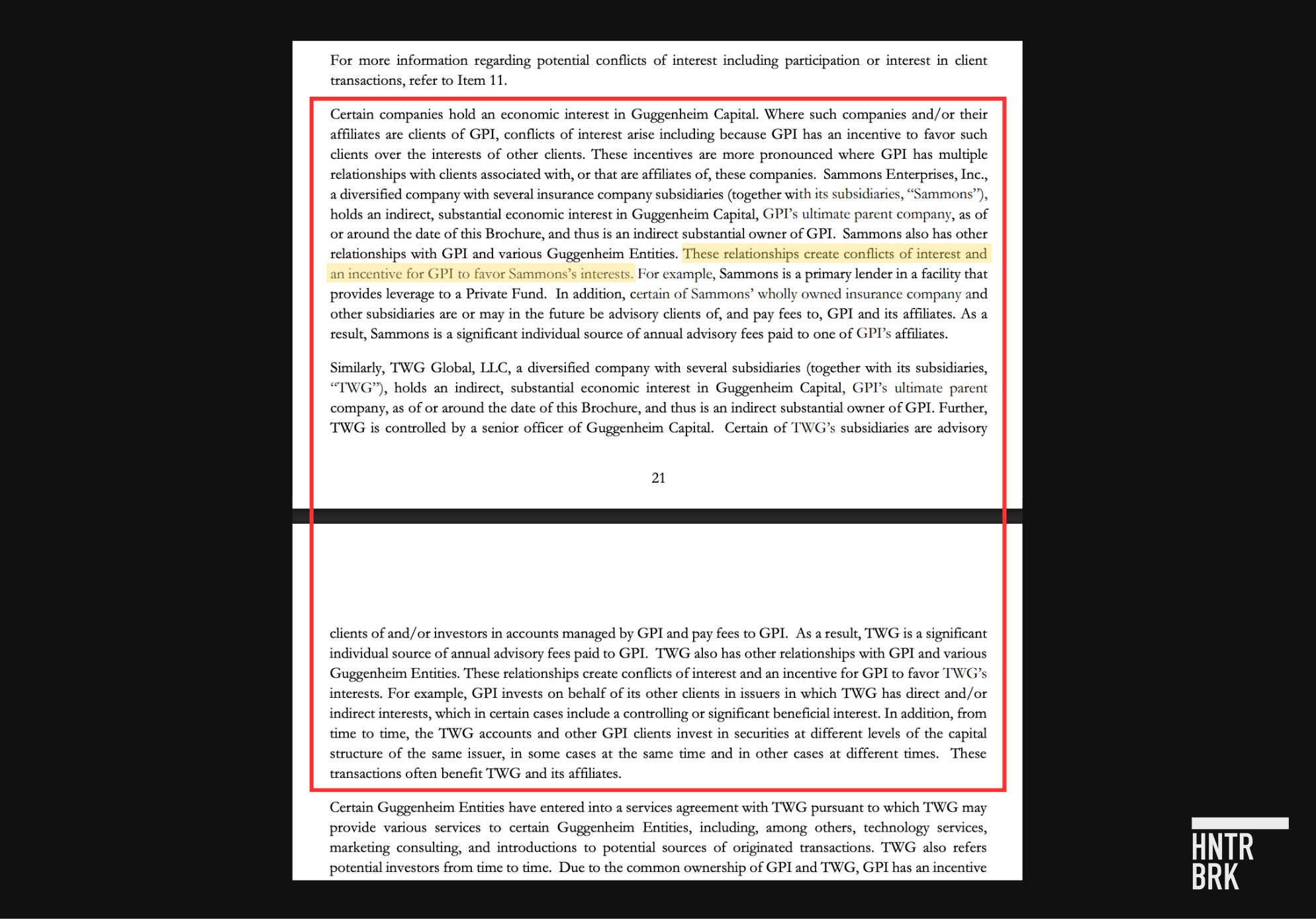
Among them: Sammons “holds an indirect, substantial economic interest in Guggenheim Capital;” “Sammons is a primary lender in a facility that provides leverage to a Private Fund;” and “Sammons is a significant individual source of annual advisory fees paid to one of GPI’s affiliates.”
But while Guggenheim continues to report the relationship across various filings, there is evidence that Sammons took steps to distance itself (at least on paper) from Guggenheim.
On page 140 of a January 2025 filing, the Sammons-owned insurer Midland National writes: “In the third quarter of 2024, Sammons Enterprises restructured its investment in Guggenheim Capital Partners which resulted in Guggenheim Capital and other related entities no longer being considered an affiliate or related party of the Company.”
To be clear: Sammons didn’t sell its Guggenheim shares, as far as the filings reveal. Instead, it converted a stake of approximately 30% economic share and 46% voting control into what Guggenheim’s most recent filing describes as an “indirect, substantial economic interest.”
What does this mean? It’s not exactly clear. Again, neither Sammons nor Guggenheim replied to repeated requests for comment. But it appears that Sammons disclosed that it has kept its economic stake while shedding its voting control.
By giving up those voting rights, Sammons allowed itself under Iowa regulations to reclassify certain assets from affiliated to unaffiliated thereby avoiding regulatory scrutiny.
What followed was an erasure across Sammons documents.
Roughly $2.1 billion of investments Midland National had carried as “affiliated” — which appear to be its Guggenheim-managed vehicles and Guggenheim bonds were — reclassified as unaffiliated.
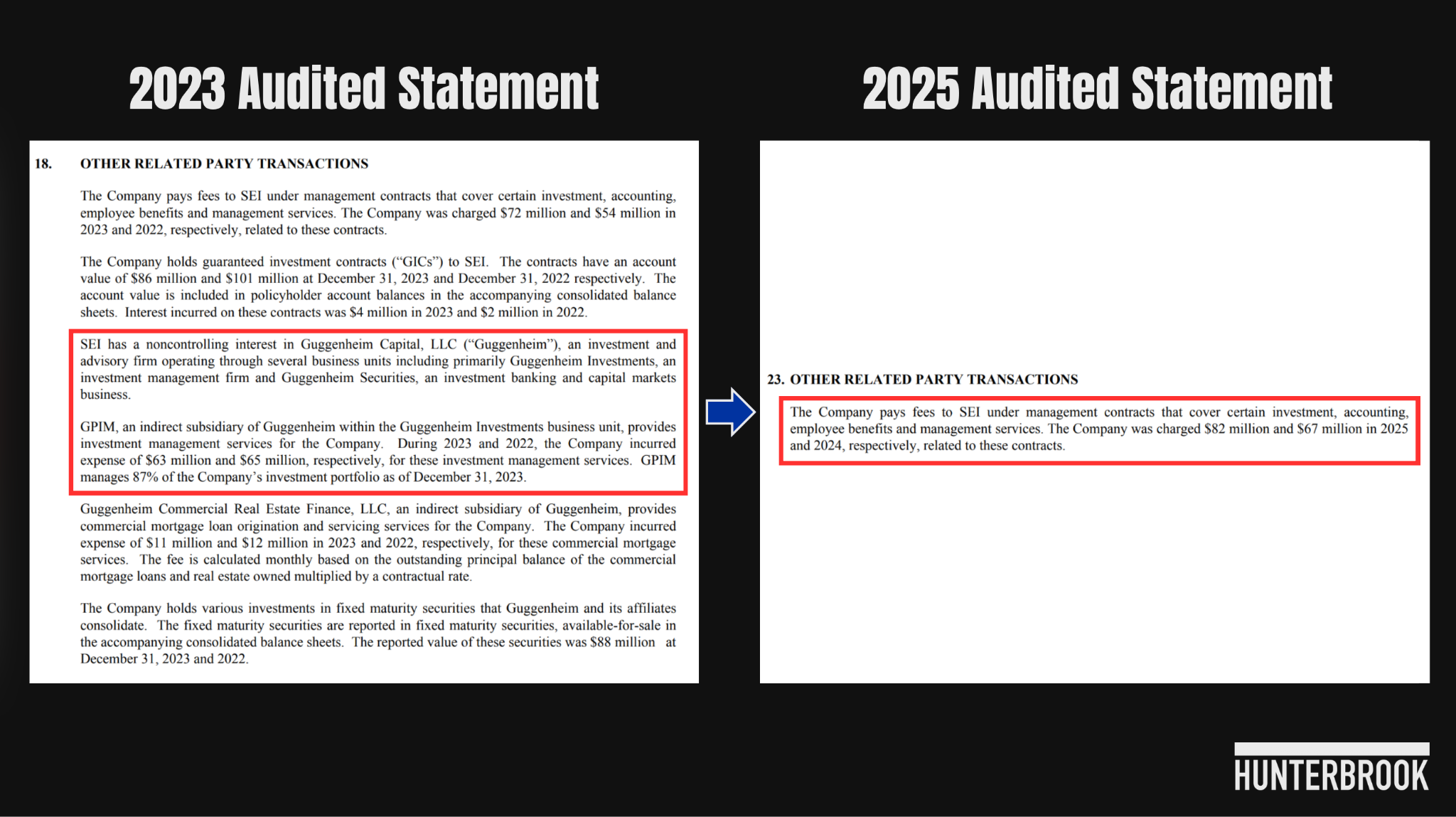
The 2023 audited statements devoted a full paragraph to the relationship by naming GPIM (Guggenheim Partners Investment Management) as manager of 87% of the portfolio. It itemized $75 million in annual fees and $88 million of fixed maturity securities that “Guggenheim and its affiliates consolidate.” By 2025, Guggenheim is named zero times, and GPIM only once, in a footnote about securities the company values privately.
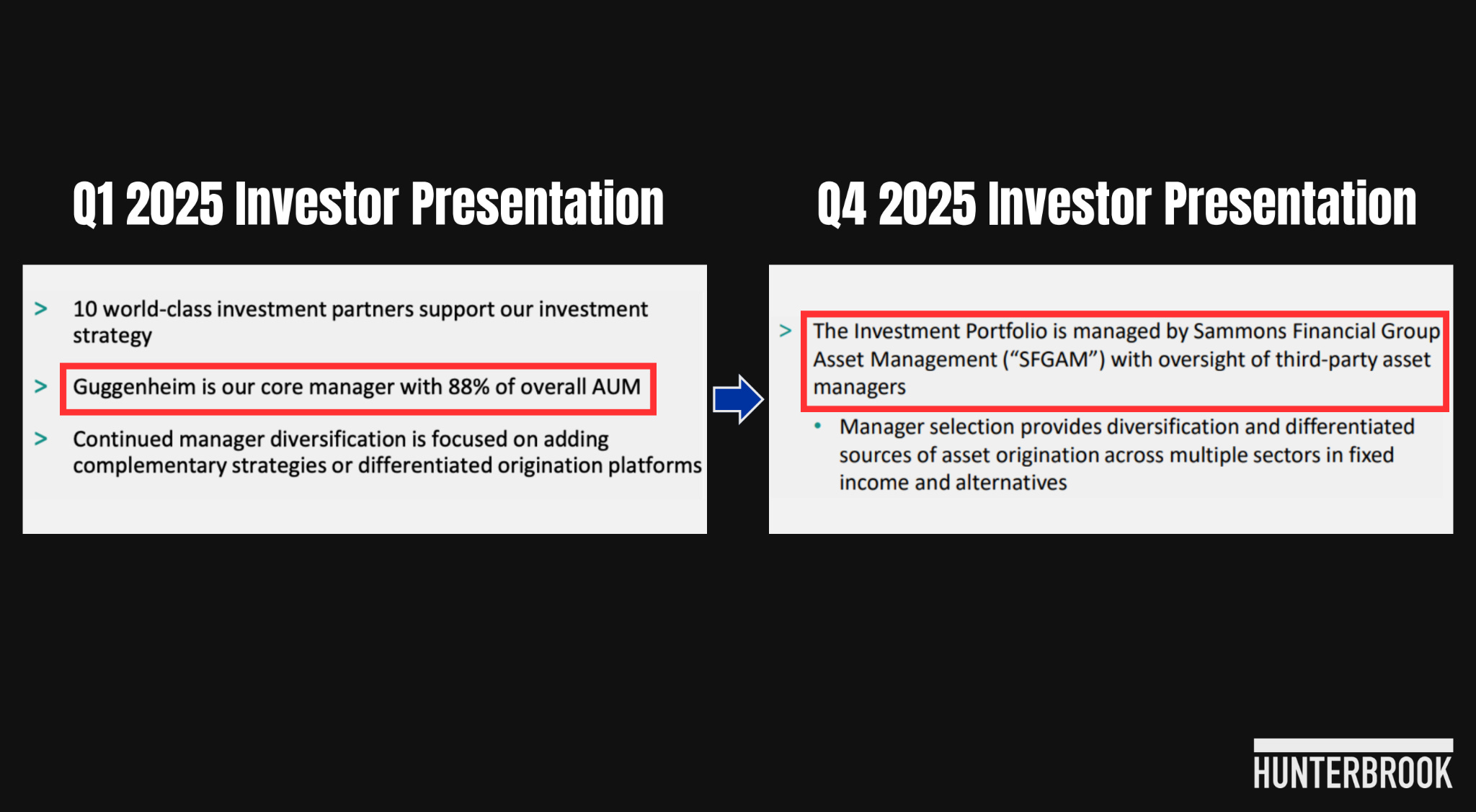
An investor deck in March 2025 called Guggenheim “our core manager with 88% of overall AUM,” whereas one in the fourth quarter of that same year made no mention of the firm.
This is an eerily familiar fact-pattern to anyone following the Delaware Life and Clear Spring investigations — in which the Department of Justice is probing whether Walter hid the related party ties between his insurers and his businesses.
Makes you wonder: What, exactly, distinguishes Sammons from Delaware Life and Clear Spring Life?
ON THE BOOKS
Hunterbrook reviewed the Sammons insurers’ investment filings line by line, from 2023 through the most recently reported quarter of 2026.
Beyond the roughly hundred billion dollars Guggenheim manages for Sammons, according to recent financial statements, we calculated that billions worth of Guggenheim-linked investments still sit in the insurers’ own portfolios.
Most of it is not labeled Guggenheim at all. Some sits in vehicles with names that give nothing away (except, perhaps, a taste for Herzog films): Fitzcarraldo Funding. Molly Aida. Campa. Orinoco. Teton. But Guggenheim’s own SEC filings reveal that these are its private funds and investment vehicles.
And at least one of those mystery vehicles can now be traced all the way to Mark Walter himself.
Take Teton Holdings I, a Guggenheim-managed investment owned almost entirely by Sammons insurers. The insurers carried the investment at roughly $197 million in 2022. By the end of 2025, it was worth only about $41 million on their books — a decline of more than $156 million.
An Iowa insurance filing identifies Teton Holdings I as the vehicle formerly known as G-Prairie LLC, managed by G-Prairie MM LLC, which the filing says is directly controlled by Guggenheim Partners Investment Management.
Then comes the missing link. Florida corporate records for Teton Ridge LLC list Teton Holdings I LLC as a member — and give its address as “c/o Guggenheim Partners Investment Mgmt.”
And Teton Ridge itself says the Western-sports and media company is owned by TWG Global, the investment conglomerate led by Walter and Thomas Tull. Walter is also Guggenheim Partners’ CEO.
The filings create a direct chain: Sammons insurers → Guggenheim-managed Teton Holdings I → Teton Ridge → TWG / Mark Walter → CEO of Guggenheim → part-owned by Sammons.
In practice, that means Sammons’ life-insurance and annuity money — from ordinary Americans — helped fund Teton Ridge, a company whose assets include The American Rodeo, a professional bull-riding team, The Cowboy Channel, a Western-lifestyle magazine, a Hollywood production studio and performance-horse operations — an unusually colorful destination for policyholder reserves.
We found no public document explaining why Sammons’ investment in Teton Holdings I lost more than two-thirds of its reported value, and the records do not establish that the decline has anything to do with the federal investigation into Walter’s other businesses. But they do show something that was previously hidden behind the name of an opaque private vehicle: Sammons insurance-company money was invested in a business inside Walter’s TWG empire, the same empire under DOJ investigation.
Sammons is directly exposed to the insurers under federal investigation, too, the ones that led to the private jet tarmac device seizure. Midland and North American hold $150 million of Delaware Life notes, purchased privately in 2016 — and swapped into a new instrument in January 2026, before the grand jury subpoenas arrived in February.
North American, meanwhile, has transferred about $367 million of liabilities to Clear Spring under a reinsurance deal. This lowers North American’s reserve requirements by ceding liabilities to Clear Spring, one of the Walter-controlled insurers that is under investigation. If Clear Spring can’t pay, North American has to rebuild the reserves, and the bill lands on Sammons’ policyholders.
This isn’t just leftover exposure from the old days, slowly running off. The relationship is still writing new checks — big ones. And shifting the capital multiplies the assets that generate fees for Guggenheim and the dividends for the owners of the insurers.
Last year, roughly a full year after the “de-affiliation,” Guggenheim’s lending arm launched a $400 million CLO, a bundle of loans that Guggenheim itself had originated, packaged, and managed. Sammons’ insurers took down $208 million of it — more than half the deal — according to their own investment schedules, apparently rolling their stake in the prior 2023 paper.
To be clear: no one has been charged with anything, and there is no indication Sammons is a subject, target, or witness in any investigation. Everything described here is, on the face of the filings, disclosed to and ostensibly permitted by regulators.
But consider the two stories side by side.
The government’s theory at Delaware Life is that related-party exposure was made to look unrelated by concealment. At Sammons, the same reporting outcome was achieved through corporate engineering.
Ratings agencies cut status after the corrected disclosures. After Delaware Life restated its disclosures — increasing its reported related-party investments from $1.4 billion, about 3% of its portfolio, to more than $17 billion, as much as 42% — S&P Global and AM Best each cut their outlooks to negative. Fitch put the company on Rating Watch Negative.
So far, Sammons has stayed out of this spotlight. That may not last.
Over the weekend, the Sammons insurers released their latest quarterly statements — the first since the firm’s CEO announced his retirement at the beginning of the month, after 16 years. (The CEO of Sammons Financial’s parent conglomerate Sammons Enterprises is unchanged).
Once again, Guggenheim was absent from the related-party note. But it was not absent from the filings.
Both insurers listed GPIM among the firms authorized to make investment decisions on their behalf. Both placed a “U” next to its name: unaffiliated. In one place, Sammons discloses that the insurers were actively buying, redeeming, and holding Guggenheim securities in this past quarter.
Whether recent scrutiny will change the disclosures in the next quarter remains to be seen.
Either way, Sammons and Guggenheim made for a helluva team for a long time, as they grew, together, into global giants.
But all great dynasties eventually end. Kobe and Shaq. Magic and Kareem.
AUTHORS
Sam Koppelman is a New York Times best-selling author who has written books with former United States Attorney General Eric Holder and former United States Acting Solicitor General Neal Katyal. Sam has published in the New York Times, Washington Post, Boston Globe, Time Magazine, and other outlets. He has a BA in Government from Harvard, where he was named a John Harvard Scholar and wrote op-eds like “Shut Down Harvard Football,” which he tells us were great for his social life. Sam is based in New York City.
Matthew Termine is a former corporate lawyer with significant experience advising companies operating within regulated industries. Matt led Hunterbrook’s investigation and reporting on United Wholesale Mortgage. In 2017, Matt was credited by the Wall Street Journal, among others, for identifying suspicious mortgage loan transactions that led to several successful criminal prosecutions, including that of a prominent political operative and the chief executive officer of a federally chartered bank. He is a graduate of Trinity College and Fordham University School of Law.
JD Jean-Jacques joined Hunterbrook from Goldman Sachs, where he worked as an investment banker. He was editor-in-chief of Howard University’s newspaper, The Hilltop, and wrote for The Exonian at Phillips Exeter Academy. Among other recognitions, JD was a White House Correspondents’ Association Scholar and was named Student Journalist of the Year by The National Association of Black Journalists. He graduated from Howard with a B.A. in history.
EDITOR
Vikas Kumar joined Hunterbrook from The Capitol Forum, where he led the corporate investigations team for a decade as a senior editor. He was previously an attorney at Gordon Feinblatt, a trial attorney for the Department of Justice, and a law clerk for a federal judge. He has a J.D. from University of Virginia School of Law and a bachelor’s from Emory University. Vikas is based in Maryland.
DISCLOSURES
© 2026 Hunterbrook Media LLC. All rights reserved. Use of this website is strictly governed by our Terms of Use. The content herein is furnished on an “AS IS” basis without any form of express or implied warranty. For information regarding our privacy practices, please refer to our Privacy Policy.
Hunterbrook Media LLC (”Hunterbrook Media”) is an investigative news organization. Hunterbrook Media is affiliated with Hunterbrook Capital LP (”Hunterbrook Capital”), an exempt reporting adviser with the U.S. Securities and Exchange Commission that serves as investment adviser to one or more investment funds. Hunterbrook Media and Hunterbrook Capital are legally separate entities under common control. Hunterbrook Capital’s investment activities are one source of funding for Hunterbrook Media’s journalistic operations. Hunterbrook Capital may hold long positions, short positions, positions through derivative instruments including options and swaps, or no position in any security covered or mentioned on this website. Consistent with applicable policies and procedures, Hunterbrook Capital may establish, modify, or close positions in covered securities before or after the publication of any Hunterbrook Media article. Following publication of any article, Hunterbrook Capital will continue transacting in covered securities for an indefinite period and may be long, short, or flat at any time thereafter, regardless of any position described at publication. Hunterbrook Media has no obligation to update any article or disclosure to reflect subsequent changes in Hunterbrook Capital’s positions.
Nothing on this website constitutes investment advice, a recommendation to buy, hold, or sell any security, or a solicitation to purchase or sell any securities. No securities shall be offered or sold in any jurisdiction where such activities would be contrary to applicable securities laws. Hunterbrook Media is not a registered investment adviser in the United States or any other jurisdiction. Nothing herein should be construed as investment advice or a recommendation of any kind. This information should not be relied upon as a substitute for independent research or professional financial, legal, or tax advice.
This website may feature forward-looking statements reflecting Hunterbrook Media’s current views. Such statements, identifiable by terms including but not limited to “anticipate,” “believe,” “estimate,” “expect,” “intend,” “may,” “plan,” “predict,” “should,” and “will,” are inherently speculative and subject to risks and uncertainties. Actual results or outcomes may substantially deviate from those projected. Hunterbrook Media expressly disclaims any obligation to update or revise any forward-looking statements, regardless of subsequent developments or new information.
The information presented is current as of the date indicated. No representation regarding the completeness or timeliness of this information is made. Some information is sourced from third parties and, while believed to be reliable, has not been independently verified, and its accuracy or completeness is not guaranteed. Hunterbrook Media is not affiliated with any sites linked to this website. Investment in securities and other financial instruments involves significant risk, including the potential loss of principal. Users are advised to conduct their own due diligence and consult professional advisors before engaging in any investment activity. Use of Hunterbrook Media’s content is entirely at the user’s risk. Users shall not use this site for any illegal or prohibited purposes and shall comply with all applicable local, state, national, and international laws and regulations.
Should any provision of these Terms of Use be adjudged invalid or unenforceable, the remaining provisions shall remain in full force and effect. Trademarks contained in links to third-party websites belong to their respective owners. Hunterbrook Media retains copyright on all text, content, graphics, and trademarks displayed on this site.