


Hunterbrook Media’s investment affiliate, Hunterbrook Capital, does not have any positions related to this article at the time of publication. Positions may change at any time. Full disclosures below.
By: Matthew Termine, Sam Koppelman
Editor: Vikas Kumar
United Wholesale Mortgage had been the largest home lender in America. Its CEO, erstwhile decabillionaire Mat Ishbia, bought the Phoenix Suns basketball team. Then Hunterbrook Media exposed UWM for misleading homebuyers. By 2026, the company’s balance sheet had already weakened from Ishbia stripping $3 billion of cash via dividends and distributions from the company. Then Ishbia made a large directional bet on interest rates. It was a bad bet. So last week, UWM suspended its dividend and signed an emergency rescue deal with the distressed situations desk at Oaktree.
Ishbia claims the bet was to hedge the potential acquisition of Two Harbors. SEC documents point to a different, more plausible explanation: a massive wager — by a CEO who had insisted he didn’t trade on rates — that helped break the company’s balance sheet. In response to a request for comment, UWM said: “UWM has been transparent in its public filings and communications, and we do not view Hunterbrook as a credible or objective source for determining the facts”.
It started with a pugnacious voicemail about a competitor.
“We fucking took those cocksuckers down,” Ishbia told an ally in a voicemail obtained by Hunterbrook. “And we’re gonna keep fucking sticking it to them forever.”
In April 2024, Hunterbrook published our debut investigation, including that message.
The months-long, data-driven deep dive revealed that many mortgage brokers that UWM and Ishbia marketed to homebuyers as “independent” were actually sending essentially all their business to UWM. The company said the article was full of “numerous lies.”
The Ohio attorney general later sued UWM over similar conduct; that lawsuit is ongoing. Homebuyers brought a federal class action against UWM; a judge dismissed several of the claims, the others survived a motion to dismiss. UWM called the lawsuit a “sham.”
Hunterbrook’s investigation also spotlit that UWM management was draining cash from the company via an unsustainable annual dividend of more than $600 million. Most of that money went to Ishbia and his family, which owned the vast majority of the company’s shares. Ishbia has also sold UWM stock aggressively over the past several years, selling more than $600 million worth of $UWMC.
Ishbia, who walked onto the basketball team at Michigan State, used the gains from the $UWMC’s SPAC-backed public listing to purchase the Phoenix Suns. He even took out a massive margin loan with J.P. Morgan against his $UWMC shares to fund the transaction.
How did the largest mortgage lender in the country run out of money?
Beyond the dividend, UWM now says that its latest loss — $600 million — was a one-time mistake related to a failed proposed acquisition of Two Harbors Investment Corp. But UWM’s own SEC filings undercut that claim. And the facts appear to indicate something very different: a naked wager intended to prop up the company and avoid the very rescue UWM ended up needing.
THE STORY ISHBIA TELLS
Since UWM disclosed the loss on August 5, Ishbia’s explanation — across an earnings call, investor deck, and company statements to the press — is that the big surprise loss was a hedge: a prudent, deal-related, one-time protection gone wrong.
The idea: UWM had planned to buy Two Harbors, an entity that owned a significant book of mortgage servicing rights (MSRs). MSRs gain value when rates rise and lose value when rates fall. So Ishbia made a bet on rate cuts, ostensibly to protect against Two Harbors’ assets becoming less valuable between when UWM offered to buy the company and when the deal was set to close.
At least that’s the story.
“We were over-hedged, if you think of it that way, protecting against the Two Harbors transaction,” Ishbia said on the August 6 call. “The market moved against us, and it’s a one-time event that won’t happen again.”
“When you’re going through and acquiring a company like Two Harbors and a massive MSR book, then our MSR book becomes double the size of what we’ve always managed,” he explained.
The narrative has stayed consistent.
The company’s investor deck stated that UWM “recognized a $603M Q2 ‘26 derivative loss tied to exposure it expected to assume in connection with the TWO transaction.”
A spokesperson told HousingWire the net loss was “primarily driven by a unique hedge-related event tied to the anticipated Two Harbors MSR transaction,” calling it “a quarter-specific mark-to-market impact” that “does not reflect the underlying strength of UWM’s core business.”
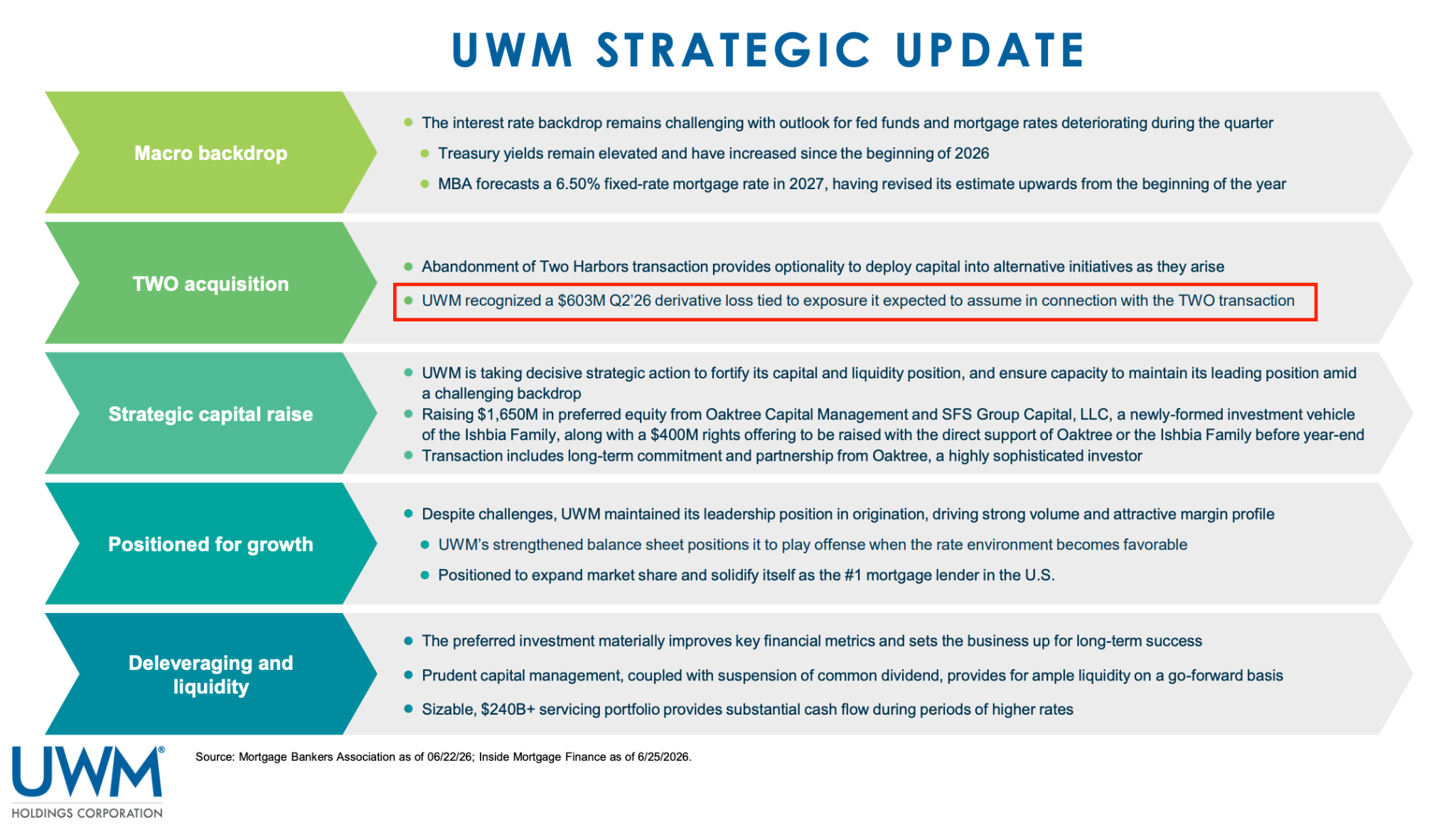
Press outlets have taken the explanation at face value, too. “UWM’s situation became acute in the latest quarter after the company took a $603 million loss related to interest-rate hedges—essentially bets that pay off if rates fall,” wrote The Wall Street Journal.
KBW analysts described the quarter’s GAAP miss as “driven by a $603 million loss on interest rate derivatives, which hedged the Two Harbors MSR portfolio,” HousingWire reported. UWM “suffered losses on a hedge position against Two Harbors’ MSR book,” the HousingWire article read, explaining that the deal “would have doubled the size of its MSR book, significantly increasing risk.”
It’s a clean explanation. But the filings suggest a different reason behind the loss: a $27.5 billion bet on interest rates that, at least at moments, may not have been hedging anything at all.
‘WE DO NOT HEDGE OUR MSRS’
A month before announcing the Two Harbors deal, Ishbia told analysts on UWM’s third-quarter 2025 earnings call: “We do not hedge our MSRs, as you are hopefully aware.”
The posture made sense. UWM’s strength is originating mortgages, a business that wins when rates fall because mortgages become more affordable for borrowers. MSRs, by contrast, move in the opposite direction.
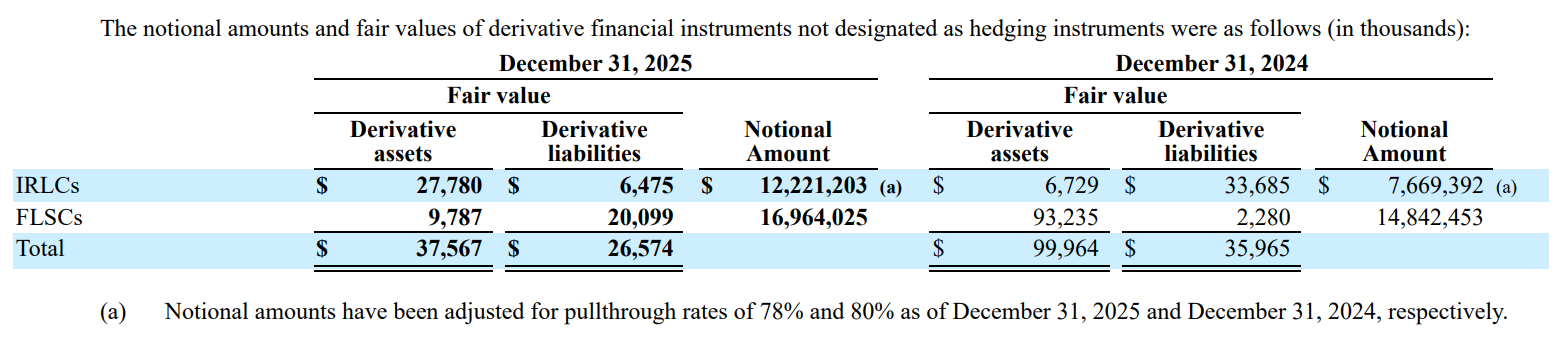
This dynamic led Ishbia to call UWM’s strength in origination a “natural hedge” on the most recent earnings call because, again, MSRs gain value with higher interest rates (because people are less likely to refi), while mortgages are more expensive (and thus harder to originate). UWM’s most recent annual filing reflected that strategy: The derivatives disclosures showed the routine pipeline instruments originators usually carry — rate locks and forward loan sale commitments — and no other standing interest rate position.
Then, in the first quarter of 2026, a new line appeared.
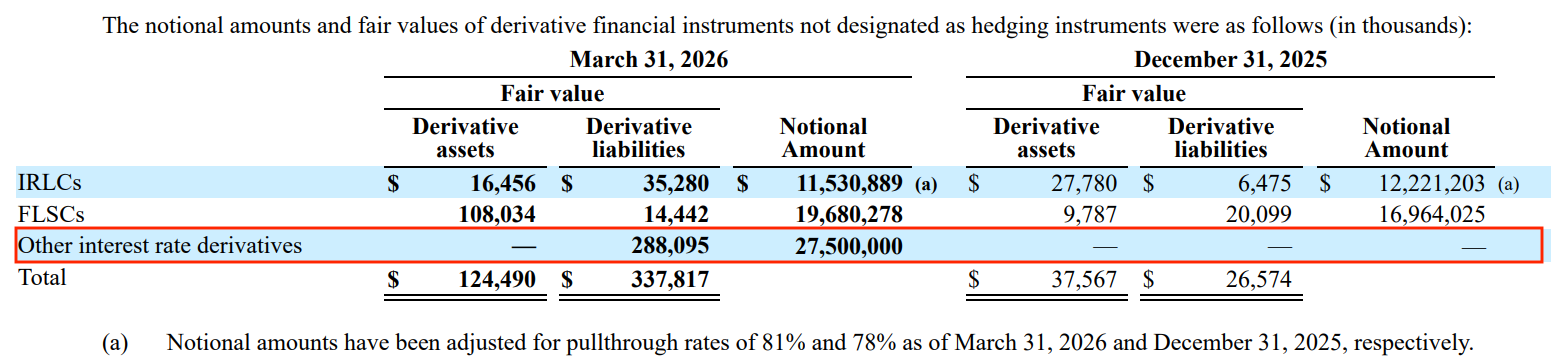
UWM’s first-quarter 10-Q, filed in May, disclosed a position that had not existed at year-end: “other interest rate derivatives.” The listed notional value: $27.5 billion, about an order of magnitude larger than the company’s market cap.
By March 31, the position was already a $288 million liability, with a $138.2 million loss running through the first-quarter income statement. Counterparties were holding $670 million of UWM’s cash as margin: more than 40% of the company’s total equity, posted as collateral to keep UWM’s derivatives positions open, the largest of which was the $27.5 billion notional position.
The position stood to lose roughly $360 million from a 25-basis-point rise in rates, based on the sensitivity disclosed by UWM. It was positioned to profit if rates fell: the same direction UWM’s entire origination franchise already leans. A hedge should offset risk. This position appeared to multiply it.
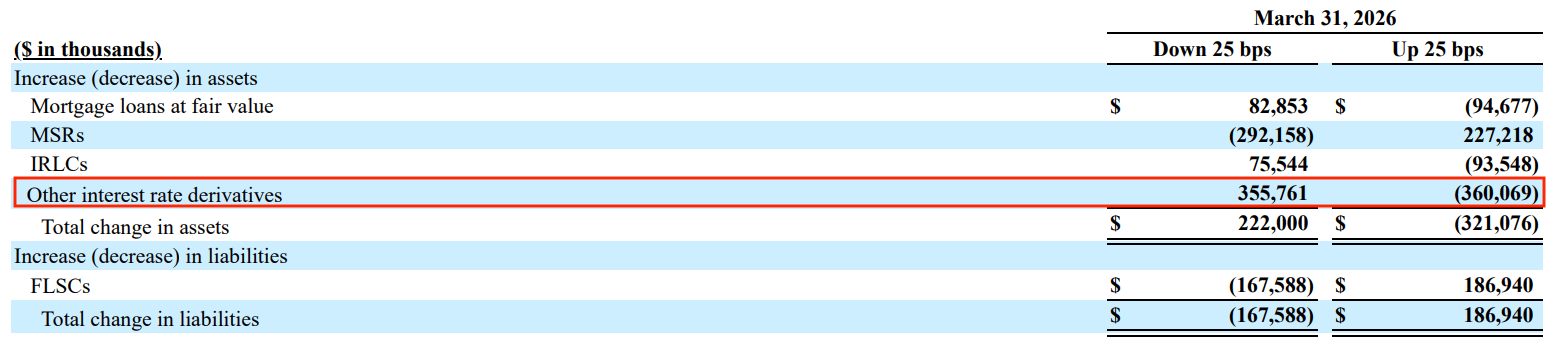
In the second quarter, the 10-year Treasury yield climbed from roughly 4.3% toward what would eventually become an 18-month high. UWM’s position lost another $603 million — $741 million in total across six months — before UWM drastically reduced the position. Book equity fell 38% in a single quarter, from $1.6 billion to $985 million.
Three weeks after the quarter ended, UWM signed the Oaktree term sheet.
TWO HARBORS DEAL DIED IN Q1
So was this ever really a hedge?
Two critical facts suggest that it was not: first, that the Two Harbors deal was already dead prior to the second quarter; second, that the Two Harbors MSR portfolio was already hedged … by Two Harbors itself.
Two Harbors terminated its merger agreement with UWM — signed December 17, 2025 — on March 27, when Two Harbors announced it had agreed to an all-cash offer from CrossCountry Mortgage. UWM’s own 10-Q confirms it received the termination fee “in the first quarter of 2026.”
The writing was on the wall even earlier: On March 16, Two Harbors adjourned its special meeting because the votes to approve the UWM deal weren’t there.
UWM maintained hope. Ishbia continually raised his bid for the asset. But for someone claiming to be interested in hedging, he did not appear to reduce the size of his bet on rate cuts as the TWO deal grew less likely to close.
UWM carried the full $27.5 billion notional position at the beginning of the second quarter — a time at which it had no contract to acquire Two Harbors and only a long-shot proxy campaign urging Two Harbors shareholders to vote down the competing deal. UWM’s stated reason for the loss was a hedge against “exposure it expected to assume in connection with the TWO transaction.” But from March 27 onward, there was no transaction. There was only the trade.
THE TWO HARBORS PORTFOLIO WAS INDEPENDENTLY HEDGED
There is another reason Ishbia’s explanation doesn’t fully make sense: The Two Harbor assets were already hedged by their owner, Two Harbors. So if Ishbia ended up buying the asset, he wouldn’t just be buying the assets, including interest-rate sensitive MSRs; he’d be buying the hedges, too.
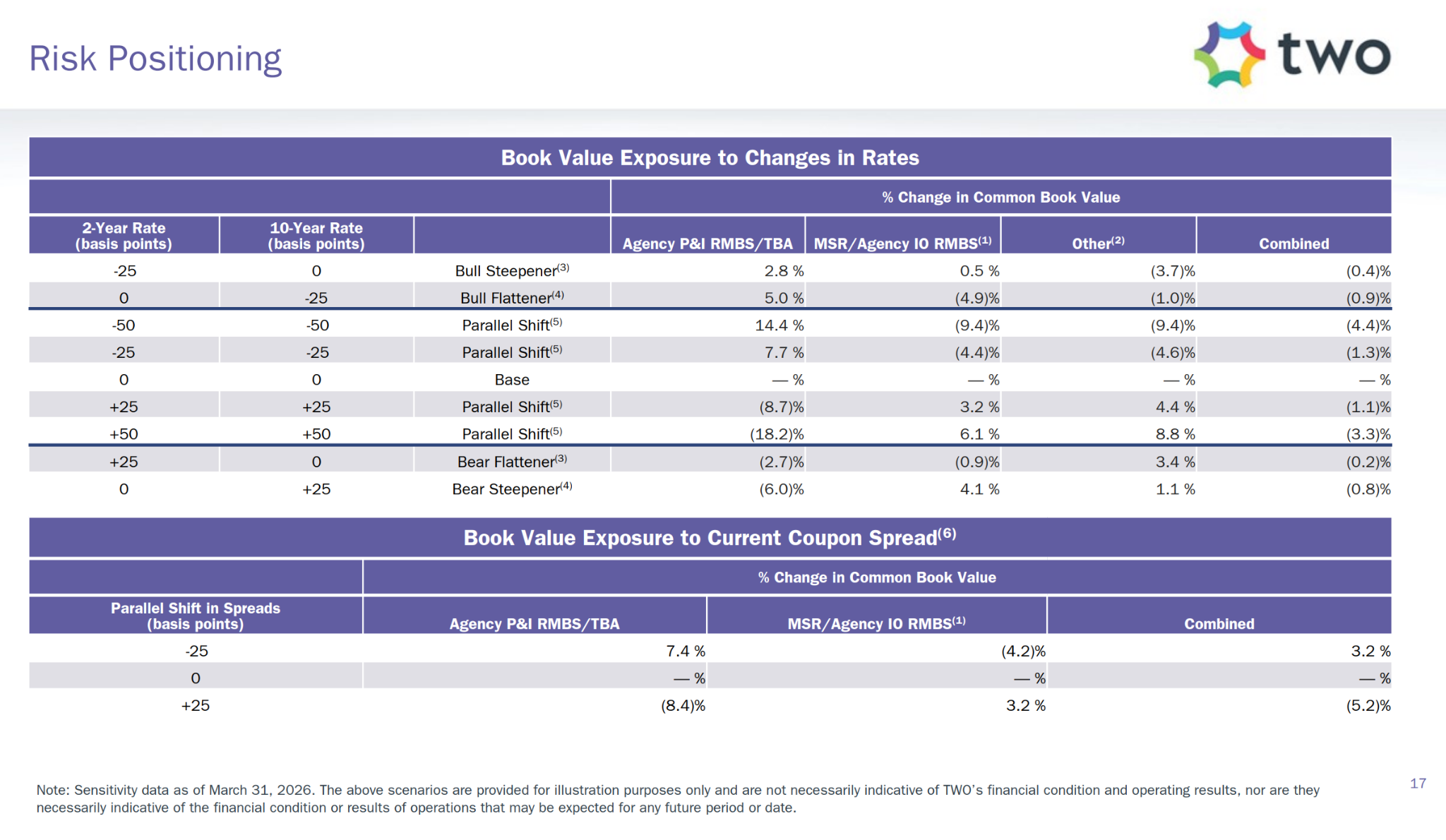
Two Harbors, after all, is a mortgage REIT that is in the business of managing mortgage assets with inherent interest rate risk. Two Harbors’ Q1 2026 Investor Presentation shows that its portfolio was subject to only a 1.3% decrease in common book value on a 25 bps decrease in interest rates, amounting to roughly $15 million. Compare this to UWM, whose MSR hedge cost the company almost half its book value.
UWM’S LAWSUIT AGAINST TWO HARBORS DOESN’T MENTION THE LOSS
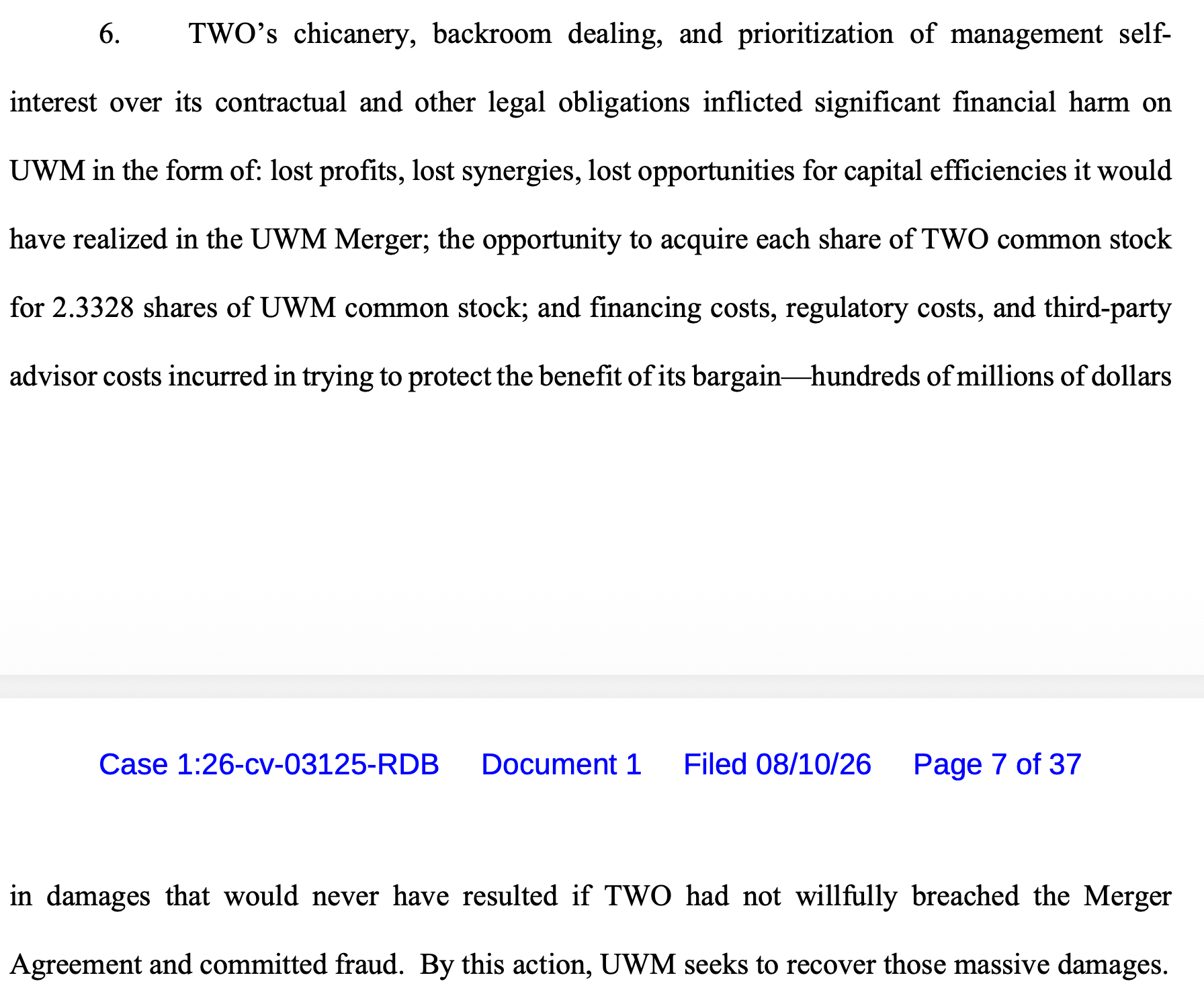
UWM is now suing Two Harbors, alleging breach of contract and fraud, claiming damages including “lost profits, lost synergies, lost opportunities for capital efficiencies it would have realized in the UWM Merger.”
If the $603 million loss were caused by the collapse of the Two Harbors transaction, it might have been the largest single line item in the complaint. But it’s nowhere to be found.
WHAT THE TRADE ACTUALLY LOOKS LIKE
By early 2026, UWM’s balance sheet was strained by years of dividends. The company had distributed roughly $3 billion since 2021. Over 80% went to the Ishbia family. Increasingly, the dividend relied on borrowed money. UWM’s secured credit lines went from zero in September 2025 to nearly $3 billion by June.
A sharp drop in interest rates would have potentially turned things around — leading not just to a refinancing boom for the company’s origination business but also, because of Ishbia’s bet, to a massive trading profit. Instead, rates rose.
The rescue that followed cost the common shareholders their dividend, their place in the capital stack and by the terms of the deal, potentially, one day, the company itself.
UWM, which had previously been governed — without much oversight — by the Ishbia family, now has slots for two Oaktree representatives on the board. If UWM fails to meet certain obligations, Oaktree can take over the entire company. And in the meantime, Oaktree isn’t taking any chances.
Its Investor Rights Agreement contains a clause requiring Oaktree executives to approve UWM’s “capitalization and hedging policy.”
In other words: The days of Mat Ishbia seemingly YOLO trading interest rates may be over.

Hunterbrook reached out to UWM, Two Harbors, and Oaktree with specific questions. Only UWM responded, noting that Hunterbrook provided a tight deadline to respond and offered the following statement:
“Hunterbrook is a hedge fund, not an independent news organization. Considering Hunterbrook’s history of publishing inaccurate allegations that have spawned multiple litigation matters, many of the claims have been resolved in UWM’s favor, it is difficult to view this inquiry as a legitimate journalistic exercise. UWM has been transparent in its public filings and communications, and we do not view Hunterbrook as a credible or objective source for determining the facts.”
AUTHORS
Matthew Termine is a former corporate lawyer with significant experience advising companies operating within regulated industries. Matt led Hunterbrook’s investigation and reporting on United Wholesale Mortgage. In 2017, Matt was credited by the Wall Street Journal, among others, for identifying suspicious mortgage loan transactions that led to several successful criminal prosecutions, including that of a prominent political operative and the chief executive officer of a federally chartered bank. He is a graduate of Trinity College and Fordham University School of Law.
Sam Koppelman is a New York Times best-selling author who has written books with former United States Attorney General Eric Holder and former United States Acting Solicitor General Neal Katyal. He helped build Fenway Strategies into one of the preeminent strategic communications firms in the country—with side quests speechwriting for Michael Bloomberg, running the surrogate remarks operation on the Biden-Harris campaign, and co-founding Mayday, which is now one of the leading information providers on how to access reproductive health care in states with bans. Sam has published in the New York Times, Washington Post, Boston Globe, Time Magazine, and other outlets — and occasionally volunteers on a fire speech for a good cause. He has a BA in Government from Harvard, where he was named a John Harvard Scholar and wrote op-eds like “Shut Down Harvard Football,” which he tells us were great for his social life.
EDITOR
Vikas Kumar joined Hunterbrook from The Capitol Forum, where he led the corporate investigations team for a decade as a senior editor. He was previously an attorney at Gordon Feinblatt, a trial attorney for the Department of Justice, and a law clerk for a federal judge. He has a J.D. from University of Virginia School of Law and a bachelor’s from Emory University. Vikas is based in Maryland.
DISCLOSURES
© 2026 Hunterbrook Media LLC. All rights reserved. Use of this website is strictly governed by our Terms of Use. The content herein is furnished on an “AS IS” basis without any form of express or implied warranty. For information regarding our privacy practices, please refer to our Privacy Policy.
Hunterbrook Media LLC (”Hunterbrook Media”) is an investigative news organization. Hunterbrook Media is affiliated with Hunterbrook Capital LP (”Hunterbrook Capital”), an exempt reporting adviser with the U.S. Securities and Exchange Commission that serves as investment adviser to one or more investment funds. Hunterbrook Media and Hunterbrook Capital are legally separate entities under common control. Hunterbrook Capital’s investment activities are one source of funding for Hunterbrook Media’s journalistic operations. Hunterbrook Capital may hold long positions, short positions, positions through derivative instruments including options and swaps, or no position in any security covered or mentioned on this website. Consistent with applicable policies and procedures, Hunterbrook Capital may establish, modify, or close positions in covered securities before or after the publication of any Hunterbrook Media article. Following publication of any article, Hunterbrook Capital will continue transacting in covered securities for an indefinite period and may be long, short, or flat at any time thereafter, regardless of any position described at publication. Hunterbrook Media has no obligation to update any article or disclosure to reflect subsequent changes in Hunterbrook Capital’s positions.
Nothing on this website constitutes investment advice, a recommendation to buy, hold, or sell any security, or a solicitation to purchase or sell any securities. No securities shall be offered or sold in any jurisdiction where such activities would be contrary to applicable securities laws. Hunterbrook Media is not a registered investment adviser in the United States or any other jurisdiction. Nothing herein should be construed as investment advice or a recommendation of any kind. This information should not be relied upon as a substitute for independent research or professional financial, legal, or tax advice.
This website may feature forward-looking statements reflecting Hunterbrook Media’s current views. Such statements, identifiable by terms including but not limited to “anticipate,” “believe,” “estimate,” “expect,” “intend,” “may,” “plan,” “predict,” “should,” and “will,” are inherently speculative and subject to risks and uncertainties. Actual results or outcomes may substantially deviate from those projected. Hunterbrook Media expressly disclaims any obligation to update or revise any forward-looking statements, regardless of subsequent developments or new information.
The information presented is current as of the date indicated. No representation regarding the completeness or timeliness of this information is made. Some information is sourced from third parties and, while believed to be reliable, has not been independently verified, and its accuracy or completeness is not guaranteed. Hunterbrook Media is not affiliated with any sites linked to this website. Investment in securities and other financial instruments involves significant risk, including the potential loss of principal. Users are advised to conduct their own due diligence and consult professional advisors before engaging in any investment activity. Use of Hunterbrook Media’s content is entirely at the user’s risk. Users shall not use this site for any illegal or prohibited purposes and shall comply with all applicable local, state, national, and international laws and regulations.
Should any provision of these Terms of Use be adjudged invalid or unenforceable, the remaining provisions shall remain in full force and effect. Trademarks contained in links to third-party websites belong to their respective owners. Hunterbrook Media retains copyright on all text, content, graphics, and trademarks displayed on this site.