



By: Michelle Cera, Laura Wadsten
Editor: Sam Koppelman
Based on Hunterbrook Media’s reporting, Hunterbrook Capital is short $ENSG and long a basket of comparable securities at the time of publication. Positions may change at any time. This article is not investment advice or a recommendation to buy, sell, or hold any security. Hunterbrook Media is collaborating with organizations like law firms including Hunterbrook Law to pursue reform based on this reporting. See full disclosures on our website.
Ensign caregivers and residents have reached out to Hunterbrook Media since we published our June 8 article. Their accounts corroborated our findings — and added new, firsthand evidence of resident hunger, payroll falsification, understaffing, and staff licensing issues. Ensign has not issued a public response to our reporting, even as the company quietly attempted to reassure Wall Street.
The Ensign Group ($ENSG) won’t respond to Hunterbrook Media’s reporting.
The company has not replied to repeated emails or phone calls. It didn’t respond to Bloomberg News, either. And it did not engage when Hunterbrook sent a billboard truck to its headquarters, instead sending security after the driver.
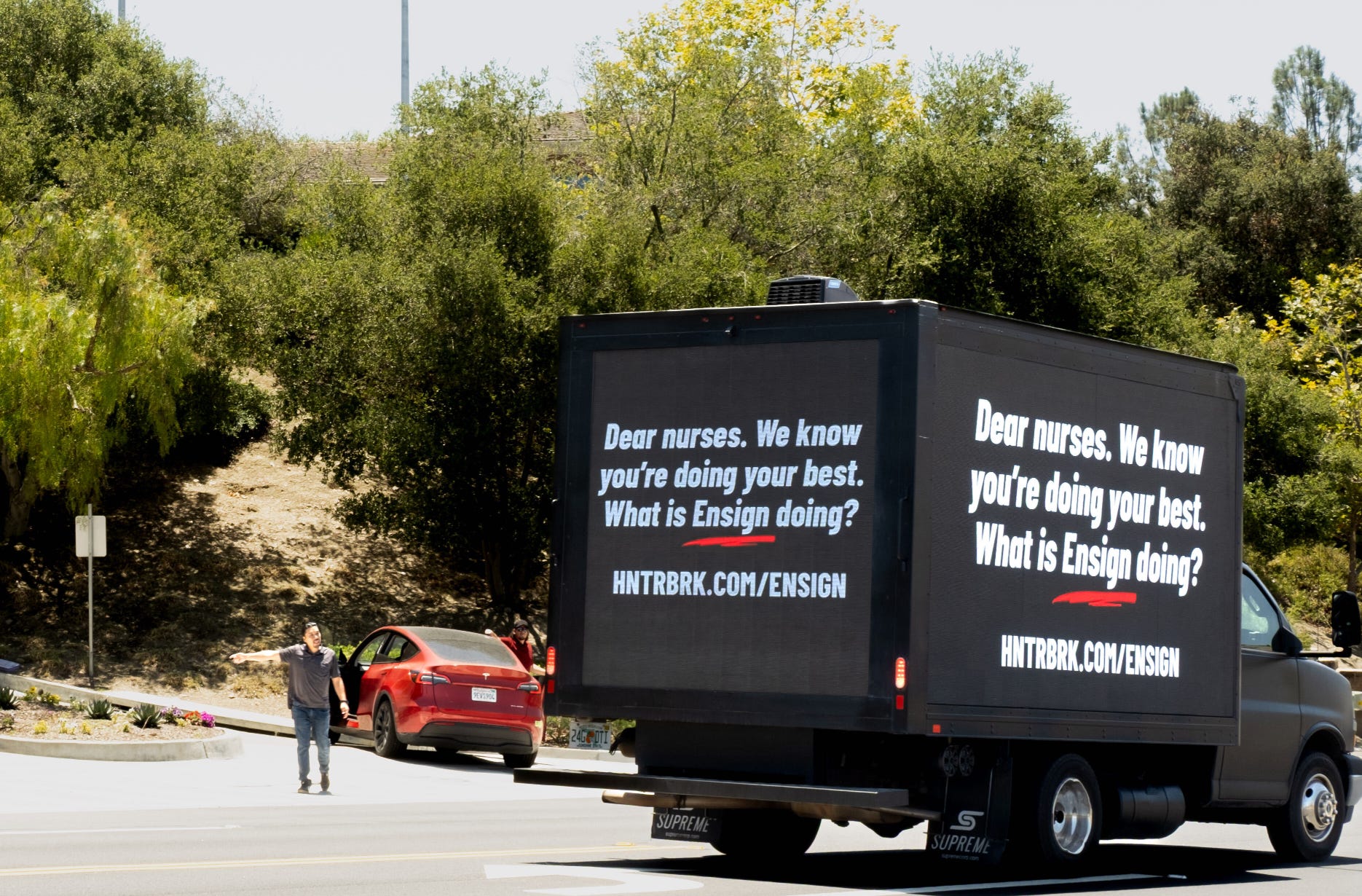
But since we published our investigation into America’s largest chain of nursing homes, staff who have worked at Ensign’s facilities have flooded Hunterbrook’s inbox with harrowing accounts of conditions inside those facilities. The company, meanwhile, has expanded its stock repurchase authorization to $100 million.
One certified nursing assistant (CNA) claimed their facility — where they had worked for a decade — was stripped of resources when Ensign took over. They even claimed to have won a company award for cutting its food budget as residents went hungry.
The alleged award isn’t on display, the CNA said: “It’s not something to be proud of.”
The kitchen is allegedly kept locked, so staff find ways to sneak in for food. The CNA said they once drove to a nearby Sonic, on their own time and their own dime, to buy a hungry resident a hamburger. The CNA makes $16.75 an hour.
That CNA wasn’t alone.
The accounts that reached Hunterbrook after our investigation into Ensign came from Texas, Arizona, California, and Tennessee. Most sources spoke on condition of anonymity, fearing retaliation. Their stories corroborate our reporting and add firsthand detail of the often grim reality inside Ensign facilities.
Asked what had changed the most since Ensign took over, the CNA from Tennessee answered: “The dignity of our residents.”
Weight Loss, Hunger
The award, the locked kitchen, the Sonic run — and there was more.
The same CNA in Tennessee told Hunterbrook about the food residents do get served. “They’re getting like half-cup-sized portions,” they said. “Like if you were on a weight loss diet.”
Federal law requires nursing facilities to provide each resident with a well-balanced diet that meets his or her specific dietary needs. Yet research still finds malnutrition and food deprivation across the industry.
A separate CNA at an Ensign facility in California recounted similar nutritional shortcomings. Though some residents had conditions with specific dietary needs, like diabetes or hypertension, they said, everyone was served the same thing.
“I don’t think it’s adequate,” the CNA told Hunterbrook about the food served to residents. “It’s not healthy at all.”
And because the floor is so short-staffed, the CNA said, residents with dementia who can’t feed themselves are simply left unfed. “Then the patients end up losing weight, and they just go downhill.”
Shortages and Locked Supply Closets
Hunger is one symptom of a broader refusal to spend on necessities.
Three people who worked for Ensign described severe shortages of even the cheapest supplies. A former licensed practical nurse (LPN) wrote in about a constant lack of basic materials for patients who were often in “very acute” need, with “numerous wounds.”
In Tennessee, a CNA said it went beyond shortages: Essentials were rationed and locked in closets only management could open. Staff bought soap and deodorant out of their own pockets to preserve some basic dignity for residents.
In California, another CNA described the same locked closets. “For the first year or more we didn’t have access to bottles of soap,” the CNA said. “They’re trying to save money or something.”
Staff, allegedly, weren’t given the alcohol pads needed to clean catheter drainage tubes, the California CNA said — so “people just empty it … and then just close it up again.”
This could lead to urinary tract infections, according to the CNA. “That could kill them.”
Inflating Nursing Hours
The shortages weren’t the only thing being hidden.
Independently of each other, both Tennessee employees described a scheme to make the facility look better staffed than it was: Nonclinical workers logged as floor CNAs.
Hours for people employed in office, housekeeping, and dietary roles were recorded as CNA hours, an employee explained — inflating the facility’s reported nursing time so that, in their words, “they don’t have to staff more CNAs for that shift.”
The LPN flagged the same alleged practice — “the use of CNA credentials for staffing purposes while employees were primarily working in non-direct care roles.”
The CNA also described a repeated situation where their hours were misreported: inserting lunch breaks they never took, and inflating their hours, including one shift logged as 19 hours. “I know I didn’t work 19 hours,” they told Hunterbrook.
They raised it with HR, which claimed it was a mistake. Within weeks, they said, another shift showed up documented as 19 hours.
Misclassifying staff hours to inflate the facility’s reported nursing hours would also inflate the facility’s CMS 5-star ratings for staffing and overall — as Hunterbrook found was the case in our initial investigation.
The Tennessee CNA described how this plays out in real life.
In keeping with Hunterbrook’s finding that registered nurse hours fall after Ensign acquires a facility, this CNA estimated the building now has a single RN for 67 patients.
Sometimes, they said, staff need help transferring a patient out of bed, but there are no extra hands.
“These people are wanting their showers. It’s impossible.”
An LPN who worked at an Ensign facility in Texas said there often weren’t even enough CNAs to take patients to the bathroom.
“I care deeply about the residents and have watched conditions deteriorate despite raising concerns internally,” they said in an email.
Practicing Above Their License
Understaffing doesn’t just shortchange residents — it pushes the problem onto employees with the lowest certification levels and pay scale.
When the schedule comes up short, our investigation found, Ensign fills the gap not by hiring, but by leaning on overworked, under-credentialed staff. That leaves frontline workers an impossible choice: Jeopardize their license to keep residents safe, or stop at what they’re legally allowed to do and watch patients go without care.
The Tennessee CNA described RN coverage simply vanishing from a shift: “If that person didn’t have an RN title and wanted that shift, then they would probably just throw another LPN in down there,” they said. “There just wouldn’t be an RN on shift.”
The LPN in Texas lived the consequences of this staffing model — left, as a new LPN, responsible for some of the sickest patients in the building without adequate support. “I was too ignorant at the time to realize my license was in jeopardy the longer I worked at this facility,” they told Hunterbrook in an email.
The California CNA recalled months when the floor had at most one RN — and the only RN providing hands-on care was the assistant director of nursing. Otherwise, LPNs staffed the floor alone. LPNs in California are not licensed to independently perform critical tasks such as ventilator management or administering IVs.
It is the definition of a moral quandary — staff forced, shift after shift, to choose between their professional code and the residents in front of them. Ensign has built a workforce of people who, in the Tennessee CNA’s words, “put 110% into their residents’ care” while quietly absorbing the legal and ethical risk of a staffing model designed to spend as little as possible on care.
The Texas LPN told Hunterbrook that their experience at Ensign made them stop working at skilled nursing facilities altogether. “I loved my patients and wanted nothing but the best for them,” they said in an email, “but it was so hard on the soul to see the neglect.”
While Ensign has not replied to repeated requests for comment from Hunterbrook Media and other news outlets, the company has quietly spoken with Wall Street.
Sell-side analysts at RBC Capital Markets and UBS Securities published notes reassuring investors — after conversations with Ensign management. The company also spoke directly with hedge funds invested in $ENSG.
Ensign’s staff, patients, and families of patients are still waiting for answers.
If you or a loved one has been affected, or if you have any relevant information to share, please reach out at ideas@hntrbrk.com. This is part two of a series on Ensign and the industry.
Authors
Michelle Cera trained as a sociologist specializing in digital ethnography and pedagogy. She completed her PhD in Sociology at New York University, building on her Bachelor of Arts degree with Highest Honors from the University of California, Berkeley. She has also served as a Workshop Coordinator at NYU’s Anthropology and Sociology Departments, fostering interdisciplinary collaboration and innovative research methodologies.
Laura Wadsten is an investigative journalist specializing in healthcare. She began her career reporting on antitrust and health care markets as a Correspondent for The Capitol Forum, a premium subscription financial publication. Previously, she was Executive Director of the nonprofit Moving to Value Alliance, where she produced the MTVA Unscripted Podcast. Laura was a Hodson Scholar and Editor-in-Chief of The News-Letter at Johns Hopkins University, where she earned a B.A. in Medicine, Science & the Humanities.
Editor
Sam Koppelman is a New York Times best-selling author who has written books with former United States Attorney General Eric Holder and former United States Acting Solicitor General Neal Katyal. He helped build Fenway Strategies into one of the preeminent strategic communications firms in the country. Sam has published in the New York Times, Washington Post, Boston Globe, Time Magazine, and other outlets — and occasionally volunteers on a fire speech for a good cause. He has a BA in Government from Harvard, where he was named a John Harvard Scholar and wrote op-eds like “Shut Down Harvard Football,” which he tells us were great for his social life.
Graphic
Dan DeLorenzo is a creative director with 25 years reporting news through visuals. Since first joining a newsroom graphics department in 2001, he has built teams at Bloomberg News, Bridgewater Associates, and the United Nations, and published groundbreaking visual journalism at The Wall Street Journal, Associated Press, The New York Times, and Business Insider. A passion for the craft has landed him at the helm of newsroom teams, on the ground in humanitarian emergencies, and at the epicenter of the world’s largest hedge fund. He runs DGFX Studio, a creative agency serving top organizations in media, finance, and civil society with data visualization, cartography, and strategic visual intelligence. He moonlights as a professional sailor working toward a USCG captain’s license and is a certified Pilates instructor.
Hunterbrook Media publishes investigative and global reporting — with no ads or paywalls. When articles do not include Material Non-Public Information (MNPI), or “insider info,” they may be provided to our affiliate Hunterbrook Capital, an investment firm which may take financial positions based on our reporting. Subscribe here. Learn more here.
Please contact ideas@hntrbrk.com to share ideas, talent@hntrbrk.com for work opportunities, and press@hntrbrk.com for media inquiries.
LEGAL DISCLAIMER
© 2026 Hunterbrook Media LLC. When using this website, you acknowledge and accept that such usage is solely at your own discretion and risk.
Hunterbrook Media LLC (”Hunterbrook Media”) is an investigative news organization. Hunterbrook Media is affiliated with Hunterbrook Capital LP (”Hunterbrook Capital”), an exempt reporting adviser with the U.S. Securities and Exchange Commission that serves as investment adviser to one or more investment funds. Hunterbrook Media and Hunterbrook Capital are legally separate entities under common control. Hunterbrook Capital’s investment activities support Hunterbrook Media’s journalistic operations. Hunterbrook Capital’s investment performance can be affected by price movements in securities, derivatives, or other financial instruments related to companies covered in Hunterbrook Media’s reporting.
The specific position, if any, held by Hunterbrook Capital at the time of publication is disclosed at the top of this article. Any position or exposure may consist of direct holdings, short sales, options, swaps, other derivatives, or other forms of economic exposure to the securities or issuers discussed herein. Any position held may include equity securities, options, swaps, or other derivative instruments. Consistent with applicable policies and procedures, Hunterbrook Capital may establish, modify, or close positions in covered securities before or after this article is published. Following publication, Hunterbrook Capital will continue transacting in covered securities for an indefinite period and may hold long, short, or no positions at any time thereafter, regardless of any position described at publication. Hunterbrook Media has no obligation to update this article to reflect subsequent changes in Hunterbrook Capital’s positions. Any discussion in this article regarding value, valuation, downside, upside, or potential future stock price reflects Hunterbrook Media’s opinion as of the publication date. Such statements should not be interpreted as price targets and should not be understood to mean that Hunterbrook Capital intends to maintain any position until any particular price, valuation, or outcome is achieved. Hunterbrook Capital may modify, reduce, increase, hedge, or close positions at any time for risk management, portfolio management, liquidity, regulatory, investor, or other business reasons.
Nothing herein constitutes investment advice, a recommendation to buy, hold, or sell any security, or a solicitation to purchase or sell any securities. Hunterbrook Media is not a registered investment adviser in the United States or any other jurisdiction. All information and opinions presented are subject to change without notice.
Hunterbrook Media strives to ensure the accuracy and reliability of the information provided, drawing on sources believed to be trustworthy. Nevertheless, this information is provided “as is” without any guarantee of accuracy, timeliness, completeness, or fitness for any particular purpose. Hunterbrook Media does not guarantee the results obtained from the use of this information, and expressly disclaims any warranty, express or implied, as to accuracy or reliability. You should conduct your own research and seek advice from qualified financial, legal, and tax professionals before making any investment decisions based on information obtained from Hunterbrook Media.
The content provided by Hunterbrook Media does not constitute an offer to sell, nor a solicitation of an offer to purchase, any securities. No securities shall be offered or sold in any jurisdiction where such activities would be contrary to applicable securities laws. Hunterbrook Media authorizes redistribution of these materials, in whole or in part, for non-commercial, informational purposes only, provided that such redistribution includes this notice without alteration. Commercial use or alteration of these materials requires the express written approval of Hunterbrook Media LLC. By accessing this content, you agree to Hunterbrook Media’s Terms of Use.