



By: Matthew Termine, JD Jean-Jacques
Editor: Sam Koppelman
Based on Hunterbrook Media’s reporting, at the time of publication Hunterbrook Capital is short bonds issued by Sammons Financial Group. Positions may change at any time. This article is not investment advice or any recommendation. See full disclosures on our website.
Even for journalists investigating the sprawling Walter saga, the divestment announcement came out of left field.
The Sammons conglomerate, which has owned a big stake in Mark Walter’s business since before it even bore the name Guggenheim, says it’s leaving the stadium after three decades.
This comes as Walter, billionaire owner of the Los Angeles Dodgers, has embarked on rapid sales for liquidity amid a federal probe into how his life insurers disclose investments. After he agreed to sell his majority stake in the Los Angeles Lakers last week, the FT reported he’s also exploring the sale of his stake in Chelsea Football Club. He even reportedly offered his Guggenheim shares as collateral to resolve holes in the balance sheets of insurers owned by The Walter Group (TWG), which back life insurance policies held by millions of Americans.
Hunterbrook Media reported on Sunday that Sammons cut Guggenheim from its disclosures the year before federal agents seized devices from Walter and another Guggenheim executive.
The removal of Guggenheim from the Sammons filings conflicted with Guggenheim’s latest filings. Guggenheim still calls Sammons a related party, its largest stakeholder, and its largest source of fees. Guggenheim also invests money from Sammons life insurers. Despite all of this ongoing business, Sammons claims Guggenheim is unaffiliated.
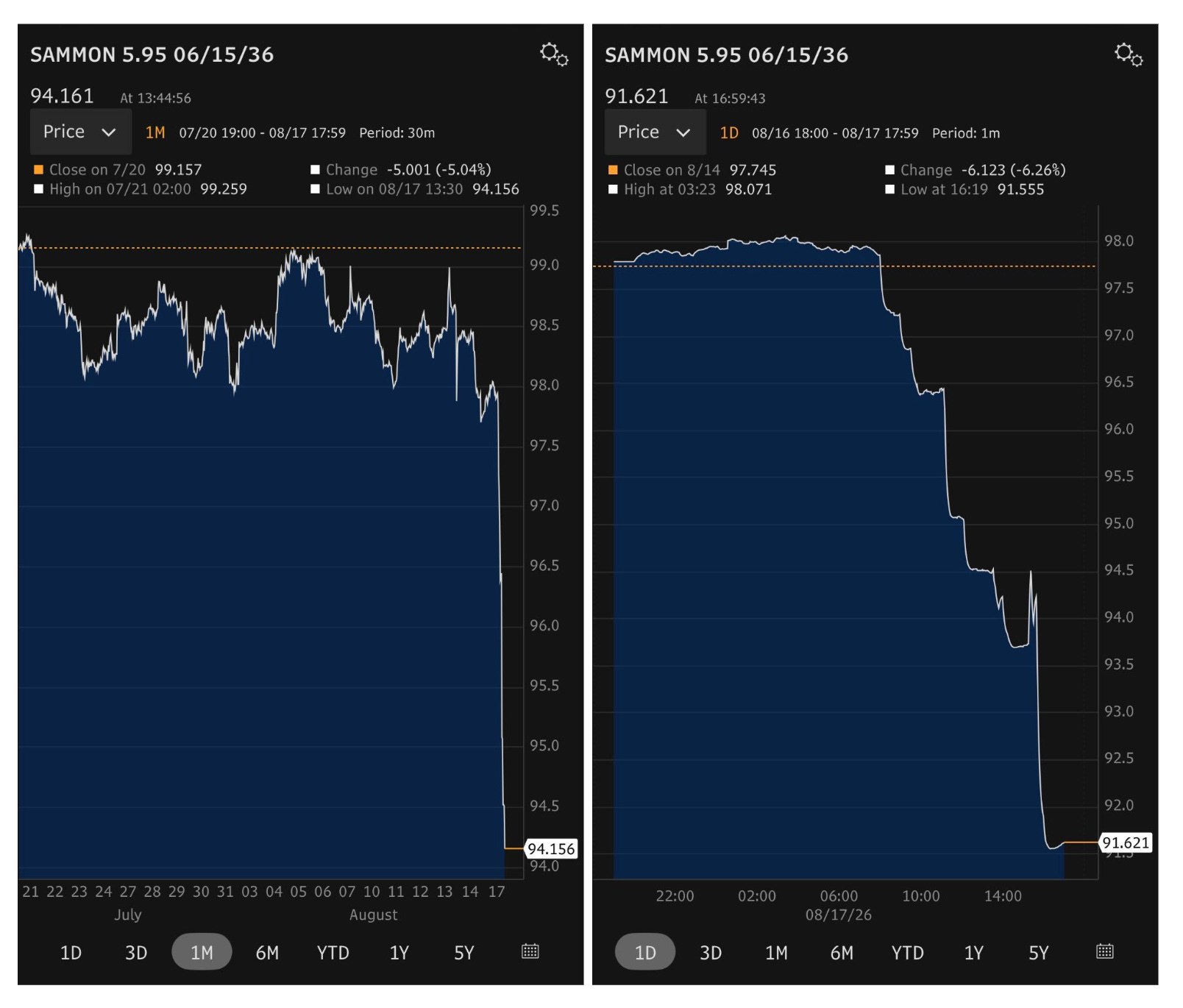
The day after Hunterbrook published its investigation, Bloomberg reported that Sammons bonds quickly sank to an all-time low. Hours later, Bloomberg also reported on a 20% drop in a term loan by Guggenheim’s GIH Borrower LLC.
BONDS ISSUED BY SAMMONS FINANCIAL GROUP DECLINED TO ALL-TIME LOW ON AUGUST 17:
Hunterbrook didn’t report weaknesses in the assets underlying the bonds from either Sammons or Guggenheim, but did detail a web of undisclosed or notable ties between the firms and their affiliates. Hunterbrook also discovered the use of Sammons life insurance money to fund assets owned by Walter’s TWG investments, including a bull-riding team, through a Guggenheim-managed investment vehicle.
Representatives of AM Best, the agency that assigned Sammons Financial’s bonds an “‘a-’ (Excellent)” rating in June, declined to comment when reached by phone on Monday, but directed Hunterbrook over email to its webpage on how it views and analyzes affiliated and non-affiliated investments. Another Sammons rating agency, Fitch did not respond to a request for comment.
But last night, Sammons Financial and its parent Sammons Enterprises chimed in, after not acknowledging repeated requests for comment leading up to the first Hunterbrook article.
Sammons did not refute the facts of Hunterbrook’s reporting. The conglomerate clarified several distinctions about its entities and emphasized that it “is a separate and independently managed organization” from “Guggenheim and certain of its affiliates.” The conglomerate also claimed that “Sammons, its officers, directors, and employees are not under investigation.”
Then Sammons announced, for the first time, that it “has been divesting over the past several years” from Guggenheim Capital, the parent company of several Guggenheim affiliates, including entities that have managed Sammons life insurance assets for many years.
A Guggenheim spokesperson declined to comment on the divestment. A Guggenheim executive said they had not heard of it.
The largest owner of an asset management giant beginning to divest its stake after 30 years of partnership would have been news on a regular Monday — even if that owner hadn’t also invested roughly a hundred billion dollars with that asset manager. As Guggenheim’s CEO is in a federal investigation and offloading assets, this marks Guggenheim’s largest stakeholder and CEO both simultaneously raising cash.
At the same time, key statements by Sammons and Guggenheim directly contradict each other.
Sammons — on behalf of Sammons Financial and its parent company Sammons Enterprises — claimed in its new announcement: “We are not affiliated with Guggenheim Capital LLC.” It also affirmed it “owns a non-voting and non-controlling, minority interest in Guggenheim Capital.”
But a May filing by Guggenheim Investments Private Credit Fund disclosed, in contrast, that:
“Sammons Enterprises, Inc., a diversified company with several insurance company subsidiaries (together with its subsidiaries, “Sammons”), holds indirect economic and voting interests in Guggenheim Capital, LLC (“Guggenheim Capital”), the Adviser’s ultimate parent company. As a result of its ownership stake in Guggenheim Capital, Sammons is the largest individual stakeholder of the Adviser. Certain of Sammons’ wholly owned insurance company and other subsidiaries are advisory clients of, and pay fees to, the Adviser. As a result, Sammons is the largest individual source of annual advisory fees paid to the Adviser. Sammons also has other relationships with the Adviser and various Guggenheim Entities.”
Is Guggenheim correct that Sammons owns “voting interests” in Guggenheim Capital, or is the Sammons conglomerate correct that it “owns a non-voting” interest in Guggenheim Capital?
Even more recently, a July 30 filing by Guggenheim Partners Investment Managements (GPIM) identifies the Sammons Enterprises vehicle called Sage Assets as a “Control Person,” because it can appoint representatives to Guggenheim Capital’s executive committee. GPIM also lists Sammons Financial’s life insurers as “related persons.” (TWG not disclosing related parties is reportedly what catalyzed the federal investigation).
And a March 31 filing by Guggenheim Private Investments (GPI; not GPIM) similarly identifies Sammons Enterprises as an “indirect substantial owner,” as well as a “significant individual source of annual advisory fees” paid to one of GPI’s affiliates and also a “primary lender.”
So one of Sammons or Guggenheim — which each manage hundreds of billions of dollars — seems to be wrong, unless the voting interests were zeroed after May 7, or Sammons and Guggenheim are using different definitions of control and voting interests.1 Sammons and Guggenheim could not immediately be reached for clarification.
Sammons also claimed on Monday that Sammons Enterprises has no “ability to control, Guggenheim Capital LLC, TWG Global Holdings LLC, nor any of their affiliates.” However, that “ability to control” may be a technical or even strictly semantic distinction.
Because in addition to the “Control Person” July filing by Guggenheim, Sammons is the largest stakeholder in Guggenheim and “the largest individual source of annual advisory fees” paid to Guggenheim. Sammons buys loans structured by Guggenheim. Sammons is a “primary lender in a facility that provides leverage” to a fund advised by Guggenheim Private Investments. And it has life insurance money invested in a Mark Walter rodeo investment held via TWG and managed by Guggenheim.
HOW IT ALL TIES TOGETHER & WHERE SAMMONS MAY BE UNTYING
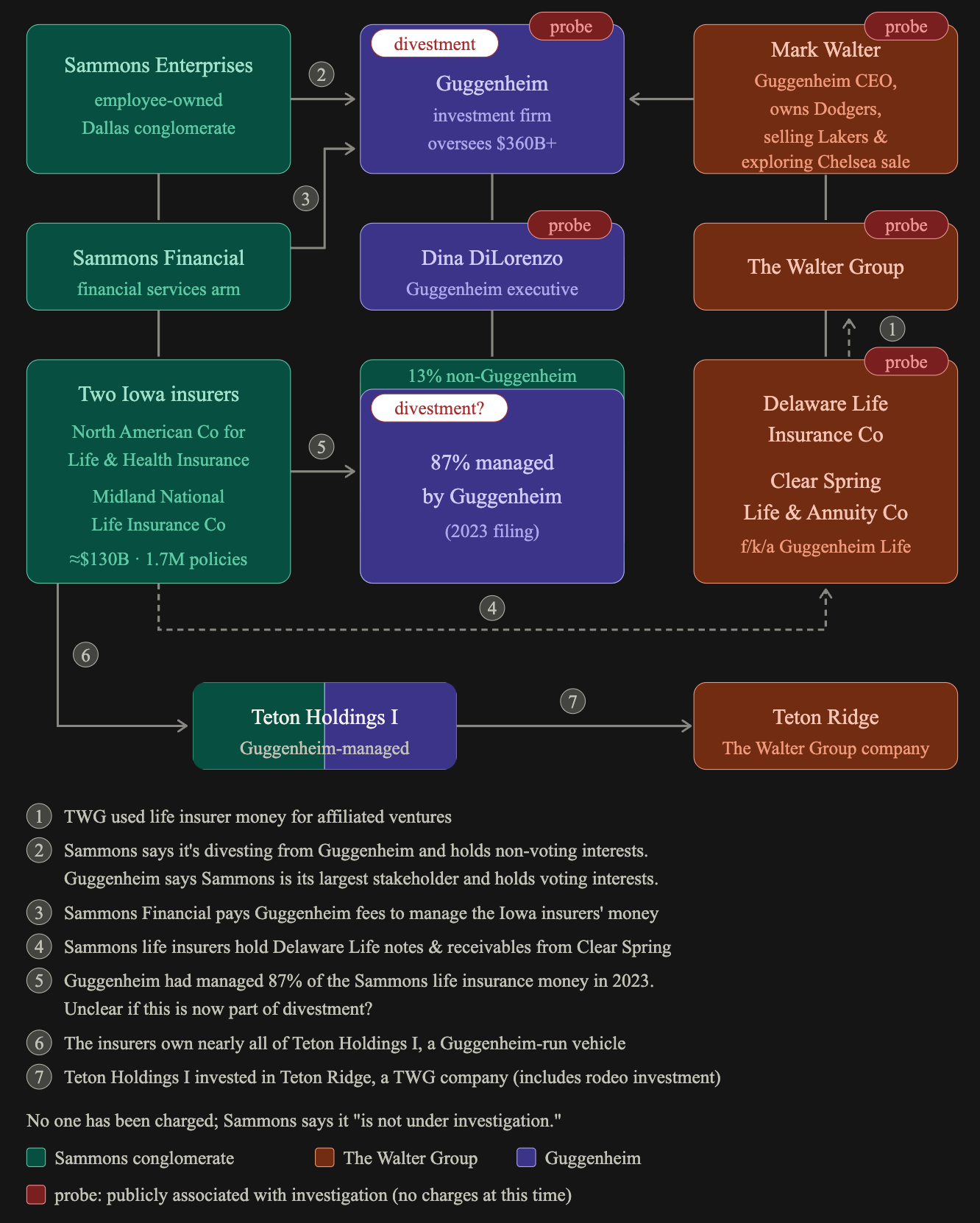
Is Sammons divesting its ownership in Guggenheim, or also its roughly one hundred billion dollars in life insurance assets managed by Guggenheim?
And if Sammons is divesting both its ownership and its fund investments, what does that mean for the value of Mark Walter’s stake — which he offered to pledge as collateral to meet life insurance loans at the center of the federal investigation?
In the new statement, Sammons now highlights diversification where it used to highlight Guggenheim’s role as its “core manager” of life insurance assets. Sammons says it’s now “utilizing more than 15 independent, third-party investment managers.”
Sammons doesn’t, however, identify what percentage of its assets each of those firms manages. As of 2023, according to Sammons audited financials, Guggenheim was running 87% of its investment portfolio, about $100 billion dollars.
That percent going down would enable Sammons to tell regulators and insurance policyholders it’s diversifying risk and reducing reliance on affiliated investors at a time when affiliations (or claims to the contrary) are under federal scrutiny.
But that same diversification would be tough news for Guggenheim, and for Walter.
And it certainly looks like the relationship between the two entities is changing. In every filing from 2023 through March 2025, Guggenheim’s SEC ownership schedules listed Sammons’ holding entity, Sage Assets, as a 25%-50% owner and “control person.” Then, in May 2025, the Sammons chain was removed: Guggenheim described a “change in the ownership structure of Guggenheim Capital, LLC by SAGE Assets, Inc. falling below 25%.”
This could be a result of the divestiture or of Sammons renouncing their voting rights.
The truth will be revealed in time. For now, it’s quite the rodeo.
AUTHORS
Matthew Termine is a former corporate lawyer with significant experience advising companies operating within regulated industries. Matt led Hunterbrook’s investigation and reporting on United Wholesale Mortgage. In 2017, Matt was credited by the Wall Street Journal, among others, for identifying suspicious mortgage loan transactions that led to several successful criminal prosecutions, including that of a prominent political operative and the chief executive officer of a federally chartered bank. He is a graduate of Trinity College and Fordham University School of Law.
JD Jean-Jacques joined Hunterbrook from Goldman Sachs, where he worked as an investment banker. He was editor-in-chief of Howard University’s newspaper, The Hilltop, and wrote for The Exonian at Phillips Exeter Academy. Among other recognitions, JD was a White House Correspondents’ Association Scholar and was named Student Journalist of the Year by The National Association of Black Journalists. He graduated from Howard with a B.A. in history.
EDITOR
Sam Koppelman is a New York Times best-selling author who has written books with former United States Attorney General Eric Holder and former United States Acting Solicitor General Neal Katyal. Sam has published in the New York Times, Washington Post, Boston Globe, Time Magazine, and other outlets. He has a BA in Government from Harvard, where he was named a John Harvard Scholar and wrote op-eds like “Shut Down Harvard Football,” which he tells us were great for his social life. Sam is based in New York City.
Nathaniel Horwitz contributed reporting.
DISCLOSURES
© 2026 Hunterbrook Media LLC. All rights reserved. Use of this website is strictly governed by our Terms of Use. The content herein is furnished on an “AS IS” basis without any form of express or implied warranty. For information regarding our privacy practices, please refer to our Privacy Policy.
Hunterbrook Media LLC (”Hunterbrook Media”) is an investigative news organization. Hunterbrook Media is affiliated with Hunterbrook Capital LP (”Hunterbrook Capital”), an exempt reporting adviser with the U.S. Securities and Exchange Commission that serves as investment adviser to one or more investment funds. Hunterbrook Media and Hunterbrook Capital are legally separate entities under common control. Hunterbrook Capital’s investment activities are one source of funding for Hunterbrook Media’s journalistic operations. Hunterbrook Capital may hold long positions, short positions, positions through derivative instruments including options and swaps, or no position in any security covered or mentioned on this website. Consistent with applicable policies and procedures, Hunterbrook Capital may establish, modify, or close positions in covered securities before or after the publication of any Hunterbrook Media article. Following publication of any article, Hunterbrook Capital will continue transacting in covered securities for an indefinite period and may be long, short, or flat at any time thereafter, regardless of any position described at publication. Hunterbrook Media has no obligation to update any article or disclosure to reflect subsequent changes in Hunterbrook Capital’s positions.
Nothing on this website constitutes investment advice, a recommendation to buy, hold, or sell any security, or a solicitation to purchase or sell any securities. No securities shall be offered or sold in any jurisdiction where such activities would be contrary to applicable securities laws. Hunterbrook Media is not a registered investment adviser in the United States or any other jurisdiction. Nothing herein should be construed as investment advice or a recommendation of any kind. This information should not be relied upon as a substitute for independent research or professional financial, legal, or tax advice.
This website may feature forward-looking statements reflecting Hunterbrook Media’s current views. Such statements, identifiable by terms including but not limited to “anticipate,” “believe,” “estimate,” “expect,” “intend,” “may,” “plan,” “predict,” “should,” and “will,” are inherently speculative and subject to risks and uncertainties. Actual results or outcomes may substantially deviate from those projected. Hunterbrook Media expressly disclaims any obligation to update or revise any forward-looking statements, regardless of subsequent developments or new information.
The information presented is current as of the date indicated. No representation regarding the completeness or timeliness of this information is made. Some information is sourced from third parties and, while believed to be reliable, has not been independently verified, and its accuracy or completeness is not guaranteed. Hunterbrook Media is not affiliated with any sites linked to this website. Investment in securities and other financial instruments involves significant risk, including the potential loss of principal. Users are advised to conduct their own due diligence and consult professional advisors before engaging in any investment activity. Use of Hunterbrook Media’s content is entirely at the user’s risk. Users shall not use this site for any illegal or prohibited purposes and shall comply with all applicable local, state, national, and international laws and regulations.
Should any provision of these Terms of Use be adjudged invalid or unenforceable, the remaining provisions shall remain in full force and effect. Trademarks contained in links to third-party websites belong to their respective owners. Hunterbrook Media retains copyright on all text, content, graphics, and trademarks displayed on this site.