



BY: Jenny Ahn, Matthew Termine, Sam Koppelman, Michelle Cera, Claire Abrahams, Blake Spendley
EDITOR: Vikas Kumar
This is the latest investigation in Hunterbrook’s housing beat, which began with our debut story in 2024: an exposé on United Wholesale Mortgage, which has since succumbed to rescue financing. We’ve investigated the private jets, yacht, and mounting debt of Restoration Hardware; the aggressive sales tactics LGI Homes used to lure renters into homes they can’t afford; and construction defects that turned dream homes into nightmares. We’ve also investigated houses on wheels, exposing how Winnebago covered up failing RV frames, now the focus of a federal lawsuit. Today’s story follows up on last week’s investigation into Lennar and Millrose, which may be among the wildest yet.
Based on Hunterbrook Media’s reporting, at the time of publication Hunterbrook Capital is short $MRP, short $LEN, and long a basket of comparable securities. Positions may change at any time. This article is not investment advice or any recommendation. See full disclosures on our website.
When Hunterbrook Media discovered that Lennar was selling houses to the company it had spun off, reporters visited communities in Florida and Texas to see these homes firsthand.
On September 29, a reporter visited 36 houses owned by Millrose Properties in Florida’s Marion County. The next day, another reporter visited 39 houses Millrose had purchased from Lennar in Princeton, Texas. They found unfurnished rooms and notices hanging from doors. At one Texas house, large spiderwebs stretched across the entrance.
Not one of the 75 homes appeared occupied.
That same week, Millrose executives were describing a business to Goldman Sachs in which tenants would already be lined up before the company bought the houses, according to a research note sent to clients reviewed by Hunterbrook.
“Millrose buys the home with a signed lease already in place,” the bank wrote in its September 30 recap of the meeting.
The pitch was a path to homeownership for people who couldn’t qualify for a mortgage: Millrose would buy the house they wanted, rent it to them, and allow part of the monthly payments to accumulate toward an eventual purchase. Having a renter identified beforehand, Goldman’s note explained, could mitigate the risk of buying a house and then needing to find someone to fill it.
But Hunterbrook’s reporting suggests that is not the business Millrose is actually operating.
Millrose was created to hold land for future construction, giving Lennar access to building sites without having to own them outright. Its largest voting shareholder is Lennar’s own CEO, Stuart Miller. Last week, Hunterbrook revealed that the land bank had become a major buyer of Lennar’s finished houses, estimating roughly $200 million in purchases in about a month.
Though Millrose accounted for just a fraction of Lennar’s home deliveries last fiscal quarter, its purchases pushed Lennar’s third quarter deliveries past guidance, the only homebuilding target it hit that quarter.
Lennar shares fell 6.7% on the first full trading day after Hunterbrook’s report, their “sharpest one-day decline since March 2024,” according to Barron’s. Millrose shares fell 8.5% the same day. Neither company has publicly addressed Hunterbrook’s findings.
In the days since, Hunterbrook has expanded its search and identified a total of 1,096 transaction records across 16 states, bringing the estimated aggregate transaction value of Millrose purchases of Lennar homes to roughly $290 million in about a month.1
And while Millrose may describe this opportunity as a small pilot, it’s a totally different business model from what the land bank had pitched investors prior to being listed last year. It also doesn’t appear to make rational economic sense: With interest rates soaring, institutional landlords have become net sellers, not buyers, of homes.
So we wondered: How was Millrose justifying this?
The Goldman note provided an answer, but new reporting reveals that the explanation Millrose gave Wall Street for those purchases may be inaccurate.
Hunterbrook found that, roughly a month after purchase, over 95% of homes Millrose bought from Lennar are advertised as available to the public for rent on the website of Evergreen, a rental management company Millrose has hired, with a move-in date on most listings ranging from “now” to mid-October.2
That is not the business Millrose described to Goldman, where the lease is signed before the purchase closes — and therefore, presumably, there would be no need to list the homes for rent.
When a Hunterbrook reporter contacted Millrose’s designated property manager, Evergreen Residential Holdings, about Millrose-owned homes this week, multiple call center representatives said Evergreen did not offer rent-to-own. Evergreen offered ordinary leases instead.
When asked whether Millrose had really made these claims, a Goldman analyst said: “I can’t talk to that,” and ended the conversation.
Neither Millrose nor Lennar have responded to Hunterbrook’s repeated requests for comment.
What’s clear is that Millrose undoubtedly has a reason to keep Lennar happy.
In addition to being Millrose’s largest customer, responsible for 72% of revenue last quarter, Lennar also has the leverage of being able pause scheduled land purchases and halve the associated payments for up to a year, giving it leverage in any broader negotiation with Millrose over the home purchases.
As Hunterbrook previously reported, Angelo Gordon, another Lennar land bank, has publicly described steep penalties for missed purchases, including forfeiting deposits and selling lots to competitors. So, unlike with Millrose, it appears Lennar cannot similarly halt payments to their other land banking partners, without jeopardizing their long-term right to the land itself.
Which is to say: If Lennar is looking to save money during a tough stretch, it may turn to Millrose.
The Pitch: A Tenant Before the Purchase
Goldman’s recap described a “rent-to-own hybrid product.”
The idea was to target customers who visit sales offices but “fail to qualify for a mortgage,” according to Goldman’s recap. Millrose would buy the homes. Tenants would rent them. A portion of the rent would count toward an eventual purchase.
Millrose’s investor pitch was about more than helping people become homeowners. Buying a house with a tenant already committed could avoid a basic problem landlords face: paying for an empty property while searching for someone to rent it.
Goldman identified that as a key advantage: “a renter is often identified before Millrose buys the home, eliminating lease-up risk.”
Millrose management also expected discounts from builders and eventual home sales to help produce returns comparable to or better than its main business of holding land for homebuilders.
Even if the renter ultimately fails to buy, the eventual sale of the house is a “meaningful component of returns,” Goldman’s recap says.
Some features were still being developed. Millrose management reportedly told Goldman that it was working out the payment structure and considering leases of at least two years. The recap does not say Millrose promised every house it owned already had a signed lease.
But identifying renters before buying was central to the explanation of why the program made financial sense.
The Properties Tell a Different Story
Hunterbrook found approximately 95% of more than 1,000 identified Millrose home addresses listed for rent on Evergreen.

Dozens of Millrose’s homes on Evergreen that Hunterbrook checked ranged from “available now” to a move-in date of October 21. Four out of five homes currently listed for rent had been purchased by Millrose over a month ago — in contrast to Millrose’s description of the program as being tailored towards pre-sourced tenants.
Hunterbrook also called the number on the Evergreen listings to test what prospective tenants were being offered.
A reporter spoke with two Evergreen representatives about one Millrose-owned home currently advertised on its website. The representatives offered leases of 12 or 18 months and denied that there was any rent-to-own program available for the property. The house would not be available until October 16 at the earliest, they said, and that date could slip because construction or renovation work was still underway.
Hunterbrook reporters also called the sales offices at dozens of Lennar communities where Millrose purchased a home. None of those who answered said there was any rent-to-own program for buyers unable to qualify for a loan. One sales rep said they were just told that they might have such a program in mid-2027 but had no details to share.
A listing or empty-looking house doesn’t necessarily mean no lease has been signed, and calls about one property don’t rule out a pilot program elsewhere. But if the rent-to-own homes described to Goldman exist, Hunterbrook could not find them.
Lennar has its buyer. Millrose gets a new business with questionable economics
Millrose’s move into rentals was authorized through an August 27 amendment to the Founders’ Rights Agreement, subsequently filed with the SEC. It defined the new assets broadly as completed houses intended to operate as rentals.
The benefits to Lennar are already visible. The 224 homes that have a listing history on realtor.com sat for a median of 86 days before Millrose’s deed was recorded. Millrose bought them at a slight discount from the last listing price — a median discount of about 4% — but still likely more than individual buyers who also got incentives averaging 13% of the purchase price.
The benefits to Millrose — besides doing a solid for a homebuilder responsible for 72% of its second-quarter revenue — are less clear. And Hunterbrook’s analysis finds the company might actually be losing money on some of these purchases.
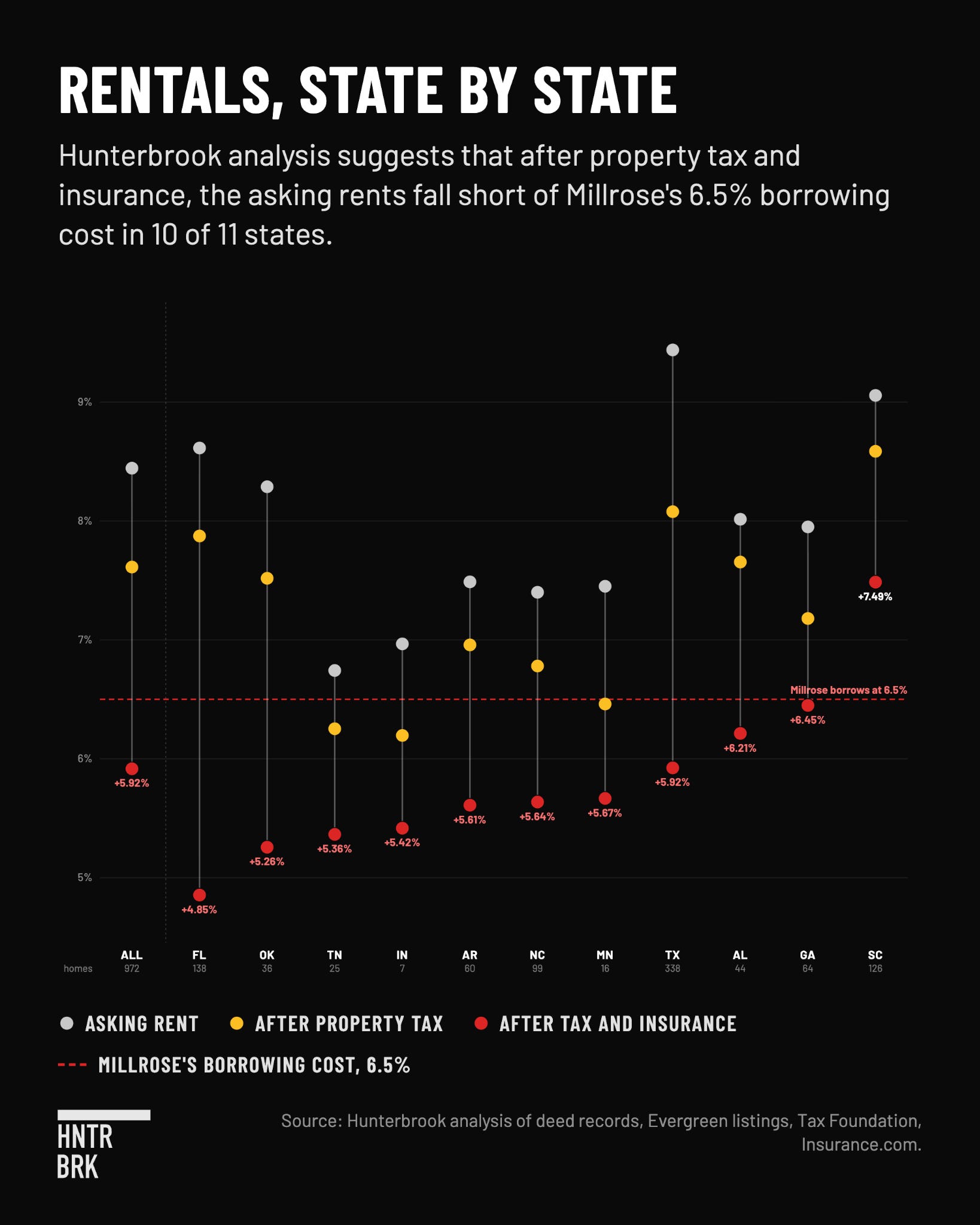
Even assuming every house finds a tenant at the full advertised rental price, Hunterbrook’s estimated yield on the rentals based on specific state-level tax and average insurance rates — two of the most important expenses in a rental business — suggests Millrose will not make enough on most of their homes to clear its borrowing costs.
Across the nearly 1,000 Millrose homes put up for rent, the gross rent comes to 8.44% of the price a year. But after factoring in taxes and insurance, proceeds to Millrose are more like 5.92%, below the 6.5% to 6.75% Millrose agreed to pay on its latest borrowing — the $1 billion of senior notes it sold on October 6, as disclosed to the SEC in an 8-K.
In states where Millrose invested most heavily — Florida and Texas — the economics are worse. In Florida, where insurance on a $300,000 house reportedly averages $8,471 a year, the yield is 4.9% before financing costs. South Carolina and Alabama, which have the lowest property taxes of any state where Millrose bought, according to Hunterbrook’s estimate, are the only ones that seem to exceed Millrose’s financing costs.
Millrose also told investors that the rentals’ return will come partly from the eventual sale of the homes. “If the renter does not convert: Millrose sells the home on the open market. There is no put-back to the builder,” Goldman’s note says.
But many of the homes sit in markets where prices are already falling and are projected to fall for at least another year. Typical home values in the zip codes where Millrose bought dropped 9% over the past year while the national index rose 1.3%, according to Zillow analytics. The decline is steepest where Millrose spent the most: Texas, which accounts for about 30% of the money, is down 4.2%.
Whether those homes can later be sold for more than Millrose paid in these markets is an open question.
AUTHORS
Jenny Ahn joined Hunterbrook after serving many years as a senior analyst in the US government. She is a seasoned geopolitical expert with a particular focus on the Asia-Pacific and has diverse overseas experience. She has an M.A. in International Affairs from Yale and a B.S. in International Relations from Stanford. Jenny is based in Virginia.
Matthew Termine is a former corporate lawyer with significant experience advising companies operating within regulated industries. Matt led Hunterbrook’s investigation and reporting on United Wholesale Mortgage. In 2017, Matt was credited by the Wall Street Journal, among others, for identifying suspicious mortgage loan transactions that led to several successful criminal prosecutions, including that of a prominent political operative and the chief executive officer of a federally chartered bank. He is a graduate of Trinity College and Fordham University School of Law.
Sam Koppelman is a New York Times best-selling author who has written books with former United States Attorney General Eric Holder and former United States Acting Solicitor General Neal Katyal. Sam has published in the New York Times, Washington Post, Boston Globe, Time Magazine, and other outlets. He has a BA in Government from Harvard, where he was named a John Harvard Scholar and wrote op-eds like “Shut Down Harvard Football,” which he tells us were great for his social life. Sam is based in New York City.
Michelle Cera trained as a sociologist specializing in digital ethnography and pedagogy. She completed her PhD in Sociology at New York University, building on her Bachelor of Arts degree with Highest Honors from the University of California, Berkeley. She has also served as a Workshop Coordinator at NYU’s Anthropology and Sociology Departments, fostering interdisciplinary collaboration and innovative research methodologies.
Claire Abrahams joined Hunterbrook from the Citizens Crime Commission of New York City, where she led the counterterrorism department. She was previously a program director for the U.S. Attorneys’ Offices - Eastern District of New York, where she worked with the national security and cybercrime section and developed the Disruption and Early Engagement Program (DEEP). She has a master’s from Columbia University and a bachelor’s from the University of Cambridge. Claire is based in New York.
EDITOR
Vikas Kumar joined Hunterbrook from The Capitol Forum, where he led the corporate investigations team for a decade as a senior editor. He was previously an attorney at Gordon Feinblatt, a trial attorney for the Department of Justice, and a law clerk for a federal judge. He has a J.D. from University of Virginia School of Law and a bachelor’s from Emory University. Vikas is based in Maryland.
If you are receiving this email, it may be because you are a subscriber to our sister publication, The Bear Cave. If you would like to unsubscribe from Hunterbrook Media’s reporting about financial markets, you can do so here. (We hope you don’t! It’s really quite good!)
DISCLOSURES
© 2026 Hunterbrook Media LLC. All rights reserved. Use of this website is strictly governed by our Terms of Use. The content herein is furnished on an “AS IS” basis without any form of express or implied warranty. For information regarding our privacy practices, please refer to our Privacy Policy.
Hunterbrook Media LLC (”Hunterbrook Media”) is an investigative news organization. Hunterbrook Media is affiliated with Hunterbrook Capital LP (”Hunterbrook Capital”), an exempt reporting adviser with the U.S. Securities and Exchange Commission that serves as investment adviser to one or more investment funds. Hunterbrook Media and Hunterbrook Capital are legally separate entities under common control. Hunterbrook Capital’s investment activities are one source of funding for Hunterbrook Media’s journalistic operations. Hunterbrook Capital may hold long positions, short positions, positions through derivative instruments including options and swaps, or no position in any security covered or mentioned on this website. Consistent with applicable policies and procedures, Hunterbrook Capital may establish, modify, or close positions in covered securities before or after the publication of any Hunterbrook Media article. Following publication of any article, Hunterbrook Capital will continue transacting in covered securities for an indefinite period and may be long, short, or flat at any time thereafter, regardless of any position described at publication. Hunterbrook Media has no obligation to update any article or disclosure to reflect subsequent changes in Hunterbrook Capital’s positions.
Nothing on this website constitutes investment advice, a recommendation to buy, hold, or sell any security, or a solicitation to purchase or sell any securities. No securities shall be offered or sold in any jurisdiction where such activities would be contrary to applicable securities laws. Hunterbrook Media is not a registered investment adviser in the United States or any other jurisdiction. Nothing herein should be construed as investment advice or a recommendation of any kind. This information should not be relied upon as a substitute for independent research or professional financial, legal, or tax advice.
This website may feature forward-looking statements reflecting Hunterbrook Media’s current views. Such statements, identifiable by terms including but not limited to “anticipate,” “believe,” “estimate,” “expect,” “intend,” “may,” “plan,” “predict,” “should,” and “will,” are inherently speculative and subject to risks and uncertainties. Actual results or outcomes may substantially deviate from those projected. Hunterbrook Media expressly disclaims any obligation to update or revise any forward-looking statements, regardless of subsequent developments or new information.
The information presented is current as of the date indicated. No representation regarding the completeness or timeliness of this information is made. Some information is sourced from third parties and, while believed to be reliable, has not been independently verified, and its accuracy or completeness is not guaranteed. Hunterbrook Media is not affiliated with any sites linked to this website. Investment in securities and other financial instruments involves significant risk, including the potential loss of principal. Users are advised to conduct their own due diligence and consult professional advisors before engaging in any investment activity. Use of Hunterbrook Media’s content is entirely at the user’s risk. Users shall not use this site for any illegal or prohibited purposes and shall comply with all applicable local, state, national, and international laws and regulations.
Should any provision of these Terms of Use be adjudged invalid or unenforceable, the remaining provisions shall remain in full force and effect. Trademarks contained in links to third-party websites belong to their respective owners. Hunterbrook Media retains copyright on all text, content, graphics, and trademarks displayed on this site.
471 transactions did not have a purchase price recorded on their deed records. For 248 transactions without recorded prices, Hunterbrook estimated purchase prices using the home’s last asking price less 4.31%, the median discount calculated from 74 recorded-price homes in a public listing-history check. For 223 others, we applied the lowest advertised price in the Lennar community where Millrose purchased the home.
This excludes 60 of Millrose’s purchased homes that Hunterbrook could not match with a street address. Where deeds lacked street addresses, we matched their parcel numbers or subdivision, lot, and block descriptions to county assessor and GIS records. Of the 1,040 purchases that we could match with a street address, 991 (95.3%) matched Evergreen’s available-home listings as of October 6.