


By: Till Daldrup, Evan Comen
Editor: Sam Koppelman
Hunterbrook Media’s investment affiliate, Hunterbrook Capital, does not have any positions related to this article at the time of publication. Positions may change at any time. Full disclosures on our website.
This is the latest investigation in Hunterbrook Media’s investigative series on the poisoning of American communities. For decades, polluters have sickened towns and cities across the U.S. by releasing toxic chemicals. Hunterbrook has built a nationwide database to expose harm to communities and ecosystems, then hold accountable those responsible. After reporting from Illinois, Nebraska, California, Texas, Louisiana, New Mexico, and Indiana, this investigation takes us to Virginia. Hunterbrook Media has also investigated environmental damage and harm to communities due to industrial activity spanning from Namibia to Argentina to Peru. Please email ideas@hntrbrk.com if you suspect pollution or poisoning in your community.
Separately, ICYMI: Hunterbrook Media posted a thread on X recapping our work over the past three months — from an investigation of a European defense giant to a feature on a hidden photonics supplier in Taiwan. Repeatedly, our reporting has been validated, including this month in a big way. Read more. And stay tuned for our next article, which we plan to publish… tomorrow.
When Louisa Alice Dickison found out last year that the air her daughter is breathing may cause cancer, she felt she could not stay silent.
“I had no choice, ethically and morally, as a mom in this community, it felt imperative for me to put myself out there just to tell people what was going on and give them the facts,” Dickison told Hunterbrook Media.
Dickison recently turned her Instagram profile public to start posting videos and stories about the cancer risk that ethylene oxide (EtO) emissions from medical sterilizers and warehouses handling medical equipment could pose to people living in Richmond, Virginia., and its suburbs.
She lives in the vicinity of two medical sterilization facilities: The Central Virginia Health Network/Bon Secours Mercy Health sterilizer in Northwestern Richmond and Sterilization Services of Virginia’s (SSV) facility in Henrico.
Dickison started talking to community members and learned most of them were unaware that these facilities were located near their homes. “Virtually nobody knows,” she said.
In late March, she attended a town hall meeting organized by the environmental nonprofits Southern Environmental Law Center and Virginia Interfaith Power & Light that aimed to raise awareness about ethylene oxide and Biden-era emissions rules for the chemical that the EPA is attempting to roll back.
Two weeks after this meeting, Sterilization Services of Virginia’s facility in Henrico accidentally released more than 500 pounds of ethylene oxide, according to records from the Virginia Department of Environmental Quality (DEQ). Early on April 9, a faulty check valve released 580 pounds of liquid EtO onto the roof of the facility. As temperatures rose to 50 degrees Fahrenheit, the chemical evaporated and “dispersed into the atmosphere,” according to a DEQ air inspection report.
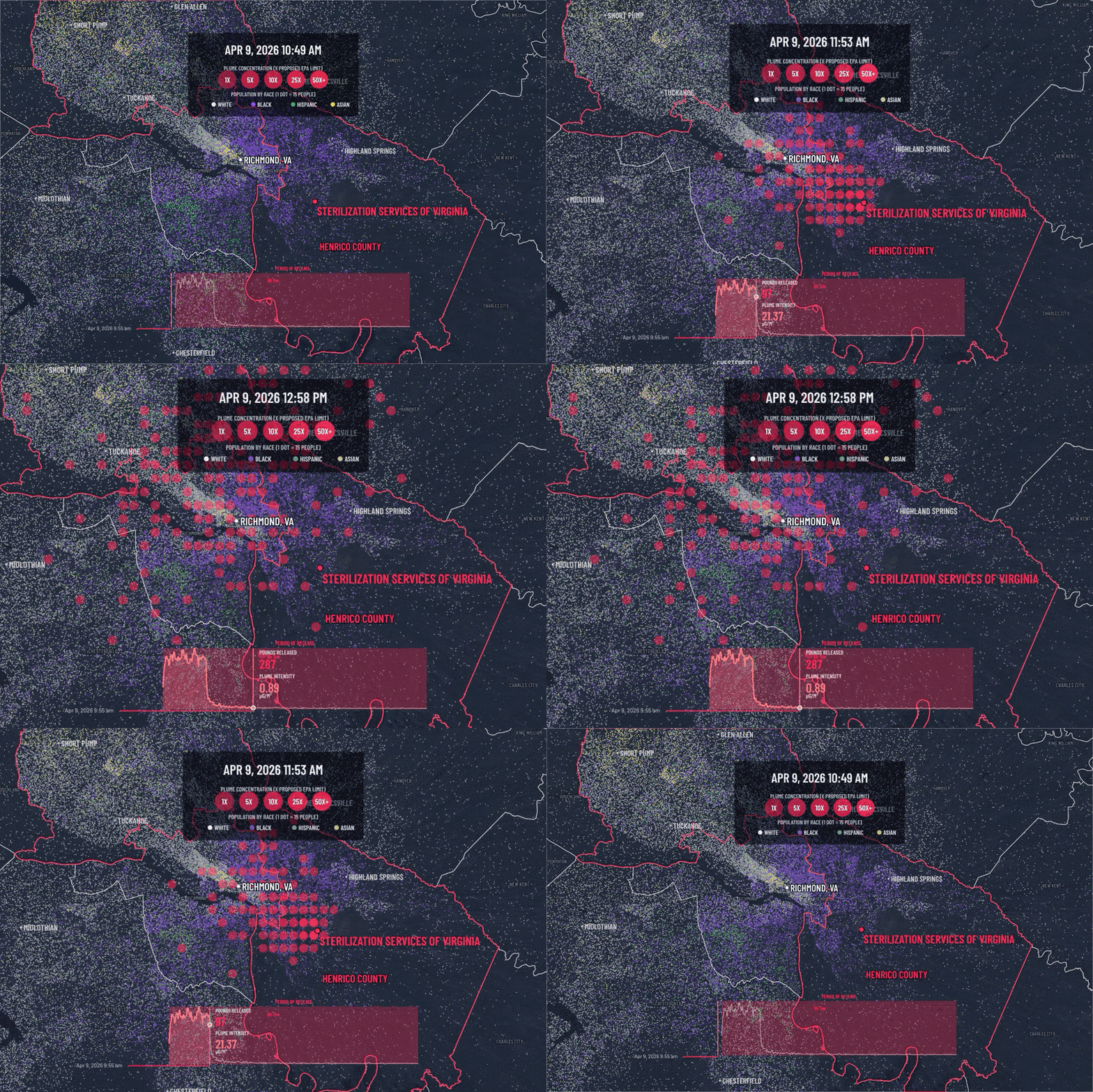
The release at SSV likely exposed more than 260,000 people living nearby to elevated levels of ethylene oxide, a Hunterbrook analysis shows.
A plume model that Hunterbrook generated using the National Oceanic and Atmospheric Administration’s (NOAA) HYSPLIT tool shows that the evaporated ethylene oxide soon reached residential neighborhoods about a mile from the facility. The tool takes into account local weather conditions at the time of the release.
Dickison said she has not been notified by authorities about this release and first learned about it when Hunterbrook asked her about it. Her nine-year-old daughter was with her father that day and would have been right near the sterilization facility.
“I’m horrified,” Dickison said.
The DEQ issued a notice of violation on April 24, stating that the released EtO amount goes beyond what the facility is allowed to emit in an entire year, according to its permit. The notice says SSV needs to show regulators how it aims to “correct the cause of malfunction and to prevent its recurrence.”
A DEQ spokesperson told Hunterbrook that SSV responded to the notice of violation and submitted a corrective action plan, which includes the installation of an EtO release alarm system and new pressure relief check valves, as well as regular check valve testing and replacement.
Sterilization Services of Virginia did not respond to repeated requests for comment.
Data Shows Elevated Cancer Risk Around Sterilizer
SSV uses ethylene oxide as a sterilizing agent for medical devices. The chemical plays a crucial role in our healthcare system, but it’s also a ruthless carcinogen. In 2016, the EPA in a revised toxicity assessment concluded it is 30 times more carcinogenic to adults — and 60 times more so to children — than previously thought.
Ethylene oxide is linked to blood cancers like leukemia, non-Hodgkin lymphoma, and multiple myeloma, as well as breast cancer. In 2024, under the Biden administration, the EPA issued stricter rules that require commercial medical sterilizers and large chemical plants to reduce their ethylene oxide emissions. The EPA now aims to roll those regulations back.
Henrico County — which includes SSV’s facility and its immediate surroundings — has an overall incidence rate across all cancer types that’s just slightly above the state average, according to National Cancer Institute data for 2018 to 2022.
But the picture changes drastically when the data is filtered for cancers that are associated with ethylene oxide exposure and population groups that actually live in the vicinity of SSV’s medical sterilization site. Henrico County snakes around the state capital, Richmond, in the shape of a dumbbell. While the western part is mostly white and Asian, the eastern part — where SSV is located — is primarily Black.
The county has the third-highest leukemia incidence among Black residents in the entire state. It also ranks seventh for non-Hodgkin lymphoma and ninth for early breast cancer cases among Black patients. That’s out of 95 counties in Virginia.
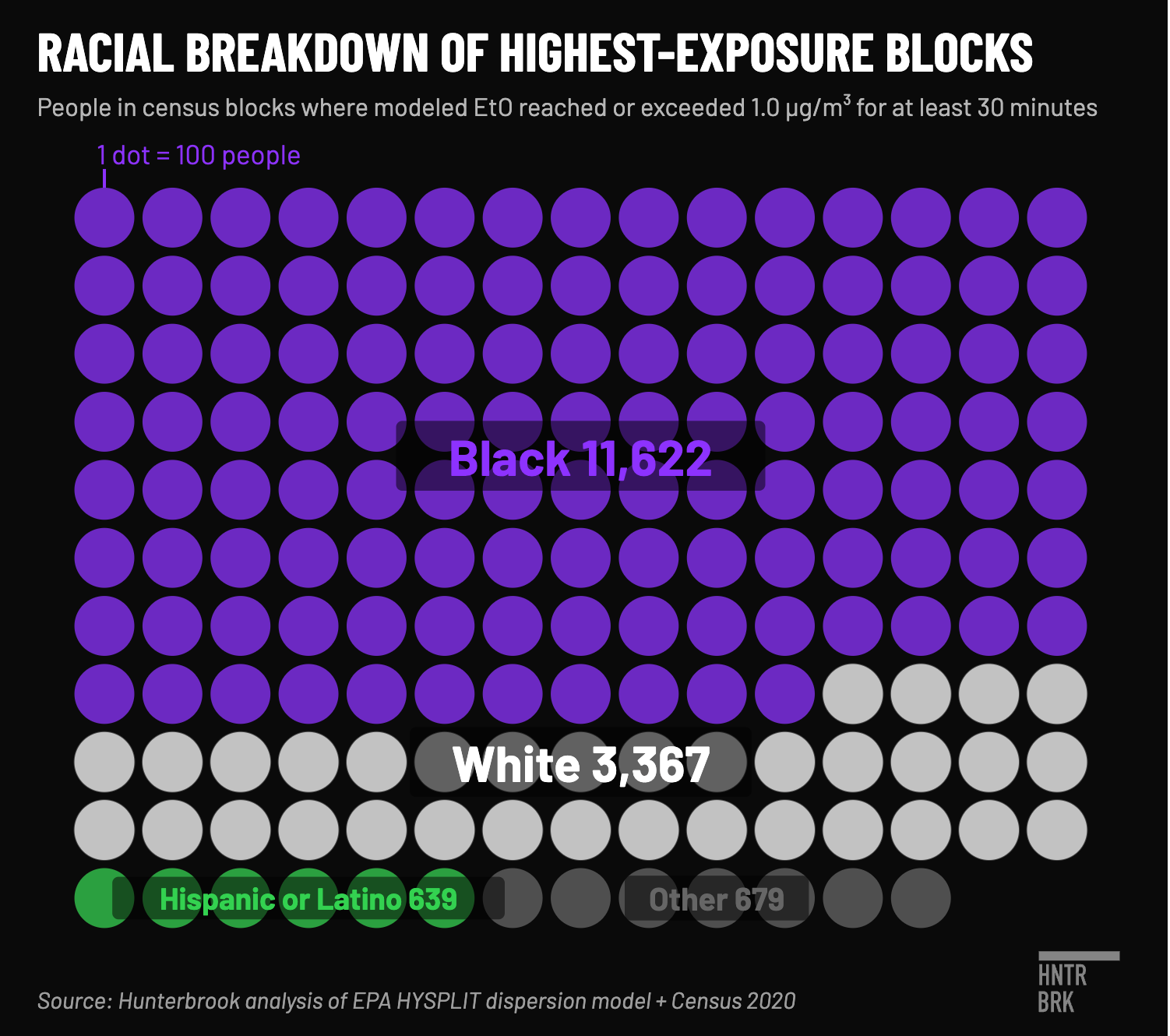
Hunterbrook’s plume model analysis indicates that Black residents are indeed more impacted by emissions from SSV’s facility than members of other racial groups: 71% of people who live in census blocks where modeled ethylene oxide concentrations reached or exceeded 1 microgram per cubic meter for at least 30 minutes during the April 9 release are Black.
“The evidence is undeniable that ethylene oxide is a chemical that absolutely increases the health risks to people who are breathing this in on a consistent basis. The fact that it’s in a predominantly Black community cannot be ignored,” said Monica Hutchinson, president of the Henrico County NAACP. “The [Trump] administration has proven to be extremely hostile to anything to help safeguard or protect the Black community and other vulnerable communities.”
SSV’s facility is not the only polluter in the area. Richmond International Airport is nearby, as well as a large landfill. But cancer data and the county’s population distribution suggest that incidence rates of cancers associated with ethylene oxide exposure are elevated among people who live near the SSV building.
Science would suggest that people in close proximity to a facility that’s emitting thousands of pounds of ethylene oxide per year have an elevated cancer risk, Joe Goffman, a former assistant administrator in the EPA’s Office of Air and Radiation, told Hunterbrook.
“Ethylene oxide has always been known to be a carcinogen that presents a level of risk that the Clean Air Act recognizes and deems it appropriate for regulation,” he said.
Trump Issued Exemptions From Stricter Rules
Sterilization Services of Virginia is one of 40 medical sterilization facilities that in July 2025 received a two-year presidential exemption from Biden-era ethylene oxide rules that would have imposed new emissions-control requirements on commercial sterilizers.
The Virginia DEQ told the Henrico Citizen, a local news organization, that, notwithstanding the exemption, the Sterilization Services of Virginia facility is already meeting the requirements under those new regulations.
“In 2025, SSV installed additional control equipment to further reduce their emissions of EtO,” the DEQ said in a written statement to the Citizen. “They began operating this new equipment in October of 2025. With the addition of this equipment, SSV is now equipped to meet 2028 EtO emission standards [two years early].”
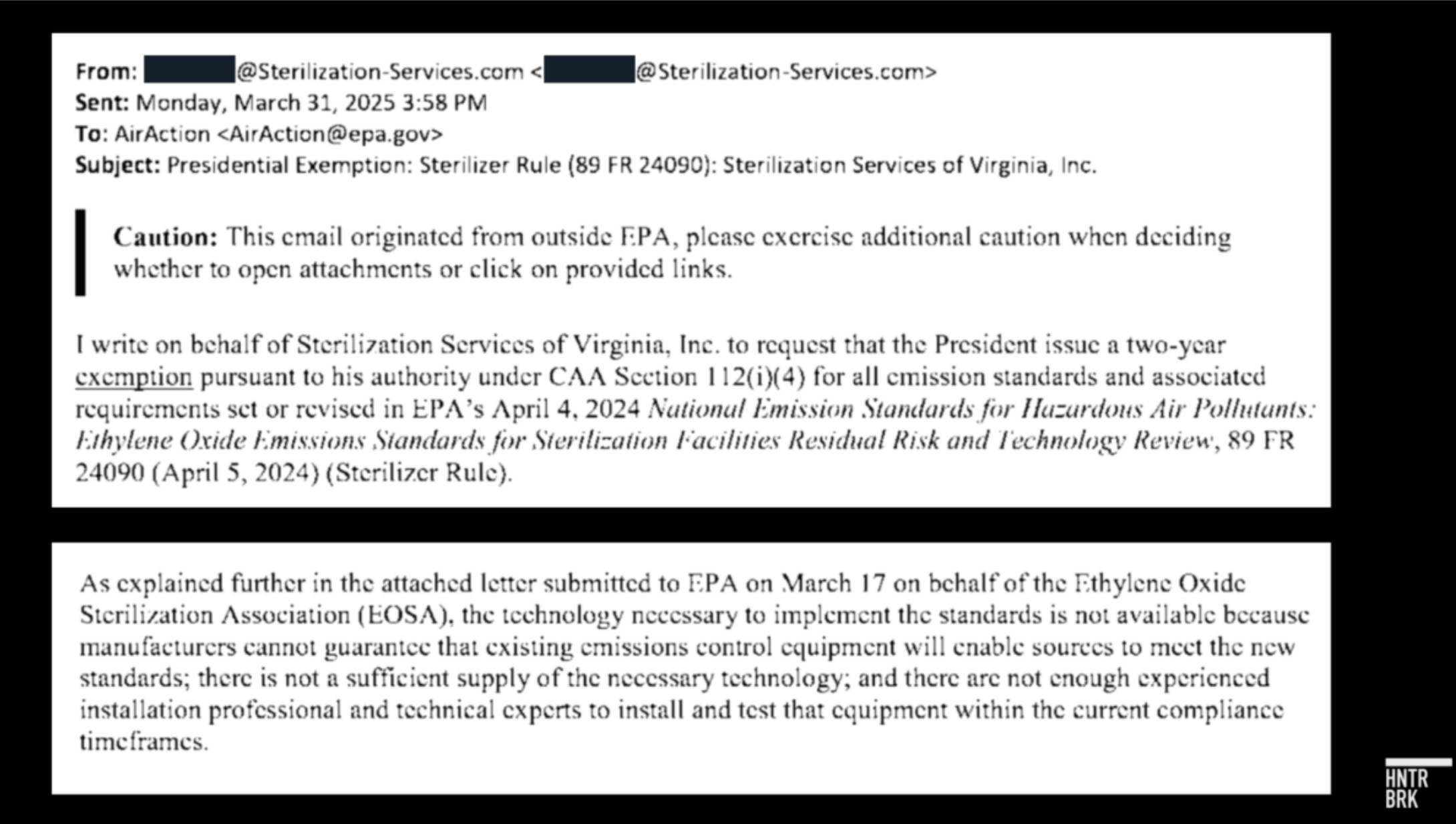
The statement appears to refer to a dry bed reactor, which breaks down trace ethylene oxide, that SSV started operating that month. But just six months prior, when the company requested the presidential exemption, SSV said in reference to the new ethylene oxide rules that “the technology necessary to implement the standards is not available,” according to a copy of an email obtained by Hunterbrook.
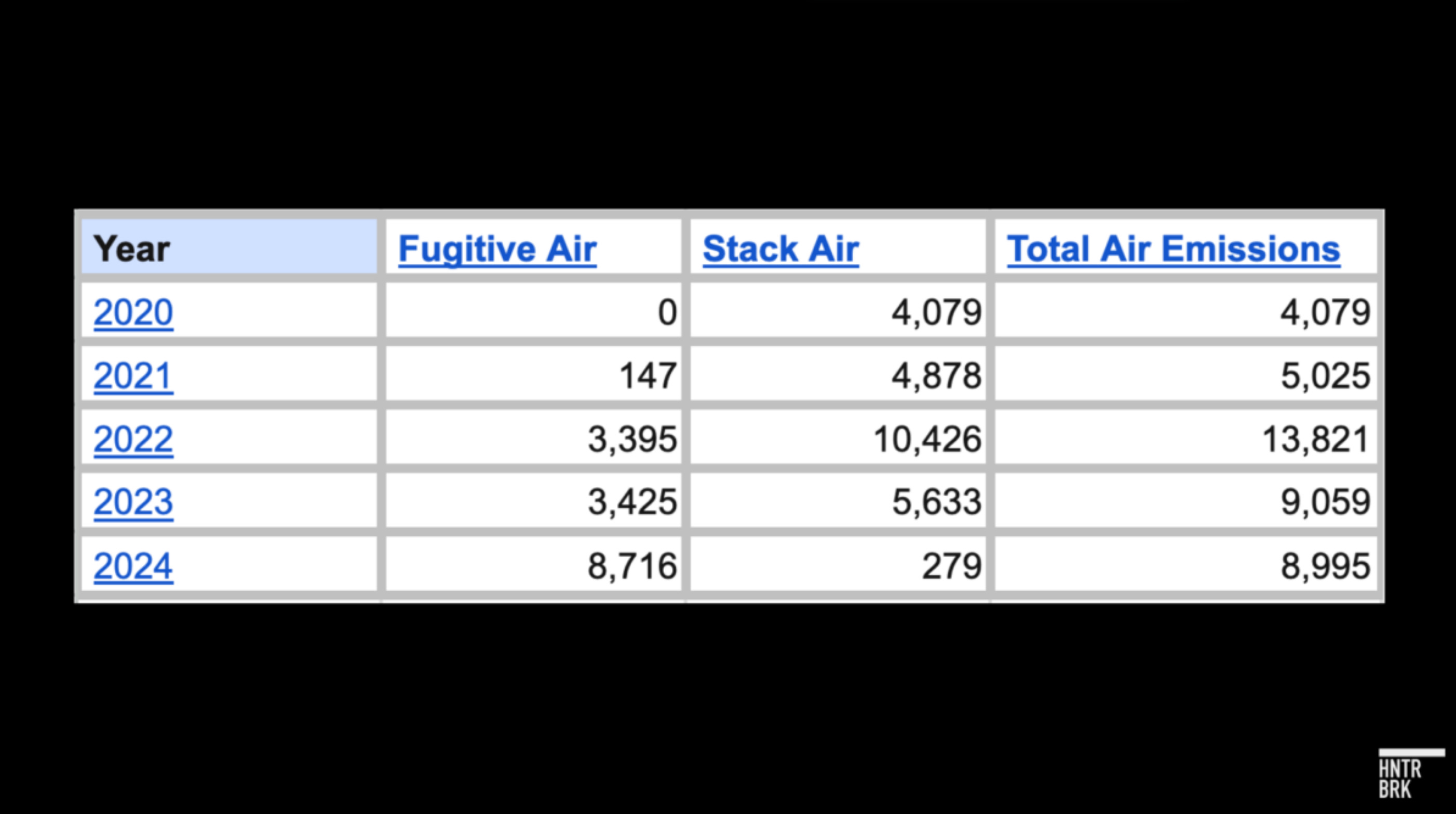
Emissions data that SSV submitted to the EPA’s toxics release inventory shows that while the company has reduced ethylene oxide emissions from its stacks, fugitive releases have increased rapidly, and the facility’s total emissions in 2024 — the latest available data — were higher than they were in 2020.
Fugitive emissions are the industry term for leaks that escape through valves, cracked seals, and loose connectors rather than being channeled through controlled smokestacks or vents.
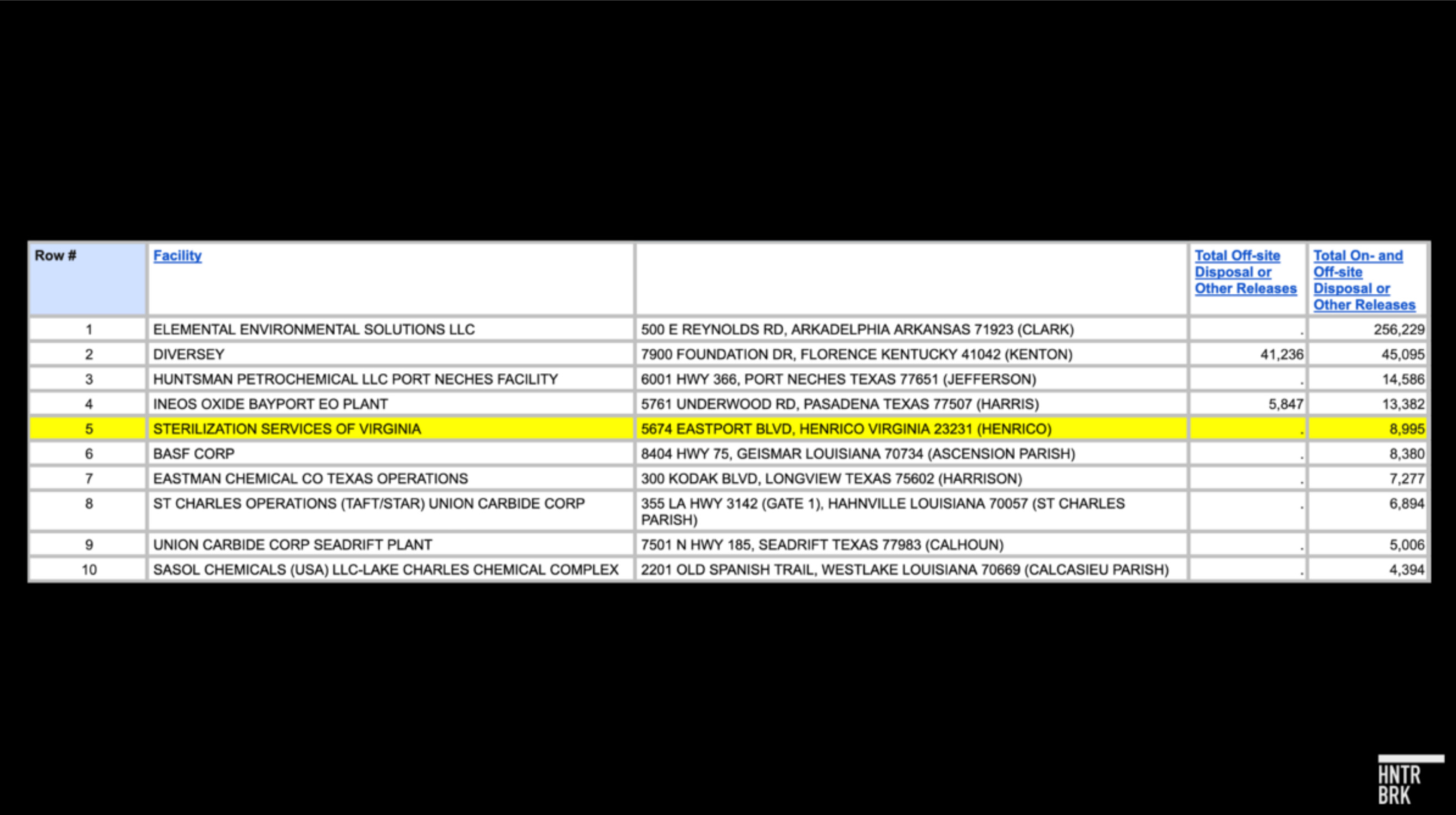
The latest emissions data for 2024 also shows that SSV was the fifth-largest ethylene oxide emitter in the entire U.S., ahead of large industrial facilities like BASF’s plant in Geismar, Louisiana., and Eastman Chemical’s site in Longview, Texas. According to the EPA data, SSV’s facility has the highest ethylene oxide emissions of all medical sterilizers in the country.
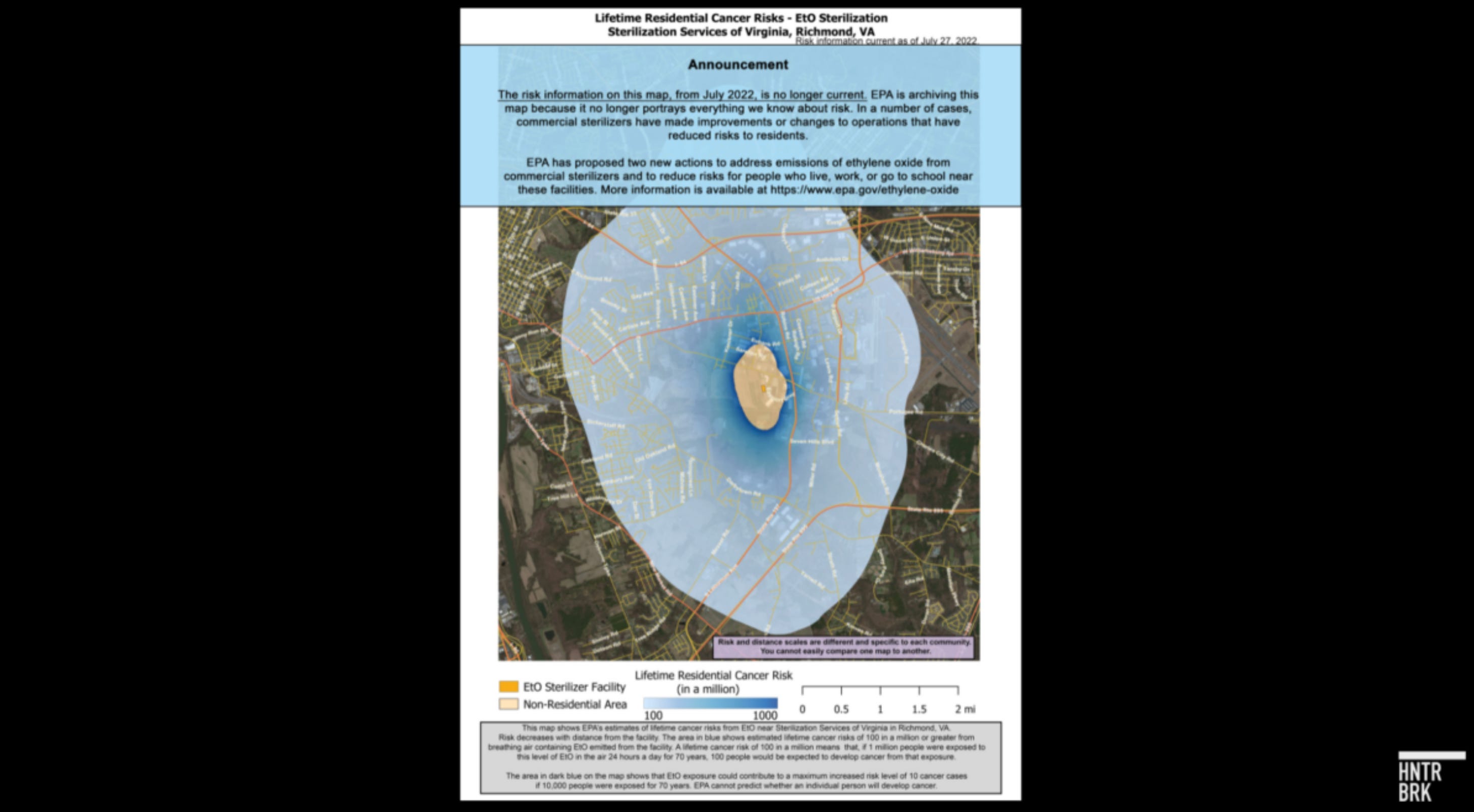
The EPA had flagged SSV in 2022 as one of 23 medical sterilizers nationally that emitted potentially dangerous levels of ethylene oxide. At the time, the agency estimated that the lifetime cancer risk in residential areas near the facility was 100 in a million. That means if 1 million people were exposed to the level of EtO in the air near SSV 24 hours a day for 70 years, at least 100 people would be expected to develop cancer from that exposure.
At a town hall meeting in 2023, the EPA sought to alleviate local residents’ worries about their cancer risk. SSV had “recently installed new controls that have dramatically reduced those emissions,” according to a Henrico Citizen report at the time.
When asked about the current fugitive emissions at SSV, a Virginia DEQ spokesperson told Hunterbrook that the higher emission numbers are “due to calculation differences” and are “not reflective of an ‘increase’ in fugitive emissions.”
When Hunterbrook followed up and asked what those calculation differences are, the DEQ said that the increased fugitive emissions are due to a misunderstanding on SSV’s part on how to report these emissions. The company had since “rectified their emissions calculation process,” a DEQ spokesperson said.
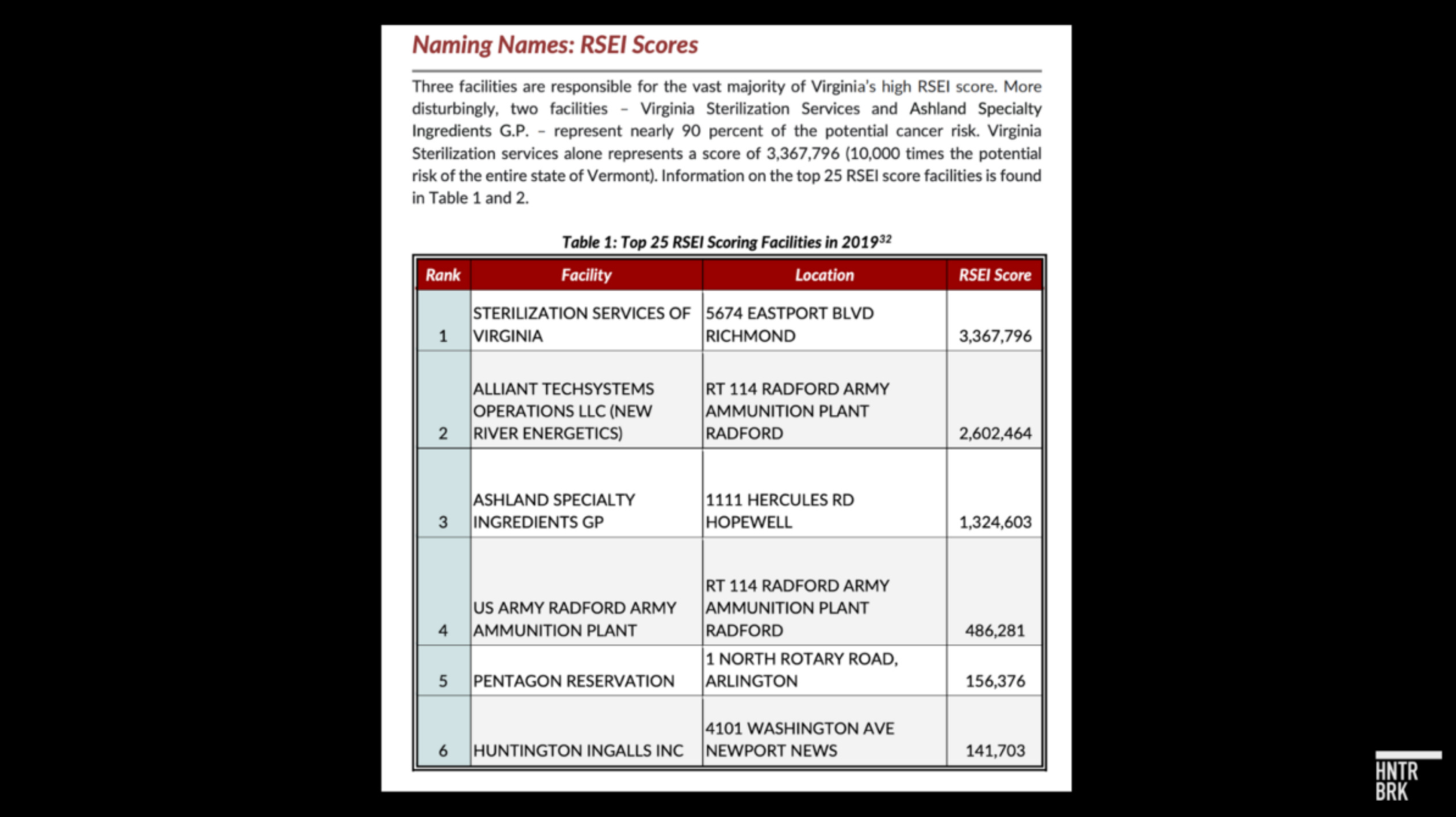
As early as 2019, Sierra Club’s Virginia chapter had pointed to SSV as one of the state’s major emitters of hazardous pollutants. Its report, “Air Toxins and Health Risk in Virginia,” showed that the Henrico facility had the highest Risk-Screening Environmental Indicators (“RSEI”) score in the entire state. RSEI is an EPA metric that estimates the relative potential human health risk from toxic chemical releases based on the quantity released, chemical toxicity, and population exposed. According to the Sierra Club report, the potential health risk associated with SSV’s facility was 10,000 times higher than the potential risk of the entire state of Vermont at the time.
The SSV facility opened in 1990 and “occupies 76,000 square feet of processing and warehouse space,” according to the company’s website. Sterilization Services also operates a second facility in Atlanta, Ga. Its third facility, Sterilization Services of Tennessee in South Memphis, closed in 2024 after persistent community activism against its EtO emissions.
Regulatory Rollback
The April roof leak at SSV shows that while emissions controls can reduce ethylene oxide emissions in daily operations at medical sterilizers, the risk of a large accidental release of the hazardous pollutant persists.
And now the EPA aims to roll back several Biden-era safeguards against ethylene oxide emissions that are already in place.
When the agency announced these regulations in 2024, it said they would eliminate over 90% of ethylene oxide emissions from commercial sterilizer facilities and reduce the number of people exposed to cancer risks from ethylene oxide by 92%.
In a March announcement, the agency struck a different tone: “EtO is the only safe and effective sterilization method available for many medical devices,” the agency wrote. “EPA is concerned that the current Biden-era EtO emission standards actively threaten facilities’ ability to sterilize equipment and jeopardize one of America’s only options for a secure domestic supply chain of essential medical equipment.”
Data cited by the U.S. FDA shows that approximately 50% of all sterile medical devices in the U.S. are sterilized with ethylene oxide. Other treatment methods include steaming and radiation.
The EPA’s legal argument for rescinding the new rules is that the Clean Air Act prevents the agency from conducting more than one risk review. Since the EPA had already completed a review for ethylene oxide in 2006, argues the agency, the second risk review the Biden EPA conducted in 2024 should not have been completed.
“What the current administration is arguing is, you don’t have the authority to do that. You get one shot at the apple, and it doesn’t matter how much more information science provides you after you’ve regulated,” said Goffman, who worked for the EPA under former Presidents Barack Obama and Joe Biden. “We can’t let these guys win on the absurd notion that Congress meant for the agency to remain ignorant while the rest of the world is increasing its understanding of human health effects of certain chemicals.”
Among other things, the EPA is planning to change the requirement to use continuous real-time emission monitoring systems. Under the proposed change, the EPA will give sterilizers the choice between installing emissions monitoring systems or annual performance testing and parametric monitoring, where key indicators of system performance are measured instead of actual emissions.
Louisa Dickison already submitted her comment on the proposed new rules.
“It’s just appalling and unfathomable to support anything other than basic community awareness and protection,” she told Hunterbrook. “What is the EPA’s job if not to protect the environment, and the environment includes the people who live in it.”
The EPA did not respond to a request for comment in time for publication.
Authors
Till Daldrup joined Hunterbrook from The Wall Street Journal, where he focused on open-source investigations and content verification. In 2023, he was part of a team of reporters who won a Gerald Loeb Award for an investigation that revealed how Russia is stealing grain from occupied parts of Ukraine. He has an M.A. in Journalism from New York University and a B.S. in Social Sciences from University of Cologne. He’s also an alum of the Cologne School of Journalism (Kölner Journalistenschule). Till is based in New York.
Evan Comen is currently the senior data editor at U.S. News & World Report, where he focuses on government rankings and accountability reporting. He has worked as a data journalist since 2015, covering climate change, urban economics, and public policy. Evan has a B.A. in economics from the University of North Carolina at Chapel Hill and is based in New York.
editor
Sam Koppelman is a New York Times best-selling author who has written books with former United States Attorney General Eric Holder and former United States Acting Solicitor General Neal Katyal. Sam has published in the New York Times, Washington Post, Boston Globe, Time Magazine, and other outlets — and occasionally volunteers on a fire speech for a good cause. He has a B.A. in Government from Harvard, where he was named a John Harvard Scholar and wrote op-eds like “Shut Down Harvard Football,” which he tells us were great for his social life. Sam is based in New York.
Graphic
Dan DeLorenzo is a creative director with 25 years reporting news through visuals. Since first joining a newsroom graphics department in 2001, he has built teams at Bloomberg News, Bridgewater Associates, and the United Nations, and published groundbreaking visual journalism at The Wall Street Journal, Associated Press, The New York Times, and Business Insider. A passion for the craft has landed him at the helm of newsroom teams, on the ground in humanitarian emergencies, and at the epicenter of the world’s largest hedge fund. He runs DGFX Studio, a creative agency serving top organizations in media, finance, and civil society with data visualization, cartography, and strategic visual intelligence. He moonlights as a professional sailor working toward a USCG captain’s license and is a certified Pilates instructor.
Hunterbrook Media publishes investigative and global reporting — with no ads or paywalls. When articles do not include Material Non-Public Information (MNPI), or “insider info,” they may be provided to our affiliate Hunterbrook Capital, an investment firm which may take financial positions based on our reporting. Subscribe here. Learn more here.
Please email ideas@hntrbrk.com to share ideas, talent@hntrbrk.com for work, or press@hntrbrk.com for media inquiries.
LEGAL DISCLAIMER
© 2026 by Hunterbrook Media LLC. When using this website, you acknowledge and accept that such usage is solely at your own discretion and risk. Hunterbrook Media LLC, along with any associated entities, shall not be held responsible for any direct or indirect damages resulting from the use of information provided in any Hunterbrook publications. It is crucial for you to conduct your own research and seek advice from qualified financial, legal, and tax professionals before making any investment decisions based on information obtained from Hunterbrook Media LLC. The content provided by Hunterbrook Media LLC does not constitute an offer to sell, nor a solicitation of an offer to purchase any securities. Furthermore, no securities shall be offered or sold in any jurisdiction where such activities would be contrary to the local securities laws.
Hunterbrook Media LLC is not a registered investment advisor in the United States or any other jurisdiction. We strive to ensure the accuracy and reliability of the information provided, drawing on sources believed to be trustworthy. Nevertheless, this information is provided “as is” without any guarantee of accuracy, timeliness, completeness, or usefulness for any particular purpose. Hunterbrook Media LLC does not guarantee the results obtained from the use of this information. All information presented are opinions based on our analyses and are subject to change without notice, and there is no commitment from Hunterbrook Media LLC to revise or update any information or opinions contained in any report or publication contained on this website. The above content, including all information and opinions presented, is intended solely for educational and information purposes only. Hunterbrook Media LLC authorizes the redistribution of these materials, in whole or in part, provided that such redistribution is for non-commercial, informational purposes only. Redistribution must include this notice and must not alter the materials. Any commercial use, alteration, or other forms of misuse of these materials are strictly prohibited without the express written approval of Hunterbrook Media LLC. Unauthorized use, alteration, or misuse of these materials may result in legal action to enforce our rights, including but not limited to seeking injunctive relief, damages, and any other remedies available under the law.