


Busy week for Hunterbrook! Last week, we reported that Bloom Energy fuel cells were being installed at Nebius’ Vineland data center before the project had Planning Board approval; this morning, we published news that the City of Vineland issued two stop work orders over that unpermitted work, which Nebius executives didn’t mention on Wednesday’s earnings call. Earlier this week, we reported on how Mat Ishbia mortgaged UWM to fund his NBA dream. And if you missed it, check out our investigation into LaSalle, the secretive private prison company, as well. Read the full articles and disclosures on our website.
BY: Till Daldrup
EDITOR: Vikas Kumar
Hunterbrook Media’s investment affiliate, Hunterbrook Capital, does not have any positions related to this article at the time of publication. Positions may change at any time. Full disclosures on our website.
Solar is coming home.
That, at least, was the impression given in May by press coverage of JinkoSolar’s sale of its Florida manufacturing plant. “US private equity firm acquires controlling stake in JinkoSolar’s American operations,” a Solar Power World headline read. “Major Chinese solar panel manufacturer JinkoSolar Holding has agreed to sell a 75.1% stake in subsidiary Jinko Solar (U.S.) Industries to American private equity firm FH Capital under plans announced Friday,” Nikkei wrote.
Jinko’s divestiture could allow its solar panel operation in Jacksonville, Florida, to remain eligible for Biden-era federal tax credits that pay module assemblers 7 cents per watt produced. For Jinko’s U.S. subsidiary, they are crucial. The 45X credit subsidizes the production of solar energy components and other goods in the U.S. In 2025, JinkoSolar’s U.S. operations received $146 million from the credit, according to the company’s annual report. This was more than three-quarters of the net profit its Florida plant reported that year in Jinko’s Shanghai Stock Exchange disclosure.
New Trump administration rules stipulate that a U.S. solar operation becomes a “foreign-influenced entity” and therefore loses its tax credit eligibility, if a single Chinese company or other specified foreign entity owns at least 25% of it (among other rules designed to limit foreign influence). “Specified foreign entities” are the governments, citizens, and companies of China, Russia, Iran, and North Korea, anything they control, and entities on certain U.S. government blacklists.
These foreign-entity rules are one arm of a broader U.S. crackdown on Chinese solar that also includes anti-dumping duties on solar cells from Chinese manufacturers’ Southeast Asian plants, a forced-labor import ban, and a 15% tariff and minimum import prices on polysilicon, wafers, cells, and modules that was announced last week.
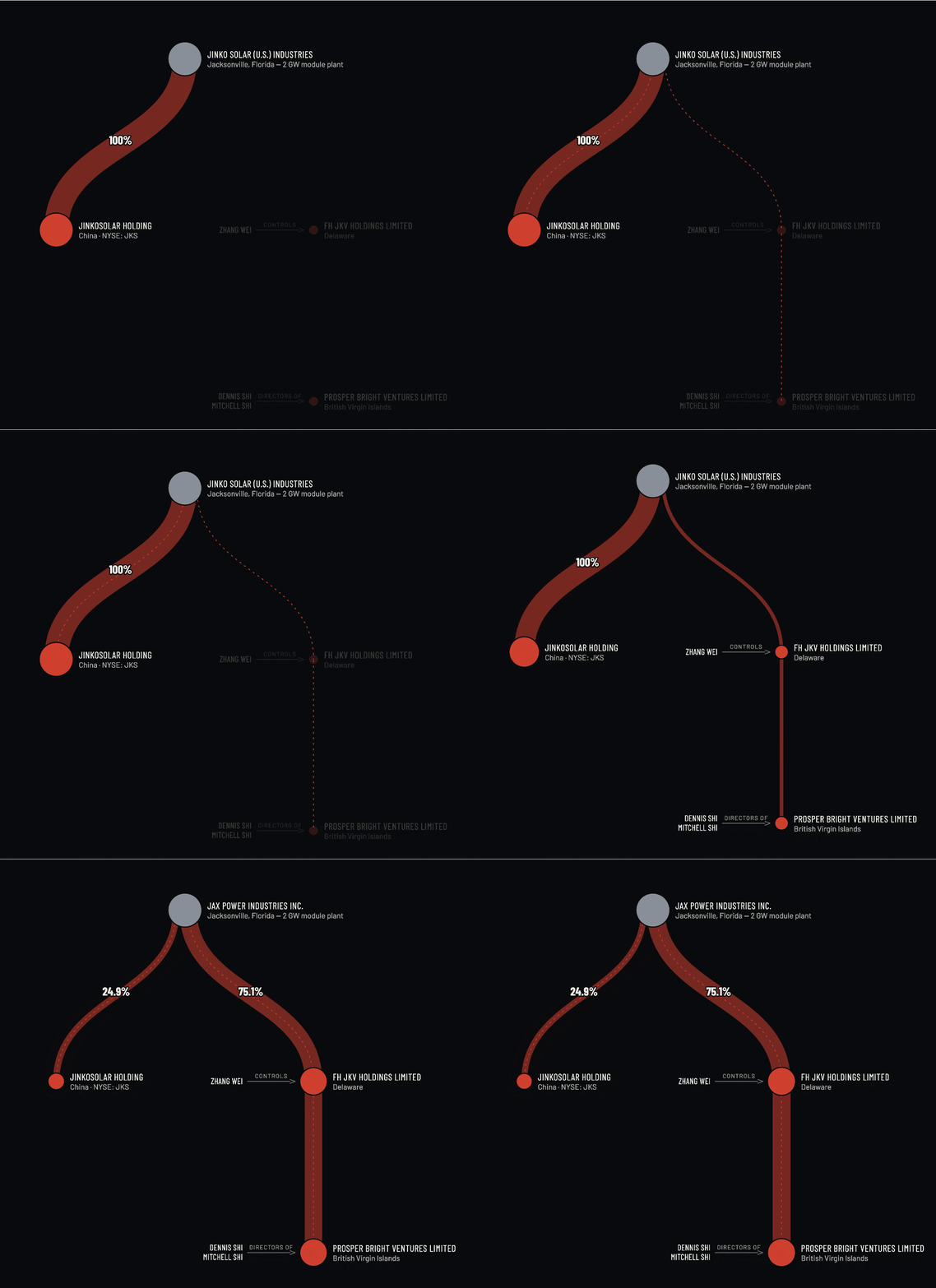
Jinko sold 75.1% of its U.S. business to what press coverage called an “American” firm and kept a stake just below the ownership threshold, which means the Florida plant could remain eligible for tax credits.
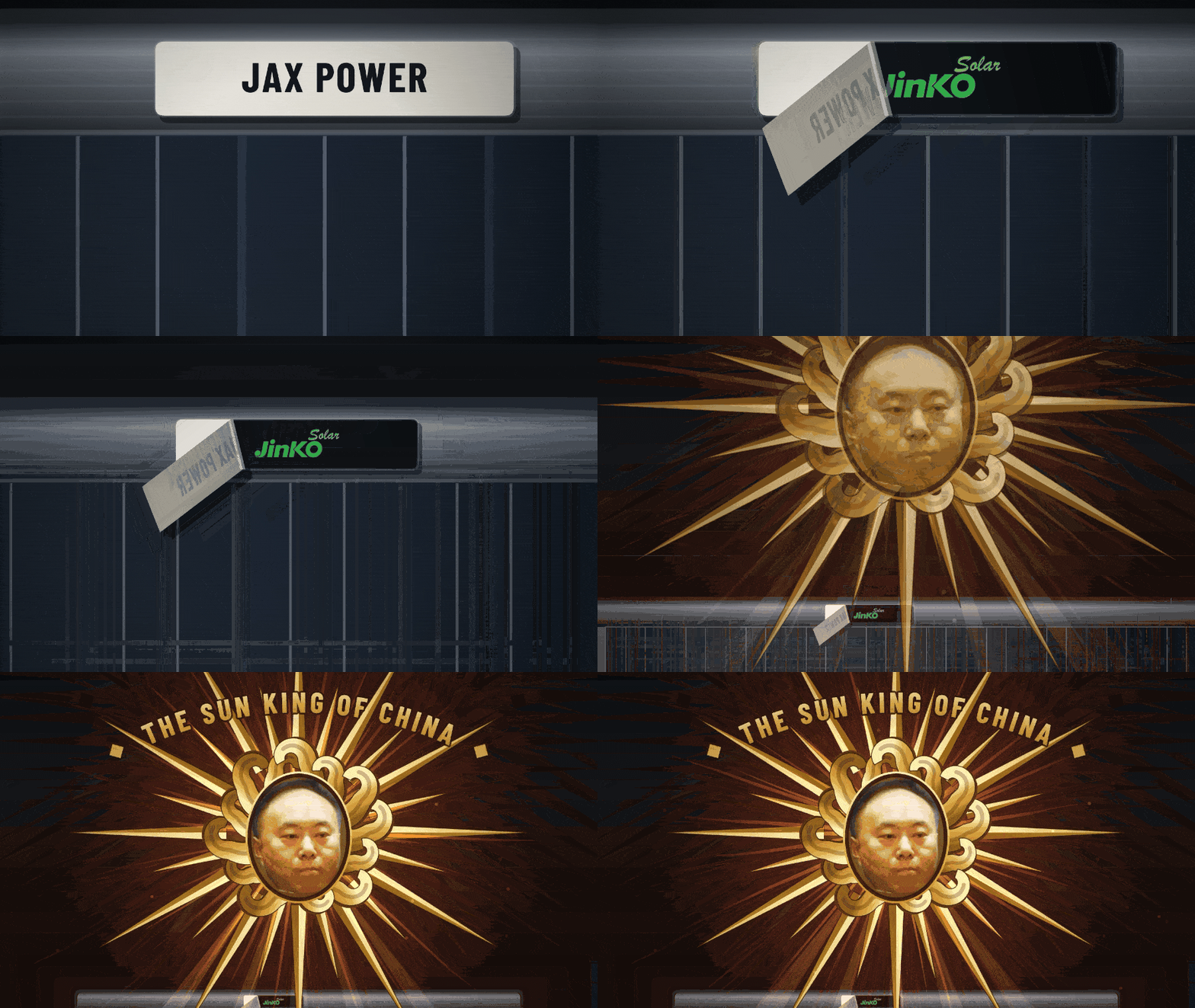
But a Hunterbrook analysis of corporate filings in the U.S., the British Virgin Islands, and Hong Kong suggests that FH Capital, the private equity firm that announced it is acquiring the majority stake in Jinko’s U.S. operations through a designated affiliate, is not American at all but is actually based in Hong Kong. It is controlled by the family of Zhengrong Shi, known as the “Sun King,” the founder and owner of several major Chinese solar companies.
FH Capital confirmed to Hunterbrook in a written statement that Shi himself was involved in the deal. “Dr. Shi is an internationally recognized solar scientist and entrepreneur who brings decades of technical and industry experience to his work,” the statement reads. “In that capacity, he lent his technical and industry expertise during the Jinko transaction.”
Dennis Shi, his son, is now the board director of Jinko’s former U.S. business, which was renamed Jax Power Industries Inc. in July, according to Florida corporate filings. Dennis is also president at Sunman Energy, his father’s Shanghai-headquartered solar module company, according to an Australian news report from March. Sunman manufactures its panels in mainland China, according to pv magazine. Its new manufacturing facility in the U.S. was still under construction and a plant in Australia in planning stages as of December 2025, the magazine reported.
Several tax law experts, however, told Hunterbrook that despite the Shis’ ties to China, the arrangement would possibly not trigger the new foreign influence restrictions as written. That’s because Shi and his family are Australian citizens. The Treasury Department also hasn’t released guidance on whether Hong Kong is going to be considered China under the foreign entity of concern (FEOC) rules, according to the tax experts. FH Capital’s Hong Kong ties were first reported by Bloomberg.
FH Capital told Hunterbrook that it is “an investment advisory firm that operates internationally,” and that the acquisition was completed through a Delaware entity called FH JKV Holdings Limited.
“FH Capital is not a shareholder or investor in the restructured Jinko Solar U.S. manufacturing entity,” the company said. “It acted as an investment adviser in connection with the transaction, including supporting its structuring, negotiation and execution. FH Capital’s advisory role should not be conflated with ownership.”
Therefore, according to the apparent logic behind the deal, its Hong Kong ties would not matter under FEOC rules.
Hong Kong’s status isn’t the only open question. While Congress’s restrictions are in force, the Treasury Department has yet to issue the regulations that spell out how exactly key tests will be applied under the law. Congress set a deadline for the end of the year.
Two other features of the deal could become problematic depending on how Treasury addresses these questions. Both concern Jinko’s continued influence over the Florida plant.
First, there could be a trademark problem: In its Shanghai Stock Exchange filing, Jinko said that it would allow the Florida plant’s modules to continue “to be sold to third parties under the Company’s brand in accordance with agreed terms,” based on a translation from the Chinese. Jinko’s U.S. trademarks are owned by its Chinese parent company, which means its former Florida business could become ineligible for tax credits: The paid use of a specified foreign entity’s intellectual property by a domestic solar operation means that this U.S. producer is under the “effective control” of that foreign entity, according to the Trump administration’s new rules. But the Treasury Department has not said whether the rules cover trademarks and logos or only production technology like patents and manufacturing know-how — leaving open whether a brand license alone is enough to trip the wire.
Second, there could be a debt issue: Only 51% of the $191.5 million purchase price was paid when the deal closed. The remaining $94 million was deferred into two tranches that come due only after “certain conditions” are met, according to Jinko’s Shanghai Stock Exchange disclosure, but the document does not specify what those conditions are, and it is unclear whether the payments have since been made. That money is owed by FH Capital’s designated affiliate, which owns 75.1% of the plant, making Jinko a major creditor of the plant’s owner. Under the FEOC rules, an entity becomes “foreign-influenced” if specified foreign entities hold 15% or more of its debt. Whether the $94 million exceeds 15% of the acquisition vehicle’s total debt can’t be determined from public filings.
As with the trademark question, the Treasury Department has not given specific guidance on this point, according to experts: Whether a deferred purchase price counts as “debt” under that test and whether a parent company’s foreign-influenced status would taint the plant that actually claims the credits are questions the Treasury Department’s interim guidance explicitly left for future rulemaking.
Until the Treasury Department answers, Jinko’s deal sits in a gray zone: It’s structured to clear the rules as written, but the Florida plant potentially faces exposure on the points the rules haven’t yet settled.
“The Trump administration and the Treasury Department are very clear-eyed about how Chinese companies will restructure and try to get creative to avoid U.S. policies designed to target them specifically,” Nick Iacovella, the executive vice president and head of public affairs and communications at the Coalition for a Prosperous America, told Hunterbrook. The lobbying organization for domestic manufacturers had celebrated Jinko’s divestiture as part of a broader retreat of Chinese solar companies in the U.S. in a blog post.
“I don’t think what Jinko has done will pass the smell test for the administration,” Iacovella said.
“We do not speculate about potential future changes in U.S. policy,” FH Capital told Hunterbrook.
Jinko Solar and an executive of Jax Industries did not respond to a request for comment.
FH CAPITAL’S TIES TO HONG KONG
The likely reason other media outlets that covered the Jinko deal thought FH Capital is an American company: It has an office in New York, according to its website. And the acquisition vehicle it used in the Jinko deal is a Delaware-registered corporation, according to Jinko’s Shanghai Stock Exchange filing.
But the office the private equity firm claims at 1325 Avenue of the Americas in Manhattan is actually an office rental space owned by Regus.
“FH Capital has never described itself as an American or U.S.-based private equity firm,” FH Capital told Hunterbrook, saying that it maintains “a presence in Sydney, Hong Kong and New York.”
Its ties to Hong Kong appear to be especially deep, according to a Hunterbrook analysis of corporate filings.
FH’s privacy policy and terms of service on its site revealed its full name (the firm appears to have deleted them within the past two weeks): “Fortune Harmony Investments Limited,” a company that’s registered in Hong Kong, corporate records show. It also lists a Hong Kong office tower as its official postal address (though it’s also just a rental space, same as its New York address).
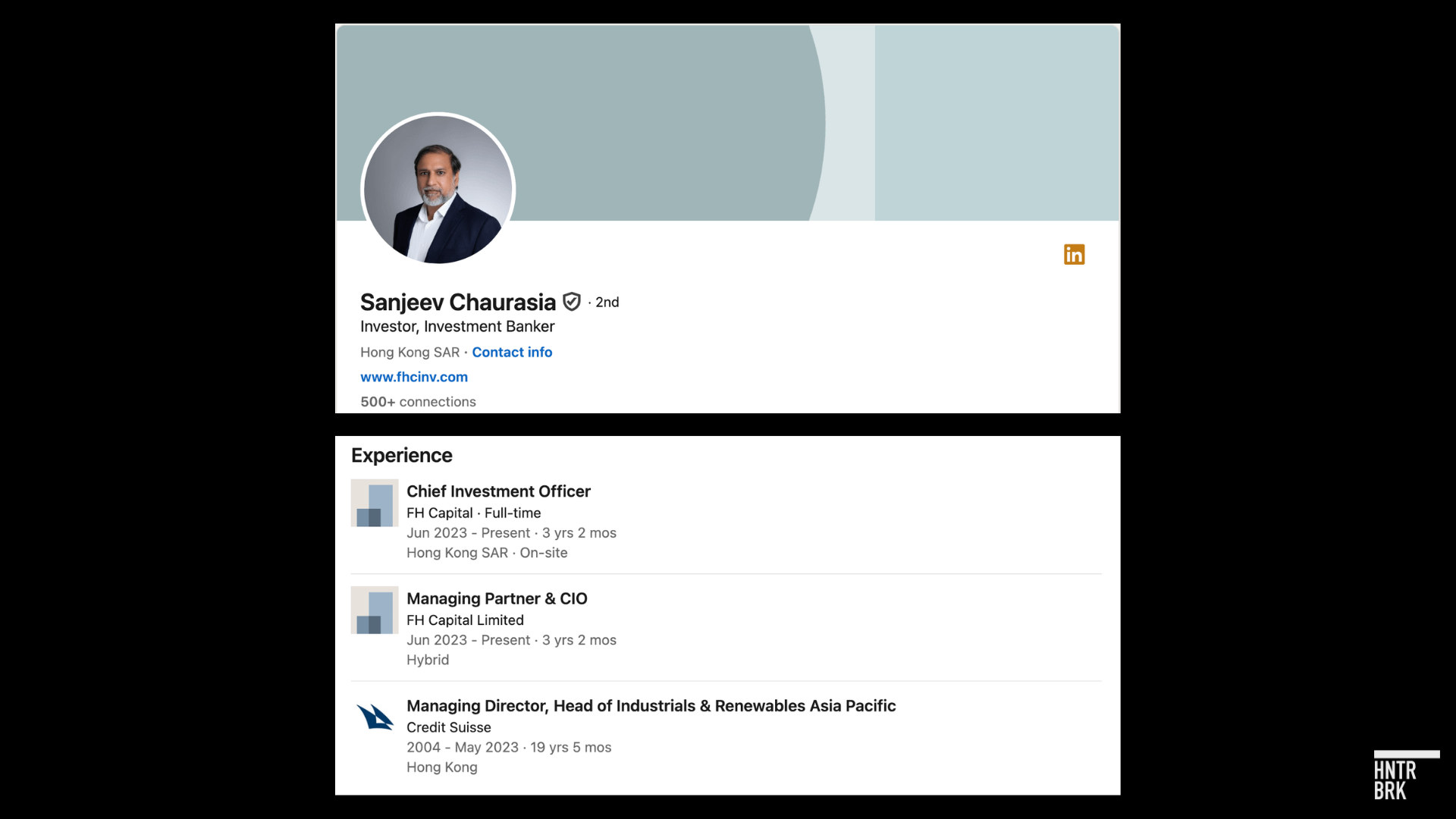
According to FH Capital’s announcement about its deal with Jinko, the private equity firm is “led by” Sanjeev Chaurasia, its managing partner and chief investment officer, who is currently listed as the only team member on FH’s website. Chaurasia previously was a managing director at Credit Suisse and “led JinkoSolar’s IPO on the NYSE in 2010,” FH’s press release said. Chaurasia is based in Hong Kong, according to his LinkedIn account.
“Mr. Chaurasia is an Indian citizen who divides his time among New Delhi, Hong Kong and New York. He was previously based in New York before Credit Suisse transferred him to Hong Kong, where amongst his responsibilities he led investment banking for the sector across the Asia-Pacific region,” FH Capital told Hunterbrook.
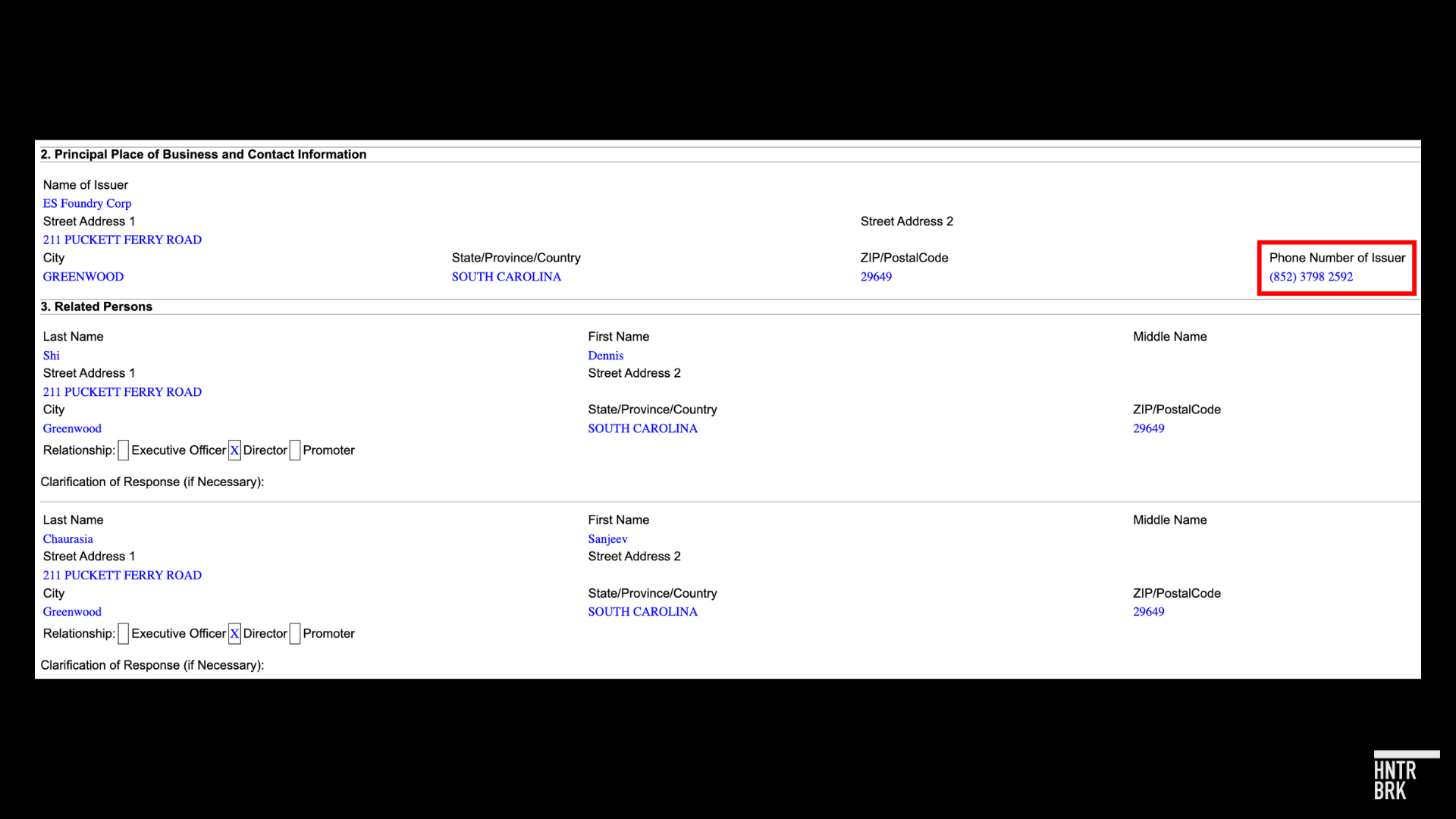
ES Foundry, a solar cell manufacturer with a plant in Greenwood, South Carolina, that FH Capital presented as part of its “portfolio” on its website, lists Chaurasia and Dennis Shi as its directors in an SEC filing. It also lists a Hong Kong phone number.
And solar project developer hep global GmbH, a company that announced it has gained FH Capital as a “financial investor,” seemingly confirmed the location of the firm’s headquarters in a May ad hoc disclosure: “FH Capital is headquartered in Hong Kong and has a diversified position in the United States through investments in module manufacturers and project developers, among other things.”
“FH Capital is not an investor or shareholder in either hep global GmbH or ES Foundry,” FH Capital told Hunterbrook. “Its role has been strictly advisory: it advised the parties that invested in hep global GmbH and has advised shareholders of ES Foundry.”
FH Capital listed ES Foundry as part of its portfolio on its website as recently as August 4, according to a screenshot saved by Hunterbrook, but that mention has since been deleted from the page.
Jinko’s disclosures with the Shanghai Stock Exchange about its divestiture state that FH Capital is an investor in ES Foundry: “Its portfolio includes investments in ES Foundry — a company focused on the manufacturing and sales of photovoltaic cells in the U.S.”
Jinko also named the specific entity that bought the majority stake in its Florida plant: FH JKV Holdings Limited, a company registered in Delaware. Jinko also disclosed that this entity is actually controlled by a British Virgin Islands entity called Prosper Bright Ventures Limited.
And the company named the person who ultimately controls FH JKV Holdings: Zhang Wei.
THE FAMILY TIES BEHIND THE DEAL
It didn’t take Chinese business media long to figure out who Zhang Wei is. Reporters matched a partially masked passport number (a standard disclosure in Chinese deal announcements) to an IPO prospectus of Zhengrong Shi’s polysilicon company Asia Silicon, which identified Zhang Wei as his wife.
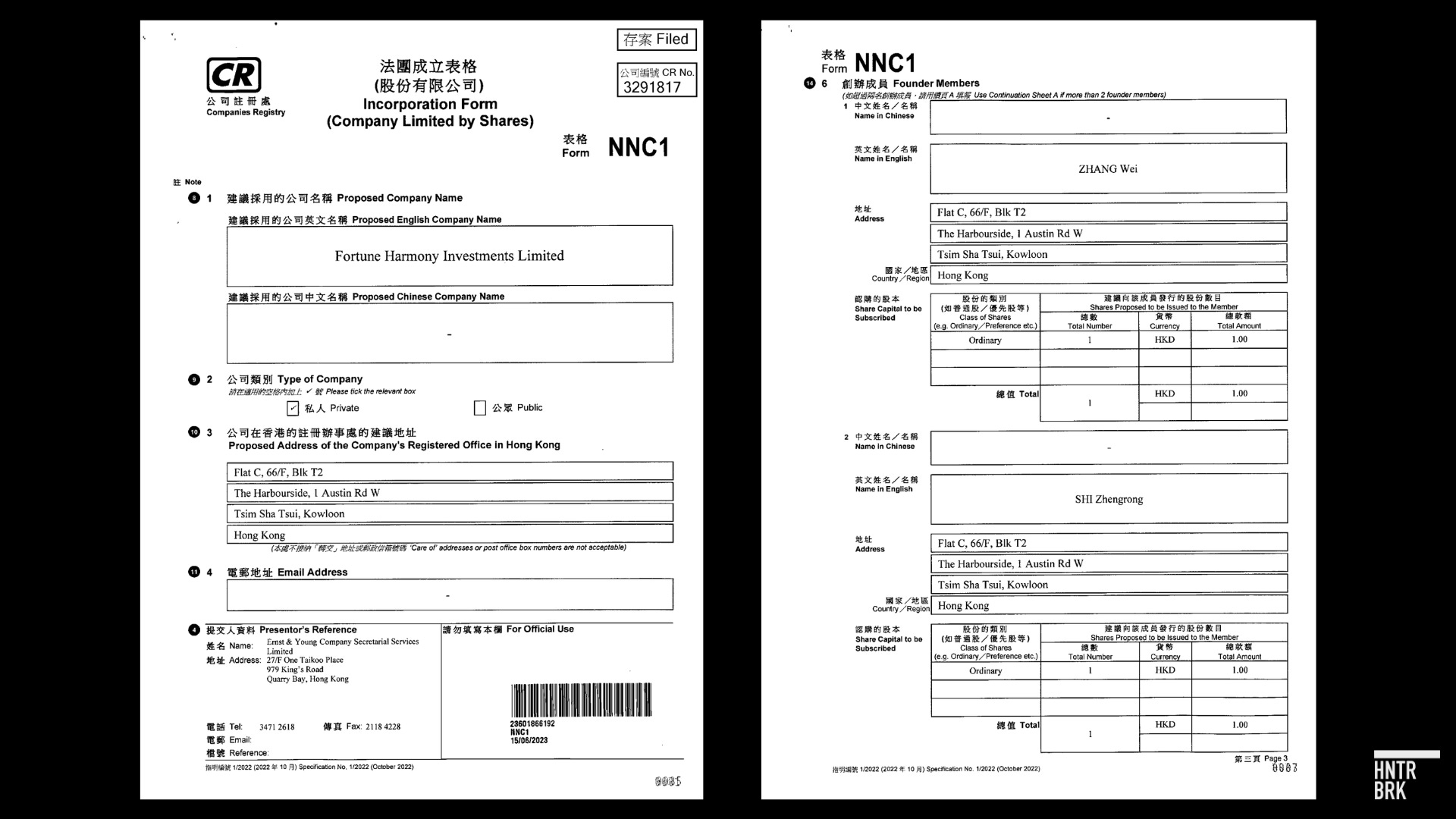
According to Hong Kong corporate filings, Zhengrong Shi and Zhang Wei founded FH Capital, or Fortune Harmony Investments, together in 2023, holding one share each. Shi exited the company in 2024, and both his and his wife’s shares were transferred to Ascend Pioneer Group Limited, a British Virgin Islands entity. Zhang Wei is the sole board director of that entity, according to British Virgin Islands filings obtained by Hunterbrook.
While Zhengrong Shi was reportedly born in China, he is an Australian citizen, and so is his wife. But both are also Hong Kong residents, according to the Hong Kong corporate registry.
Their sons, Dennis Shi and Mitchell Shi, are also both Australian citizens. Both are deeply involved with the family business.
Dennis is president of Sunman Energy. Mitchell served as an assistant to the CEO of Siltrax – his father, who also co-founded the Sydney-based hydrogen venture.
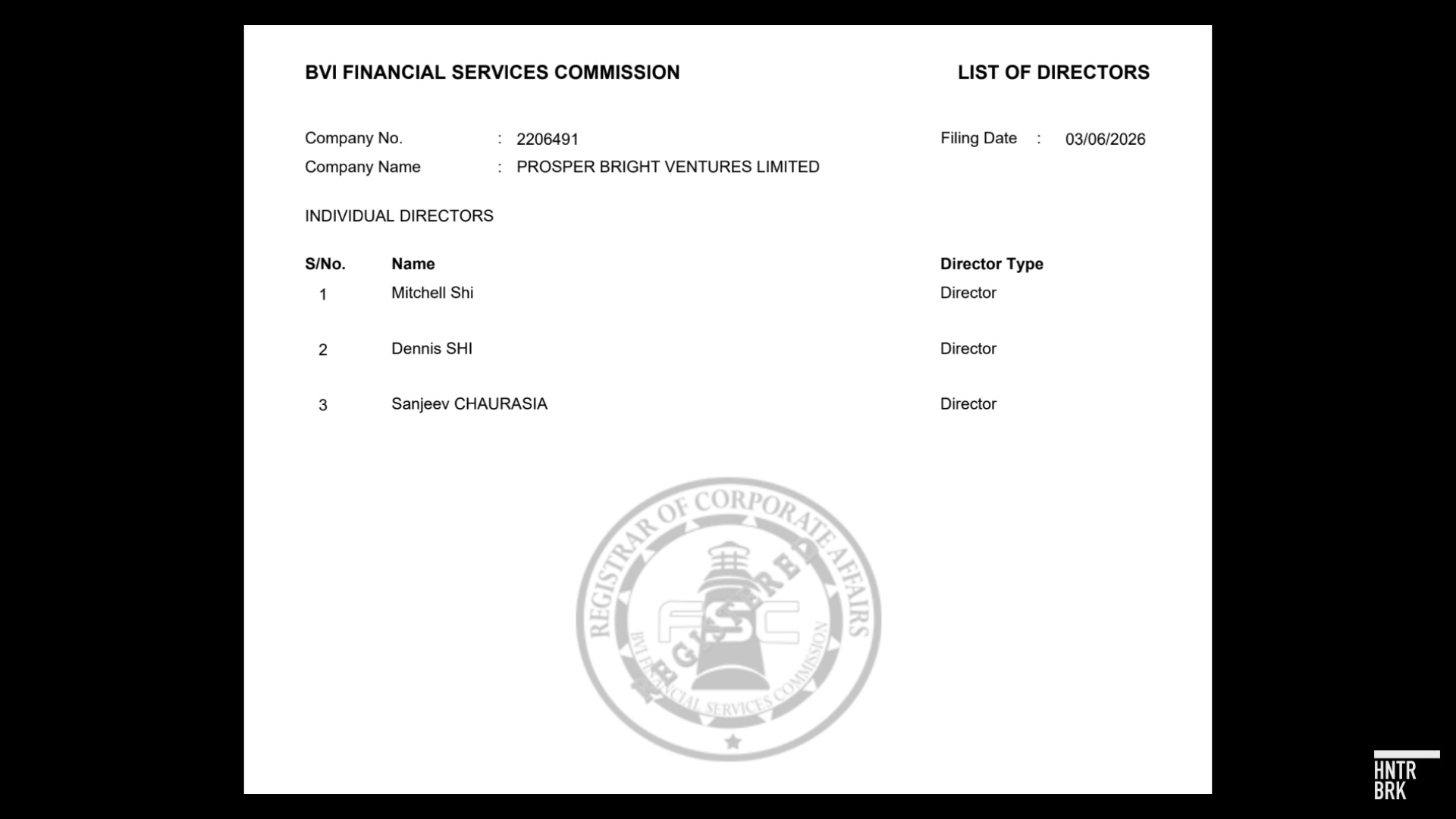
Dennis and Mitchell Shi are also both directors of the British Virgin Islands entity that controls the Delaware-registered acquisition vehicle in the Jinko deal.
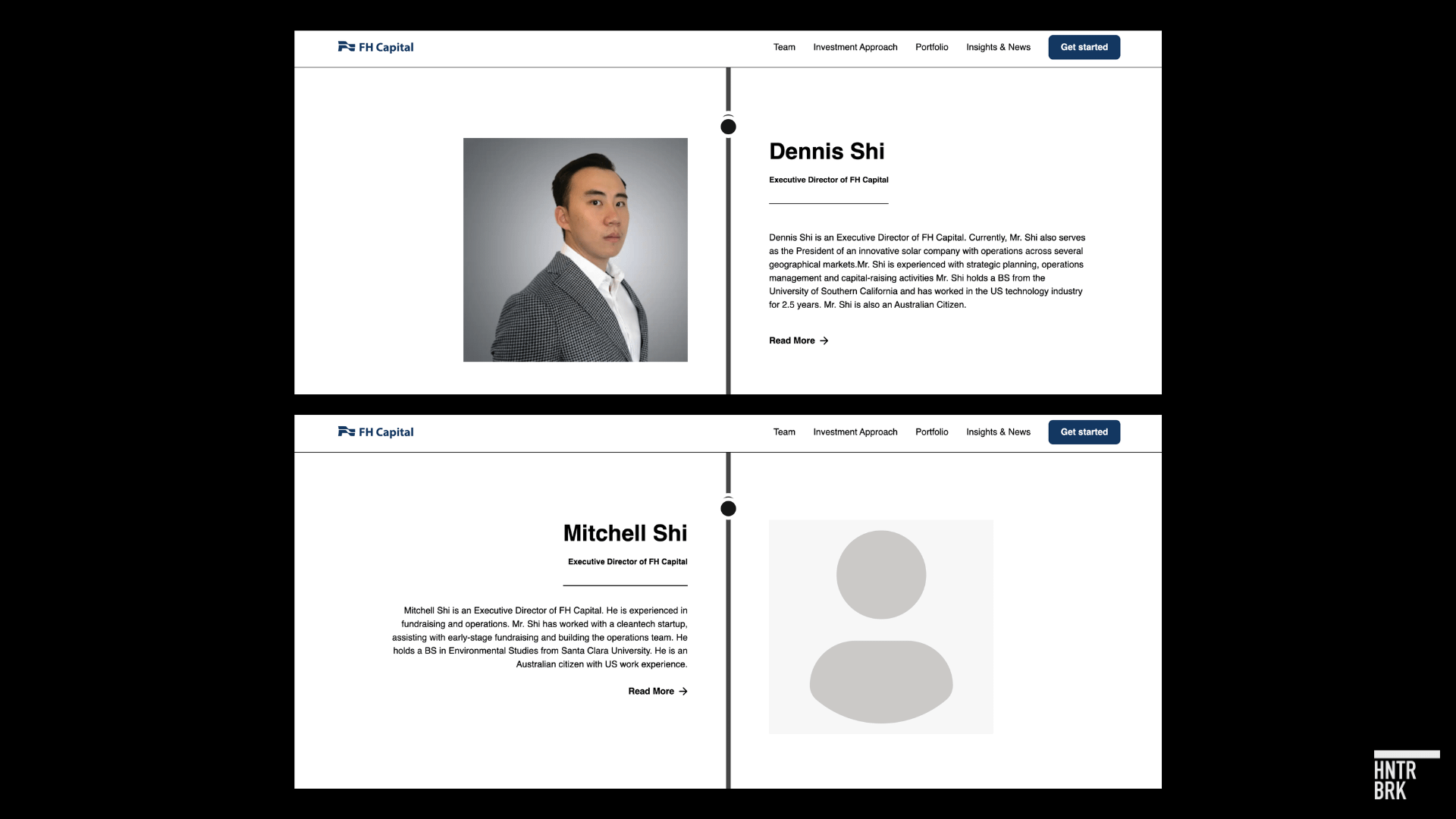
A team page on FH Capital’s website listed them both as executive directors of the firm. The Shis were removed from this page between April 11 and the deal announcement on May 8. Only Chaurasia’s bio remained on the website.
Dennis Shi appears to play a special role after the deal with Jinko: He’s now the only board director listed for the renamed Florida entity Jax Power. Michael S. Favo, the Jacksonville plant’s longtime general manager under Jinko’s ownership, is now Jax Power’s president.
In short: Zhengrong Shi’s family appears to have taken control of a 2 GW solar module plant in the U.S. It’s a comeback of sorts for the businessman nicknamed the “Sun King.”
Shi, who was born in Yangzhong, China, earned his Ph.D. at the University of New South Wales under solar pioneer Martin Green, took Australian citizenship, then returned to China in the early 2000s to found Suntech. He built the company into one of the world’s largest solar module makers. Suntech went public on the New York Stock Exchange in December 2005. In 2006 Shi was the richest man in China and his stake in Suntech was worth $1.7 billion.
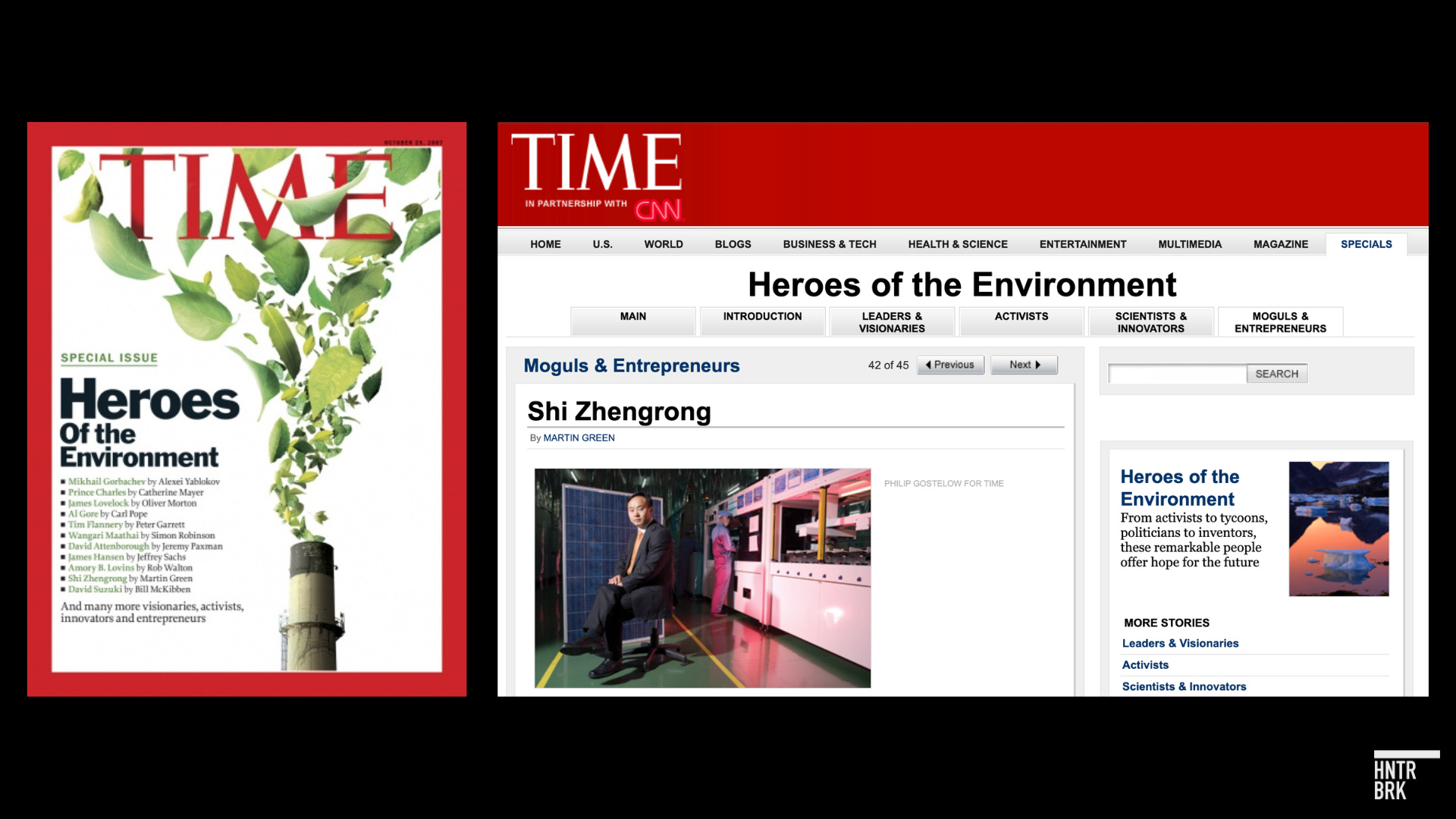
Time Magazine in 2007 named him one of its “Heroes of the Environment” (alongside Al Gore, Mikhail Gorbachev, David Attenborough and then-Prince Charles) and media coverage identified him as the world’s first “green billionaire.”
But the empire collapsed: Suntech fell apart after it was discovered that bonds pledged to it as loan collateral by an affiliated fund, which Shi part-owned, apparently never existed. Shi stepped down as CEO and was a defendant in a U.S. investor lawsuit that settled for $5 million. Suntech eventually went bankrupt and was delisted from the NYSE.
After losing Suntech, Shi spent the next decade rebuilding quietly through ventures he founded and his family runs: He founded Sunman, a Shanghai maker of lightweight solar modules. He remained the force behind Asia Silicon, the family’s Qinghai polysilicon producer, which abandoned its 2020 Shanghai IPO. And he co-founded Siltrax, the Sydney hydrogen startup.
Chinese media is framing the Jinko acquisition as a major step in Shi’s redemption arc: “Zhengrong Shi, the godfather of photovoltaics, returns,” a TMTPost headline read.
“Zhengrong Shi, the ‘godfather of photovoltaics’ who had been silent for a long time, has once again stirred up the market,” China Business Daily reported. “From founding Wuxi Suntech in 2001, to his low-key retreat, and now to taking over overseas assets, Zhengrong Shi has faded from public view over the past two decades, but he has never truly left the photovoltaic industry.”
The Jacksonville solar module plant is now in the hands of the family of one of the most influential men in the Chinese solar industry. Is Jinko’s U.S. business truly free of foreign influence under its new majority owner? And is this the type of deal that the Trump administration’s rules were designed to allow?
UNDER THE INFLUENCE
Several tax law experts told Hunterbrook that the Jinko deal appears to be sound on paper under the new FEOC rules: The main corporate officers involved, the Shi family and Sanjeev Chaurasia, who is an Indian citizen according to the Hong Kong corporate registry, are apparently not Chinese citizens or nationals. And that’s what’s relevant. An individual’s ties to or positions at Chinese companies are inconsequential under the tax credit rules, the experts said.
“Shi Zhengrong and Zhang Wei became Australian citizens in the mid-90s. Neither holds dual citizenship,” FH Capital told Hunterbrook.
FH Capital may be based in Hong Kong, but the Treasury Department hasn’t released specific guidance on whether the special administrative region will be considered part of China under the FEOC rules, two tax experts said. One tax lawyer told Hunterbrook he’s working under the assumption it will be considered China “until told otherwise by Treasury.”
But even if it were considered PRC territory: While FH Capital announced the Jinko deal under its own name, the actual acquisition was carried out via Delaware- and British Virgin Islands-registered vehicles that are themselves controlled by Shi’s family members and Chaurasia, according to corporate filings obtained by Hunterbrook.
“The acquisition was executed through FH JKV Holdings Limited, a Delaware entity controlled by Prosper Bright Ventures Limited, a BVI entity whose directors are Dennis Shi, Mitchell Shi and Mr. Chaurasia,” FH Capital told Hunterbrook. “According to Jinko Solar’s Shanghai Stock Exchange disclosures, Zhang Wei is the ultimate controller of the ownership structure.”
That would mean there is no direct connection to China or Hong Kong.
What could potentially become an issue: Jinko was only paid about half of the purchase price for its Florida operation at the closing of its deal with FH Capital. The rest of the payment, about $94 million, was deferred and is supposed to be transferred in two additional tranches, according to Jinko’s corporate filing: a first one of about $30 million, and a second of about $64 million. It’s unclear when and under which conditions those transactions are supposed to be made or whether one or both of them have already been completed.
That means Jinko may still be a major creditor of FH Capital’s designated affiliate FH JKV Holdings, which is the entity that controls the Florida plant, and that debt could make that affiliate “foreign-influenced” under the Trump administration’s FEOC rules. An entity is considered foreign-influenced if 15% or more of its debt is held by one or more specified foreign entities.
But the Treasury guidance leaves two things unclear: whether money owed as a deferred purchase price counts as “debt” under that test, and whether a parent company that fails it drags down the plant that actually claims the credits. The Treasury Department has said it will address such questions in future rulemaking.
Another possible red flag: Jinko said in a corporate disclosure that it would allow Jax Power to continue to sell solar modules “under the Company’s brand.” But Jinko’s U.S. trademarks, including its logos, are owned by its Chinese parent company, according to U.S. Patent and Trademark Office records.
Under the new FEOC rules, paying to license intellectual property from a specified foreign entity after July 4, 2025, puts the licensee under that entity’s “effective control,” which could cost the plant its tax credit eligibility. But the Treasury Department did not specify whether the rule covers soft intellectual property like trademarks and logos, or only patented hardware and production technology. It’s unclear whether using Jinko’s brand would mean that Jax Power would have to forgo the tax credits, tax experts told Hunterbrook.
Nick Iacovella from the Coalition for a Prosperous America expects the Treasury to address any open questions in reaction to divestiture deals like Jinko’s. “The longer that the Treasury waits to put the guidance out the more time that they’ll have to see how Chinese companies are restructuring to make sure that there aren’t any loopholes in the guidance,” he said.
“Multiple reputable law firms advised the buyer and seller on the Jinko Solar transaction, including on the post-closing structure and its alignment with applicable OBBBA requirements,” FH Capital told Hunterbrook, referring to the One Big Beautiful Bill Act, which includes the FEOC rules.
The tax credits are the Florida plant’s economic engine. Under Section 45X, module makers earn 7 cents for every watt produced and sold. For JinkoSolar’s U.S. operations, that was worth $146 million in 2025, more than three-quarters of the Jacksonville plant’s net profit that year.
And Jinko is not alone: Several other Chinese companies divested from their U.S. businesses over the past few months after the Trump administration introduced the new rules. LONGi reportedly cut its stake in the 5 GW plant in Pataksala, Ohio, that it runs with U.S.-based Invenergy, to “stay below” the FEOC ownership threshold. Canadian Solar moved its U.S. solar manufacturing unit from its Shanghai-listed subsidiary CSI Solar to sit under its Nasdaq-listed parent company. And JA Solar had already sold its entire Phoenix facility to American tech manufacturing company Corning before the new rules took effect.
Jinko itself spelled out the stakes in its latest annual report, warning that under the new law “the applicability of advanced manufacturing tax credits to our U.S. subsidiary in 2026 and future years is uncertain, which could have a material adverse impact” on its business. Across the industry these credits are routinely sold to corporate buyers. First Solar alone has transferred more than $2 billion of them. Jinko has disclosed that in 2025 it sold $128 million of accumulated credits for $120 million in cash, without naming the buyers.
Whether the Jacksonville plant has potentially forfeited its tax credit eligibility is unclear. Tax credits are self-assessed: Jax Power will decide what to claim on tax returns the public likely never sees, and any IRS challenge would possibly unfold in secret, surfacing only if a dispute lands in court. Quicker verdicts will likely come from the market, where credit buyers’ lawyers and insurers now demand assurances that no “prohibited foreign entity” lurks in the chain.
Until then, a U.S. business that collected $146 million in federal subsidies last year belongs to the family of the returning Sun King.
AUTHOR
Till Daldrup is an investigative journalist who joined Hunterbrook from The Wall Street Journal, where he focused on open-source investigations and content verification. In 2023, he was part of a team of reporters who won a Gerald Loeb Award for an investigation that revealed how Russia is stealing grain from occupied parts of Ukraine. He has an M.A. in Journalism from New York University and a B.S. in Social Sciences from University of Cologne. He’s also an alum of the Cologne School of Journalism (Kölner Journalistenschule).
EDITOR
Vikas Kumar joined Hunterbrook from The Capitol Forum, where he led the corporate investigations team for a decade as a senior editor. He was previously an attorney at Gordon Feinblatt, a trial attorney for the Department of Justice, and a law clerk for a federal judge. He has a J.D. from University of Virginia School of Law and a bachelor’s from Emory University. Vikas is based in Maryland.
Jean Wang and Blake Spendley contributed reporting.
Hunterbrook Media publishes investigative and global reporting — with no ads or paywalls. When articles do not include Material Non-Public Information (MNPI), or “insider info,” they may be provided to our affiliate Hunterbrook Capital, an investment firm which may take financial positions based on our reporting. Subscribe here. Learn more here.
Please contact ideas@hntrbrk.com to share ideas, talent@hntrbrk.com for work opportunities, and press@hntrbrk.com for media inquiries.
DISCLOSURES
© 2026 Hunterbrook Media LLC. All rights reserved. Use of this website is strictly governed by our Terms of Use. The content herein is furnished on an “AS IS” basis without any form of express or implied warranty. For information regarding our privacy practices, please refer to our Privacy Policy.
Hunterbrook Media LLC (”Hunterbrook Media”) is an investigative news organization. Hunterbrook Media is affiliated with Hunterbrook Capital LP (”Hunterbrook Capital”), an exempt reporting adviser with the U.S. Securities and Exchange Commission that serves as investment adviser to one or more investment funds. Hunterbrook Media and Hunterbrook Capital are legally separate entities under common control. Hunterbrook Capital’s investment activities are one source of funding for Hunterbrook Media’s journalistic operations. Hunterbrook Capital may hold long positions, short positions, positions through derivative instruments including options and swaps, or no position in any security covered or mentioned on this website. Consistent with applicable policies and procedures, Hunterbrook Capital may establish, modify, or close positions in covered securities before or after the publication of any Hunterbrook Media article. Following publication of any article, Hunterbrook Capital will continue transacting in covered securities for an indefinite period and may be long, short, or flat at any time thereafter, regardless of any position described at publication. Hunterbrook Media has no obligation to update any article or disclosure to reflect subsequent changes in Hunterbrook Capital’s positions.
Nothing on this website constitutes investment advice, a recommendation to buy, hold, or sell any security, or a solicitation to purchase or sell any securities. No securities shall be offered or sold in any jurisdiction where such activities would be contrary to applicable securities laws. Hunterbrook Media is not a registered investment adviser in the United States or any other jurisdiction. Nothing herein should be construed as investment advice or a recommendation of any kind. This information should not be relied upon as a substitute for independent research or professional financial, legal, or tax advice.
This website may feature forward-looking statements reflecting Hunterbrook Media’s current views. Such statements, identifiable by terms including but not limited to “anticipate,” “believe,” “estimate,” “expect,” “intend,” “may,” “plan,” “predict,” “should,” and “will,” are inherently speculative and subject to risks and uncertainties. Actual results or outcomes may substantially deviate from those projected. Hunterbrook Media expressly disclaims any obligation to update or revise any forward-looking statements, regardless of subsequent developments or new information.
The information presented is current as of the date indicated. No representation regarding the completeness or timeliness of this information is made. Some information is sourced from third parties and, while believed to be reliable, has not been independently verified, and its accuracy or completeness is not guaranteed. Hunterbrook Media is not affiliated with any sites linked to this website. Investment in securities and other financial instruments involves significant risk, including the potential loss of principal. Users are advised to conduct their own due diligence and consult professional advisors before engaging in any investment activity. Use of Hunterbrook Media’s content is entirely at the user’s risk. Users shall not use this site for any illegal or prohibited purposes and shall comply with all applicable local, state, national, and international laws and regulations.
Should any provision of these Terms of Use be adjudged invalid or unenforceable, the remaining provisions shall remain in full force and effect. Trademarks contained in links to third-party websites belong to their respective owners. Hunterbrook Media retains copyright on all text, content, graphics, and trademarks displayed on this site.