



By: Nathaniel Horwitz, Laura Wadsten, Michelle Cera
Editor: Sam Koppelman
Based on Hunterbrook Media’s reporting, Hunterbrook Capital is long $ACHV at the time of publication. Positions may change at any time. See full disclosures on our website.
ICYMI: Hunterbrook Media published a breaking news article yesterday on New Era Energy & Digital — which was sued by the New Mexico Attorney General for alleged “fraud on the state.” It’s a pretty wild legal complaint, and yet another example of the kinds of companies latching onto AI buzz. It’s worth a read.
Achieve Life Sciences ($ACHV) is a roughly $250 million medical company seeking FDA approval for cytisinicline, likely the best therapy to quit smoking. If approved on June 20, Achieve plans to sell the medicine in the U.S. by the end of 2026. The company is also seeking approval for the first therapy to help people quit vaping.
The FDA accepted Achieve’s anti-smoking application for review, with two successful Phase 3 clinical trials and a successful longer-term safety study. The FDA also expedited anti-vaping with both a National Priority Voucher and Breakthrough Therapy Designation. If cytisinicline is approved for anti-smoking, it will likely also be approved for anti-vaping.
Under the Affordable Care Act, nearly all American health plans must offer insurance coverage for FDA-approved smoking cessation interventions.
Cytisinicline is already used in Europe. Several smoking cessation clinicians, scientists, and health program directors that Hunterbrook interviewed for this investigation said cytisinicline should be FDA approved. None said further data was needed.
Cytisinicline has proven safer and more effective than predecessors withdrawn from the U.S. market: Pfizer’s Chantix (varenicline) — which hit $1 billion in annual sales — and GlaxoSmithKline’s Zyban (bupropion). Generic versions remain available.
Smoking is declining in the U.S. but still kills at least half a million Americans every year. E-cigarette vaping and nicotine pouches are on the rise, with a slew of new health risks.
After a perilous financing journey, Achieve ended the third quarter of 2025 with $48 million, or about nine months of burn at its current rate of about $15 million/quarter. Achieve added $5 million in October through a convertible loan and may draw another $5 million alongside launching the product. The company’s clinical expenses are declining now that its key clinical trials are complete, but Achieve will need to raise more capital for commercialization, likely alongside FDA approval.
Mark yonder, how the long laburnum drips
Its jocund spilth of fire, its honey of wild flame!
— Francis Thompson (1895), writing about Laburnum anagyroides, the natural source of cytisinicline, a safe and potent molecule that thwarts nicotine addiction.
The golden rain tree is poisonous.
Each year, on the border of spring and summer, dense flowers swoop from pendulous branches in European mountains and ornamental gardens. Horses and humans that eat the flower’s seeds by accident may get sick, but deer and hares feast on the same legumes without harm. This paradox sparked a reputation for mystical power, inspiring a symbolic tree in J. R. R. Tolkien’s “The Lord of the Rings.”
Over two centuries ago, a chemist discovered the culprit: a molecule now called cytisinicline, originally known as cytisine (but no relation to cystine, the amino acid).
Like all chemicals, cytisinicline is toxic in excess. But in lower concentrations, it’s a plant-derived medicine that Europeans have used for decades to fight tobacco addiction.
“It treats the addiction, that’s amazing,” said Dr. Mary O’Sullivan, founder and director of the smoking cessation clinic at Mount Sinai Health System, in an interview with Hunterbrook. “It’s not just suffocating the addiction or trying to get around it. It treats it. That’s an enormous step forward.”
Cytisinicline is also found in the māmane trees of Hawaii, where it feeds moths and birds, as well as the shrub mescalbean, which is used as a ritualistic hallucinogen by certain tribes.
The molecule binds to nicotine receptors, which are the proteins on brain cells that are activated by nicotine. When cytisinicline binds these receptors, it essentially replaces nicotine — reducing craving and withdrawal, without being nicotine itself.
“It’s a very good drug, what we know about it so far,” said O’Sullivan. “I have nothing but good things to say about it. I wish we had it a long time ago. It’s such a shocking thing that all these people who have had smoking-related diseases could have benefited from it so long ago.”
“We should get it on the formulary as soon as we can and get it out to our patients,” she said, referring to the list of drugs that are cleared for prescription by hospitals and insurers. “I would use it immediately, especially if it was cheap.”
After a decade-long journey, the Seattle-based company Achieve may finally receive FDA approval for cytisincline, with an approval deadline of June 20, 2026.
Dr. Robert West, a smoking cessation expert at University College London, told Hunterbrook that the FDA “definitely should” approve the option for Americans. “Cytisinicline has been used safely for decades by many millions of people in Europe and has clear efficacy.”
Smoking kills about half a million people every year in the U.S. and over 7 million people worldwide. There are about 29 million American cigarette smokers and about 28 million e-cigarette users, including many middle and high schoolers, a lot of whom go on to smoke tobacco.
A spokesperson for Achieve told Hunterbrook that of those 29 million smokers, 53% try to quit annually, yet only 10% succeed. These statistics align with recent data from the U.S. Centers for Disease Control and Prevention (CDC) — that only 8.8% successfully quit — as well as interviews with experts.
It’s hard to overstate the lethality of smoking, even after declines in American usage. Smoking causes about 9 in 10 lung cancer deaths, 6 in 10 pulmonary disease deaths, and 3 in 10 heart disease deaths.
A past therapy for smoking cessation from Pfizer earned over $1 billion in peak annual sales, despite side effects. The FDA label for varenicline — first branded as Chantix in 2006 — had a suicidality warning, plus a fourfold higher rate of nausea than cytisinicline, and higher rates of sleep issues and headaches. The FDA later removed the suicidality warning from Chantix after further data.
“Unfortunately, everyone in the world knew about the suicidal ideation and the potential for aggressive behavior,” said O’Sullivan. “It was in all the ads on TV and to this day the patients remember it, and also the providers remember it, so providers have been reluctant to prescribe varenicline even though the black box warning was taken off years ago.”
Unlike varenicline, cytisinicline has not shown the risk of suicidal ideation.
Both Chantix (varenicline) and GlaxoSmithKline’s drug Zyban (bupronion), were withdrawn from the U.S. market due to manufacturing issues. In addition to more side effects, each also required longer treatment than cytisinicline.
“From the available evidence, cytisinicline has the potential to be at least as effective as varenicline when given using an appropriate dosing regimen (e.g. for a similar length of time) and is almost certainly more effective than bupropion,” West wrote to Hunterbrook. “The side effect profile of cytisinicline is somewhat better than varenicline — similar symptoms but less common. Both are safe though in terms of serious side effects. The side effect profile looks better than bupropion.”
West viewed cytisinicline as the best therapeutic intervention available. “I am not aware of other drugs that have the same level of evidence to support them.”
Dr. Judith Prochaska — a professor in the department of medicine at Stanford University, a consultant to Achieve, and a director of Stanford Health Care’s tobacco treatment service — agreed.
“The data indicate that cytisinicline has comparable efficacy to varenicline, doubling the chances of quitting smoking through 6 months or longer relative to placebo, and with fewer self-reported adverse events than varenicline,” Prochaska wrote to Hunterbrook. “The most recent trials have found both longer duration of cytisinicline treatment and a higher dose schedule increase smoking abstinence.”
Dr. Maya Vijayaraghavan — a professor of medicine at UCSF who practices as a general internist and a researcher in tobacco control — would like to see cytisinicline directly compared with the generics. “Cytisinicline can help people stop smoking more so than placebo and may be as effective as varenicline, but we need trials that compare varenicline with cytisinicline.”
On safety, she said that: “Cytisinicline may have fewer people [with] serious adverse effects compared to varenicline. Tolerability is about the same for both medications. They both can cause nausea and GI distress, difficulty sleeping, and abnormal dreams.”
Patients On Social Media
Many who have opted for cytisinicline to quit smoking or vaping have taken to online forums to discuss their experiences. On Reddit, many reviews have been positive.
“Amazing,” one user wrote. “Easiest attempt to quit ever.”
Several Reddit users documented their journeys with quitting, including someone who struggled to quit with other methods and relapsed. That changed with cytisinicline.
“I wasn’t even sure 100% if I wanted to quit before this. But now the pills have given me only one option. To quit. Because there is literally no satisfaction in a cigarette now even if I tried,” the post read.
Another Reddit user advised others considering cytisinicline, stating, “All I can say is it made everything survivable.”
The same went for vaping.
“I was vaping every hour, for about 2 years. I was vaping in bed too. I HAD to quit, I’m SO EMBARRASSED that I let vaping get such a hold on me,” described one user, who said that now with cytisinicline they’re “3 weeks in and I’m not caving in.”
It didn’t work for every user on the thread. One added a caveat: “Yes it’s amazing, but be prepared for it to mess with your sleep a bit. Antihistamine sleep aids helped me through.”
One Facebook user who smoked for 20 years told others in a quit smoking support group that cytisinicline was successful in making them a non-smoker without side effects or withdrawal symptoms.
“Cytisine was the best decision for me,” they wrote, using cytisinicline’s other name. “The perfect medicine.”
Compelling Data
Achieve began R&D in 2015 and has since completed a half-dozen clinical studies in the U.S. testing the dynamics, safety, and effectiveness of cytisinicline.1
“For me this mission is deeply personal,” Dr. Cindy Jacobs, the former president and chief medical officer of Achieve, said on the 3Q24 earnings call. Jacobs later moved to an advisory role in September 2025. “Smoking has left a profound mark on my family. Until recently both of my parents were lifelong smokers. Two years ago my mother was diagnosed with lung cancer. In July, my father faced a total laryngectomy after being diagnosed with throat cancer, which has severely impacted his ability to eat and communicate.”
Prochaska summarized the positive results of cytisinicline as an addition to a limited arsenal of nicotine replacement therapy (NRT) options in the U.S.
“If you look at the articles, they’re written by the best people in smoking cessation, they’re written by people I trust,” said O’Sullivan.
Network meta-analysis, which simultaneously evaluates multiple treatments across randomized controlled trials, revealed that varenicline and cytisinicline lead the pack in helping smokers quit for six months or longer, according to Prochaska. Both medications showed better results than traditional NRT and bupropion.2
And regarding safety?
Cytisinicline’s side effects are generally mild and temporary, primarily affecting digestion and sleep patterns. Studies also indicate that patients report fewer adverse events with cytisinicline compared to varenicline. While there are limited direct comparisons between cytisinicline and bupropion, previous research suggests varenicline and bupropion have similar side effect profiles.
In 2021, Achieve completed a Phase 2b study (ORCA-1) with 254 adult smokers. For the 3 mg cytisinicline arm that Achieve took into Phase 3 studies, smokers were as much as five times more likely to stop smoking on cytisinicline than a placebo.3
In April 2022, Achieve completed a Phase 3 study (ORCA-2) with 810 adult smokers, evaluating the effectiveness of 3 milligrams of cytisinicline taken three times daily for six and 12 weeks. The six-week group had a 25.3% abstinence rate vs. 4.4% for placebo, whereas the 12-week group had a 32.6% abstinence rate vs. 7% for placebo. The study also assessed up to 24 weeks, with similar results.
In May 2023, Achieve completed a second Phase 3 study (ORCA-3) with 792 adult smokers. The design largely mirrored the first Phase 3 study. The six-week group had a 14.8% abstinence rate vs. 6% for placebo, while the 12-week group saw a 30.3% abstinence rate vs. 9.4% for placebo. Continuous abstinence rates through 24 weeks further demonstrated efficacy.
According to Chantix’s FDA label, it had a 12-week abstinence rate of around 23% and more safety issues than cytisinicline. According to Zyban’s FDA label, it had a lower efficacy rate in the 15% to 20% range, making cytisinicline a compelling alternative, especially due to its relatively fewer side effects and shorter treatment duration.
In one direct comparison study from 2018 in New Zealand with results in 2021, cytisinicline outperformed Chantix. In another comparison study from 2021 in Australia, Chantix had a slight edge on cytisinicline. The industry publication STAT News noted in a 2023 article that Achieve “argues that the latter study uses a 25-day course of treatment, a shorter course than that used in the biotech’s trials.” STAT also noted that only about a quarter of Chantix patients complete a full course of therapy. In Achieve’s Phase 3 trials, more patients stayed on cytisinicline than placebo.
In addition to smoking cessation, Achieve is pursuing FDA approval for vaping cessation, in part based on its Phase 2 trial (ORCA-V1) concluded in August 2023, half of the cost covered by a $2.8 million grant from the NIH’s National Institute on Drug Abuse program.
31.8% of participants who received 12 weeks of cytisinicline quit vaping compared to 15.1% of those on placebo, without more side effects. These results were presented at medical conferences in 2024 and published in JAMA Internal Medicine in May 2024.
Achieve then received Breakthrough Therapy designation from the FDA for cytisinicline as a vaping cessation treatment in July 2024. This designation seeks to expedite the development and review of drugs that may have a substantial improvement over existing therapies for serious or life-threatening conditions. There are currently no drugs approved for vaping cessation.
West felt the focus should remain on tobacco. “Vaping carries a small fraction of the risk of smoking and from a public health perspective smoking must be our number, one, two and three priority,” he wrote. “Anything that detracts from this would be undesirable.”
The FDA accepted Achieve’s New Drug Application (NDA) for cytisinicline to enable smoking cessation in September 2025, based on data from the completed ORCA-2 and ORCA-3 trials, as well as its long-term safety assessment in an open-label trial (ORCA-OL), in which patients knew they were receiving cytisinicline.
In November 2025, Achieve announced results from “the fourth and final scheduled safety review by the Data Safety Monitoring Committee, or DSMC, for the ORCA-OL trial.”4
“Adverse events reviewed during the final DSMC meeting were mostly mild in severity, and no serious adverse events were deemed to be treatment related. The DSMC found no concerns with respect to drug safety.”5
O’Sullivan was not worried about the ORCA-OL trial. “I haven’t seen any red flags about it,” she said, noting that she is not one of the clinicians involved in the trial.
As with all applications, the FDA could still require additional data or studies if any safety concerns arise. Achieve also needs to maintain long-term access to cytisinicline supply. The company is in a legal dispute with its original supplier, Sopharma, though Achieve named other suppliers in its FDA application.6
“Straightforward dosing and low rates of adverse events led to improved treatment adherence and success, including a long-term safety study that exceeded enrollment benchmarks,” an Achieve spokesperson told Hunterbrook. “Achieve has completed two Phase 3 studies with over 1,600 adults who smoke, many with multiple prior quits including on legacy Rx products. Cytisinicline has demonstrated in clinical trials to be safe, effective and well-tolerated.”
Returning Leadership
In August 2024, Achieve’s former CEO, Richard Stewart, reassumed the position after serving as executive chairman since September 2020.
The new executive chairman, Tom King, said in the accompanying press release: “The change in leadership is driven by the need to have a CEO with substantial M&A and commercial experience pushing the company forward to future critical milestones, whether that be a potential licensing transaction or strategic transaction for the commercialization of cytisinicline.”
Stewart is the founder of Ricanto, a firm that seeks potentially undervalued pharmaceutical assets and has flipped a couple in modest acquisitions.
Ricanto previously supported Renown Pharma, with an experimental therapy for Parkinson’s disease; Huxley Pharma, another company working on central nervous system (CNS) therapies, which BioMarin acquired for $58 million in 2009 during the financial crisis; and Brabant Pharma, a third CNS therapies company, acquired by Zogenix in 2014 for $20 million in cash, $15 million in stock, and future milestone and royalty payments.
Before founding Ricanto and working on its portfolio companies, Stewart served for seven years as CEO of Amarin, a once multibillion-dollar pharmaceutical company that suffered a massive stock decline after competition from generics.
Choppy Financing History
Achieve is funded through the second quarter of 2026, which includes the FDA approval deadline on June 20, but the company will need to raise additional capital for commercialization.
In July 2024, Achieve did a $20 million debt refinancing with Silicon Valley Bank (SVB), which is now a division of First Citizens Bank. Achieve had previously entered a $25 million debt deal in December 2021, in which Achieve borrowed $15 million with the potential for an additional $10 million from SVB and SVB Innovation Credit Fund VIII, L.P.7 Achieve can draw an additional $5 million before it will need to tap additional financing sources.
Sailing had not been smooth.
Achieve did multiple reverse stock splits leading up to 2020, had a going concern notice from its auditor PwC in its 2022 10-K filing (though this was resolved in 2023), and paid for stock promotion as recently as 2024 from Zacks Small Cap Research, whose analyst has tossed Achieve a softball question on an earnings call.
Commercial Opportunity
Smoking is making a cultural comeback. And while overall rates are declining in the U.S., it remains an enormous public health crisis. Despite millions of people trying to quit, the success rate is dismal.
“Two in three adults who smoke want to quit, and yet more than 9 in 10 quit attempts fail,” Dr. Judith Prochaska told Hunterbrook. “Adults who use tobacco and want to quit need access to evidence-based quit aids.”
Vijayaraghavan cited ananalysis from Massachusetts General Hospital suggesting that “if cytisinicline became immediately available, approximately 71,000 people could quit smoking in one year and maintain long-term abstinence.”
And while smoking is on the decline, vaping is skyrocketing, with its own health risks.
“There is a big demand for vaping cessation,” said Vijayaraghavan. “As more people are trying the newer e-cigarette products that can be quite addictive, there is likely to be more need.”
Achieve is positioned to be the first mover in this space.
Prochaska noted that cytisinicline also showed a clear benefit for adults who exclusively vape. The FDA has given Achieve two types of expedited review, positioning cytisincline to be the first FDA-approved anti-vaping therapy.
The boutique investment firm Rogue Funds — which disclosed a long position in May 2024 — estimated potential revenue of $300 million to $600 million per year. The estimate is based on 10% of the 14 million people in the U.S. trying to quit smoking each year deciding to use a prescribed medication, with 30%-60% of that market share going to Achieve, and $700-$800 pricing based on a discount to Pfizer’s pricing for Chantix, now only sold as the generic varenicline. Rowe applied an industry-standard 3x valuation multiplier to his projected revenue to estimate a valuation of $1 billion to $1.8 billion for ACHV.
The financial analyst Keith Dalrymple of DF Research projected a fivefold return based on similar assumptions.
Federal Coverage Requirements for Smoking Cessation Suggest Favorable Health Insurance Reimbursement Landscape
Under the 2010 Affordable Care Act, or “Obamacare,” nearly all health insurance plans must offer some type of coverage for smoking cessation interventions.
The specific services and treatments covered can vary from plan to plan, but most Americans have health insurance that covers FDA-approved medications to help them quit smoking. 2014 government guidance provides an example of coverage that would comply with the ACA requirement:
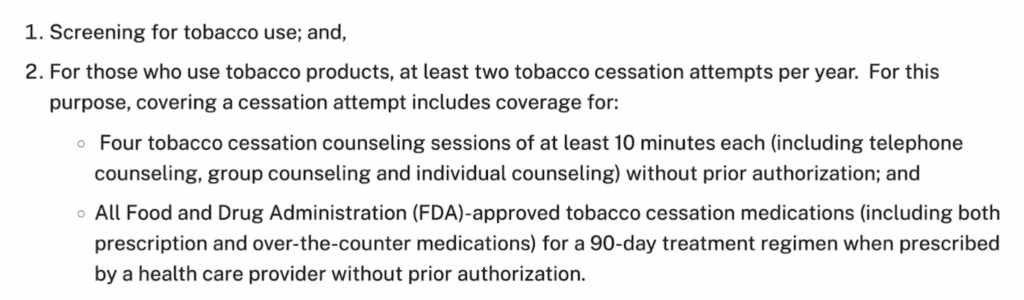
The ACA prohibits state Medicaid programs from excluding FDA-approved tobacco cessation medications from coverage.8 100 million Americans were covered by Medicaid during 2023, the most recent data available from the Medicaid and CHIP Payment and Access Commission.
Most private health plans are required to cover preventive services with a U.S. Preventive Services Task Force rating of “A” or “B.”9 Smoking cessation interventions have an “A” rating, with the Task Force recommending FDA-approved medications alongside counseling.
About 203.7 million Americans had private health insurance in 2024, and HHS recently reported 24.2 million consumers enrolled in ACA Marketplace Exchange plans for 2025.
All Medicare beneficiaries are eligible for smoking cessation counseling at no cost.
Medicare Part D plans cover cessation medications that require a prescription (not over-the-counter) with cost-sharing allowed. Medicare Advantage plans must offer benefits equivalent to Part D plans.
Given the high cost of tobacco-related health risks, health insurance plans may view interventions like quit-aid medications as a worthwhile investment that saves money overall. In a 2020 report on smoking cessation, the U.S. surgeon general wrote, “Smoking cessation medications approved by the U.S. Food and Drug Administration and behavioral counseling are cost-effective cessation strategies.”
A spokesperson for Achieve told Hunterbrook, “Upon potential FDA approval, Achieve is committed to working closely with patients, healthcare providers, and insurers to ensure access.”
Few Options Beyond Cytisinicline
Although cytisinicline has been around for decades, Achieve has patents on its specific version, as well as on its use for smoking cessation in the U.S.
Beyond cytisinicline, there are few options in the U.S. compared to other countries.
“It is unfortunate that the nicotine mouth spray, which has been approved for use in more than 50 countries globally, has not received FDA approval as a therapeutic cessation aid for use in the US,” Prochaska wrote to Hunterbrook.
“There are some possible therapeutic interventions with glucagon-like peptide-1 receptor agonists and deep brain stimulation,” wrote Vijayaraghavan, referring to popular GLP-1 drugs best known for weight loss and a neurosurgical treatment that uses electrodes implanted in the brain. “However, these are early in their phase of inquiry and need robust clinical trials with behavioral counseling and other forms of FDA-approved pharmacotherapy.”
Smoking cessation therapies also compete with the ongoing advocacy of the tobacco industry.
“Tobacco use is an issue of social justice and equity where populations with high rates are the ones that have faced targeted marketing by the industry and systemic inequities that have led to high rates. There is a need for more smoking cessation trials of FDA approved aids and other adjunctive approaches in community-based sites with populations that are representative of those who smoke enrolled in those trials,” said Vijayaraghavan.
Delmonte Jefferson, executive director of the Center for Black Health & Equity, made a similar point at a public session about smoking cessation hosted by the FDA on October 21, 2024.
“We went from picking tobacco to the tobacco industry targeting Black people,” said Jefferson.
Dr. Dorothy Hatsukami — professor of psychiatry and behavioral sciences at the University of Minnesota and an expert on cancer prevention — ascribed the limited number of options more to the decisions of American regulators than to entrenched industry interests.
“I do not think that the industry has delayed smoking cessation approaches,” Hatsukami wrote to Hunterbrook. “Rather, I think the FDA tends to be very conservative in its approach for approving smoking cessation pharmacological treatments.”
A spokesperson for Achieve told Hunterbrook the company has not encountered resistance from the tobacco industry or the vaping industry in its pursuit of cytisinicline’s approval.
“The big industry players would like to pivot away from smoking, which they admit is a harmful product, and would like to pivot towards harm reduction products, such as vaping,” wrote Hatsukami. “There is resistance towards this approach among some members of the public health community, where the goal is to eliminate all tobacco or nicotine use.”
O’Sullivan summed up her perspective on the potential of cytisinicline to reduce harm and save lives. “I think it’s a really wonderful opportunity. I’m looking forward to having it, I’m looking forward to the world having it,” she told Hunterbrook.
“Put it in the water!”
Authors
Nathaniel Horwitz is CEO of Hunterbrook. He has co-founded, invested in, and served on the boards of several biotechnology companies, ranging from AI-designed medicines for cancer to cell therapies for autoimmune diseases. He has a BA in Molecular Biology from Harvard, where he coauthored biomedical research in the scientific journal Cell. His writing on medicine has been published in The Washington Post, The Atlantic, and The Daily Beast. His first job out of high school was reporting for his hometown newspaper, including an investigation of vaccination rates in local schools. He volunteers as executive chair of the 501(c)(3) education nonprofit Mayday Health.
Michelle Cera trained as a sociologist specializing in digital ethnography and pedagogy. She completed her PhD in Sociology at New York University, building on her Bachelor of Arts degree with Highest Honors from the University of California, Berkeley. She has also served as a Workshop Coordinator at NYU’s Anthropology and Sociology Departments, fostering interdisciplinary collaboration and innovative research methodologies.
Laura Wadsten is an investigative journalist specializing in healthcare. She began her career reporting on antitrust and health care markets as a Correspondent for The Capitol Forum, a premium subscription financial publication. Previously, she was Executive Director of the nonprofit Moving to Value Alliance, where she produced the MTVA Unscripted Podcast. Laura was a Hodson Scholar and Editor-in-Chief of The News-Letter at Johns Hopkins University, where she earned a B.A. in Medicine, Science & the Humanities.
LEGAL DISCLAIMER
© 2025 by Hunterbrook Media LLC. When using this website, you acknowledge and accept that such usage is solely at your own discretion and risk. Hunterbrook Media LLC, along with any associated entities, shall not be held responsible for any direct or indirect damages resulting from the use of information provided in any Hunterbrook publications. It is crucial for you to conduct your own research and seek advice from qualified financial, legal, and tax professionals before making any investment decisions based on information obtained from Hunterbrook Media LLC. The content provided by Hunterbrook Media LLC does not constitute an offer to sell, nor a solicitation of an offer to purchase any securities. Furthermore, no securities shall be offered or sold in any jurisdiction where such activities would be contrary to the local securities laws.
Hunterbrook Media LLC is not a registered investment advisor in the United States or any other jurisdiction. We strive to ensure the accuracy and reliability of the information provided, drawing on sources believed to be trustworthy. Nevertheless, this information is provided “as is” without any guarantee of accuracy, timeliness, completeness, or usefulness for any particular purpose. Hunterbrook Media LLC does not guarantee the results obtained from the use of this information. All information presented are opinions based on our analyses and are subject to change without notice, and there is no commitment from Hunterbrook Media LLC to revise or update any information or opinions contained in any report or publication contained on this website. The above content, including all information and opinions presented, is intended solely for educational and information purposes only. Hunterbrook Media LLC authorizes the redistribution of these materials, in whole or in part, provided that such redistribution is for non-commercial, informational purposes only. Redistribution must include this notice and must not alter the materials. Any commercial use, alteration, or other forms of misuse of these materials are strictly prohibited without the express written approval of Hunterbrook Media LLC. Unauthorized use, alteration, or misuse of these materials may result in legal action to enforce our rights, including but not limited to seeking injunctive relief, damages, and any other remedies available under the law.
Clinical trials of cytisinicline in the U.S. at clinicaltrials.gov: NCT03268343, NCT03303911, NCT03509948, NCT03709823, NCT03848208, NCT05631938, NCT05981768, and NCT05566288.
Specifically, the odds of quitting were 2.33 times higher with varenicline and 2.21 times higher with cytisinicline, compared to 1.37 for nicotine patches, 1.41 for fast-acting NRT, and 1.43 for bupropion. In real numbers, while only six out of 100 people quit with a placebo, 14 quit with varenicline, 13 with cytisinicline, and eight to nine with other methods.
The final results were published in the scientific journal Nicotine and Tobacco Research in April 2021.
As of 2024, trial was designed to assess the safety of 3 milligrams of cytisinicline taken three times daily in adults who smoke or use nicotine e-cigarettes, with the primary endpoint being the frequency of serious adverse events. The trial had to provide safety data on at least 300 subjects treated for six months to support the NDA submission. Additionally, Achieve was required to provide data on at least 100 subjects treated for a cumulative period of one year prior to potential product approval.
“Based on agreement with the FDA to follow ICH E1 guidance, results of the ORCA-OL trial are expected to meet the FDA requirement to provide safety data on a minimum of 300 subjects treated with cytisinicline for a cumulative period of six months as part of the anticipated NDA submission. Subsequently, data on at least 100 subjects treated for a total cumulative period of one year will be provided prior to potential product approval. ORCA-OL is being conducted at 29 clinical trial sites across the United States, all of which participated in previous ORCA-program clinical trials.” (ACHV 3Q24)
Achieve currently relies heavily on Sopharma, a single supplier for cytisinicline’s active pharmaceutical ingredient, manufactured in Bulgaria. Any disruptions at Sopharma due to geopolitical issues or production challenges could delay development and commercialization. Achieve must pay Sopharma a mid-single-digit-percent sales royalty.
The new loan in July 2024 refinanced the existing debt facility and extended the maturity date by over three years from August 1, 2024, to December 1, 2027. The new loan includes $10 million that was received at closing, $5 million upon FDA accepting the cytisinicline application, and $5 million at SVB’s discretion. The loan is interest-only through the end of 2025, followed by two years of monthly payments of principal plus interest until maturity. There is an option for a six-month extension to the interest-only period and maturity date upon achieving certain regulatory and financial milestones. The interest rate is 7% or a floating rate, and the maturity is at the end of 2027, with a potential extension to June 2028. SVB can convert debt into common stock at a $7 strike.
See 42 U.S.C. § 1396r-8(d)(7). States participating in the Medicaid Expansion program must cover the services with no cost-sharing, like copays; states without Medicaid Expansion — aka “traditional” Medicaid programs — are not subject to this requirement.
See 42 U.S.C. § 300gg-13 and 42 U.S.C. § 300gg-6.